This article explains how business accounts work for freelancers without a registered company or sole proprietorship. It covers eligibility, key account features, business payment functionality and the Wallester Freelancer solution.
You might complete freelance assignments, invoice direct clients, and purchase professional software or equipment without forming a commercial entity. As independent earnings accumulate alongside personal bills, managing payments through an everyday current account becomes messy. Providers set specific customer qualifications, meaning access to a dedicated business payment account for freelancers depends directly on provider terms, residency status, and local financial rules. Finding an appropriate financial setup requires reviewing realistic, compliant banking options.
Can you open a business account without registering a company?
An independent specialist can obtain a business payment account for freelancers without establishing a formal corporate structure. Many payment institutions support professional activity undertaken directly by an individual.
Understanding this arrangement requires distinguishing between distinct legal and commercial classifications. A natural person is an individual human being acting in an independent personal or professional capacity. A registered sole proprietorship represents a distinct commercial registration linked to an individual with specific domestic filings. A registered legal entity is an incorporated organisation, such as a limited company, with separate legal personality. Meanwhile, a business payment account serves commercial and professional operations, whether the holder is an incorporated entity or an independent individual.
The phrase “without registration” requires careful precision here. Within banking terminology, it denotes the absence of an incorporated entity or registered sole proprietorship in the country of activity. It never implies freedom from tax reporting, commercial obligations, or professional standards. Business registration rules, permits, and trade licences differ across jurisdictions and trades, as outlined in the European Commission guidance on registration, permits and licences. Unregistered trade is not universally permitted across Europe, so every professional must verify domestic legislation.
Q&A: Does opening a business account register a freelancer as a business?
No. Establishing an account provides financial services for professional activity and does not register a company or establish a sole proprietorship. Your commercial structure and tax status remain subject to domestic statutory authorities.
Further Reading: Freelancer Without a Company in the EU: How to Work Legally as a Natural Person
What should a freelancer look for in a business account?
Choosing a business account without company registration requires a focus on features designed for natural persons. A clear separation between professional cash flows and household spending makes record-keeping easier and helps with tax reporting. Furthermore, official statistics published by Eurostat on EU labour market transitions in 2026 record that 3.1 million unemployed individuals in the EU entered employment during the second quarter of 2026 alone. As modern working patterns expand flexible independent work, choosing the right payment tools prevents operational disruptions.
When comparing providers for a freelance business account, examine these primary criteria:
- Natural-person eligibility permitting non-registered professionals to open accounts.
- Incoming payment mechanisms accepting domestic and cross-border client transfers.
- Reliable outgoing payment rails for supplier settlements and subscription charges.
- Virtual or physical payment cards assigned for commercial transactions.
- Supported settlement currencies matching your main client contracts.
- Clear spend thresholds and transparent monthly operational parameters.
- Direct remote onboarding with straightforward verification steps.
| Feature | Personal account | Registered-business account | Freelancer business account |
| Account holder | Individual | Registered legal entity or sole proprietorship | Natural person |
| Main purpose | Personal spending | Registered business activity | Independent professional activity |
| Company registration | Not applicable | Required for the registered structure | May not be required by the relevant product |
| Professional payments | Provider-dependent | Business use | Product-dependent |
| Business cards | Provider-dependent | Product-dependent | Product-dependent |
| Tax status | Separate issue | Governed by business structure | Separate issue |
Exact eligibility and permitted use depend on the provider and applicable local rules.
Q&A: Can a freelancer use a personal account for professional payments?
Accepting commercial turnover into personal current accounts depends on the institution’s terms. Retail banking agreements frequently forbid business transactions, which can trigger transaction queries or sudden account closures.
Further Reading: Freelancer Financial Setup: Invoicing & Banking Guide
What does Wallester Freelancer offer to independent professionals?
Wallester Freelancer is a Wallester Business client type for natural persons carrying out independent commercial or professional activity without a registered legal entity or sole proprietorship in their country of operation. The account is opened to the Freelancer as a natural-person client, while the product is intended to support the Client’s commercial or professional activity.
The product provides business payment infrastructure for individuals who need a dedicated account, payment cards, incoming and outgoing transfers and related payment functionality. The Client acts as the account holder, cardholder and ultimate beneficial owner of the funds. The account is intended for business use and is not designed for consumer transactions.
Typical use cases include receiving payments for freelance or consulting services, paying for business-related subscriptions, tools, travel or advertising, separating business-related inflows and expenses from personal spending, and using a dedicated payment card for independent professional activity.
The product supports top-ups by bank transfer, credit card, debit card and stablecoin. It also supports payments, including wire transfers, and transfers between Wallester clients.
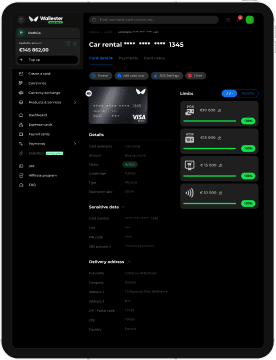
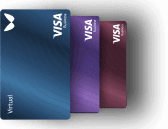
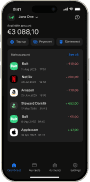
Freelancers can create and manage virtual and physical cards, manage main and sub-accounts with IBAN assignment, use the mobile application and Client Portal, and access API integration. Supported currencies are EUR, GBP, SEK and DKK, with possible future extension depending on the partner bank setup.
The default maximum monthly limit is EUR 3,000 per client and applies only to spending, including outgoing payments and card spending. Incoming funds are not capped by this product-level limit. Up to 3 active virtual cards may be maintained at the same time. Physical cards may be issued at the Client’s expense without a predefined numerical restriction.
Wallester Freelancer is available to natural persons residing in the EEA, covering all 27 EU Member States plus Iceland, Liechtenstein and Norway. The product is intended for business use related to the Client’s declared commercial or professional activity. It is not intended for personal or household spending, salary distribution, holding funds or activity unrelated to the declared activity.
The absence of a registered legal entity or sole proprietorship is not, in itself, an obstacle to opening the account within the Freelancer product model. The Client remains responsible for properly declaring and reporting income under applicable tax or legal frameworks.