This guide covers how to receive EUR from EU clients, how SEPA Credit Transfers work, what bank details the client needs, how long transfers take, what affects the total cost, and how to choose between standard and instant SEPA payments.
You have completed work for an EU client and need to collect payment in euros. A SEPA transfer gives the client a familiar bank-payment route, but your account setup still matters. You need an account that accepts euros, accurate payment details, a clear invoice, and a provider with suitable fees. This preparation helps you avoid unnecessary currency conversion, keeps costs down, and lets you match incoming credits to open invoices.
How can I receive EUR payments from an EU client?
The most straightforward route for a business with a EUR account that can receive SEPA Credit Transfers is to provide the client with the required account details and ask the client to make a SEPA payment in EUR.
The transaction moves through a standard settlement chain:
Client → client payment provider → SEPA payment rails → recipient payment provider → recipient EUR balance
Follow these six practical steps to collect euro payments from European clients:
- Open or select a business account capable of accepting incoming SEPA Credit Transfers in euros.
- Verify whether your payment provider supports both standard SEPA and SEPA Instant Credit Transfers.
- Review your provider’s fee schedule for incoming cross-border euro payments and foreign exchange terms.
- Supply your client with your official account name, International Bank Account Number (IBAN), and currency.
- Issue an invoice clearly stating the total euro amount due, payment terms, and a unique payment reference.
- Match the incoming credit against your open invoice using the payment reference.
| Payment method | Typical use | Speed | Main cost consideration |
| SEPA Credit Transfer | Standard EUR client payments | Up to one banking business day under scheme rules | Provider fees |
| SEPA Instant Credit Transfer | Time-sensitive payments | Within seconds when supported | Provider pricing |
| Card payment | Clients who prefer card checkout | Usually fast | Merchant processing fees |
| International transfer outside SEPA | Payments that cannot use SEPA | Depends on payment route | Transfer and FX costs |
Q&A: Do EU clients need my bank’s SWIFT or BIC code to send a SEPA payment?
For euro transfers within the European Economic Area, the beneficiary IBAN is the standard technical identifier for directing funds. Under payment rules established by theEuropean Commission, payers can initiate SEPA transactions using the IBAN. Some banking portals still present an optional BIC field, but providing your IBAN satisfies core routing criteria.
What bank details do I need to receive a SEPA payment?
Provide your client with your registered account name, your complete International Bank Account Number, the currency, and a distinct payment reference.
Your IBAN is the primary identifier used by clearing systems to route money to your account. Give your payer your legal entity or trading name as registered with your financial institution to prevent compliance verification pauses. Never publish confidential banking credentials, login passwords, multi-factor codes, or payment card verification numbers.
Payment details
- Account name
- IBAN
- Bank/payment provider
- BIC/SWIFT
- Currency
- Payment reference
Quoting a distinct invoice reference allows automatic reconciliation when the incoming payment credits your ledger.
According to the European Payments Council, the SEPA geographical scope currently covers 41 countries and territories. SEPA’s scope is broader than the EU, so EU membership and SEPA reachability are not the same thing. Participating in SEPA schemes depends on payment service provider connectivity.
Q&A: Can a client in an EU country pay me if my account is outside the EU?
This depends on whether your payment service provider and account are reachable through the relevant SEPA scheme. SEPA is broader than the EU, so EU membership of your country is not the only factor. Reachability determines whether the institution can accept transfers across these payment channels.
How long does a SEPA payment take?
Settlement time depends on whether the payment executes as a standard SEPA Credit Transfer or a SEPA Instant Credit Transfer.
Under scheme rulebooks from the European Payments Council, the beneficiary payment service provider must receive funds within one banking business day following receipt of the payment instruction. Standard processing operates on banking business days. A transfer submitted after a provider cut-off time may be treated as received on the next banking business day. Applicable non-processing days can also affect the practical arrival date.
SEPA Instant Credit Transfer is designed to make funds available within seconds, with current scheme rules reflecting a five-second target execution time. Broader European Union regulatory standards mandate widespread instant euro connectivity across eligible institutions. Both the sending and receiving payment service providers must participate in the relevant instant-payment service for the transaction to be processed as a SEPA Instant Credit Transfer.
| Feature | SEPA Credit Transfer | SEPA Instant Credit Transfer |
| Settlement speed | Up to one banking business day under scheme rules | Within seconds when supported |
| Availability | Standard SEPA participation | Requires relevant instant-payment support |
| Best for | Routine client payments | Time-sensitive payments |
| Timing considerations | Banking business days and provider processing | Designed for 24/7 instant processing |
| Cost | Depends on provider | Depends on provider |
Q&A: Does a SEPA payment arrive on weekends?
Standard SEPA Credit Transfers follow banking-business-day processing, so a payment submitted outside the relevant processing cycle may be handled on the next banking business day. SEPA Instant Credit Transfers are designed for continuous availability, subject to the participating payment service providers and applicable scheme conditions.
How can I keep the cost of receiving EUR payments low?
Receive payments directly into a dedicated euro balance with an institution that charges transparent inbound fees.
Under EUR-Lex Regulation (EU) 2021/1230, a payment service provider must charge the same fee for a cross-border euro payment as for a corresponding national payment of the same value in the national currency of the Member State where the payment service provider is located. This regulation governs cross-border payment charges. It does not eliminate account fees, foreign exchange conversion spreads, or outward transfer rates.
If the receiving account automatically converts incoming EUR into another currency, the provider may apply an exchange rate margin or conversion fee. Keep transaction expenses down by following practical cost controls:
- Receive EUR into a EUR-denominated account or balance when possible.
- Compare your provider’s incoming SEPA fee before choosing where to hold funds.
- Check the foreign exchange rate and conversion spread if EUR will later be converted into domestic currency.
- Give clients standard SEPA payment details for routine EUR invoices.
- Opt for instant payments when settlement speed matters and the pricing remains acceptable.
Receive EUR payments with Wallester
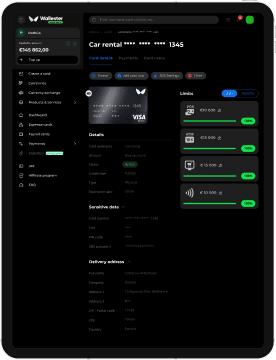
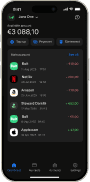
Wallester offers a free-to-start account for freelancers and self-employed professionals with its own IBAN. EUR is one of the 10 supported currencies (EUR, USD, GBP, SEK, NOK, CZK, HUF, RON, PLN and DKK), so a freelancer can share their account details with an EU client and ask them to pay by bank transfer. Freelancers can also send invoices to keep client payments organised. Received funds can stay in the account, be exchanged between supported currencies when needed, or be spent with physical and virtual cards, including Apple Pay and Google Pay.
There is no setup fee and no monthly fee for the account, the app or the cards. Wallester is licensed as a payment institution by the Estonian Financial Supervision and Resolution Authority (Finantsinspektsioon) and is a Visa Principal Member.
To collect a EUR payment with the account:
- Open the account and complete verification.
- Give the client your account name, IBAN and the currency (EUR).
- Issue an invoice with the total euro amount, the payment terms and a unique invoice number.
- Ask the client to pay by bank transfer and include the invoice number as the payment reference.
- Match the incoming payment to the open invoice.