This comparison breaks down the functional differences between purchasing cards (P-cards) and procurement software platforms. It outlines how spending controls, approval workflows, purchase order generation, and payment execution operate across both options, helping finance leaders determine the right purchasing structure for their business operations.
Finance teams face a direct operational decision when structuring business spending: whether to issue payment cards or deploy full purchasing platforms. A purchasing card provides instant payment capabilities with preset limits, while procurement software manages request approvals, vendor contracts, and purchase orders before money changes hands. Choosing between a p-card vs procurement software requires evaluating where your organisation needs financial oversight, transaction speed, or formal accounting governance across daily operations.
What is a P-card and what does it do?
A purchasing card (P-card) is a commercial charge card that allows designated staff to make direct purchases without generating purchase orders or going through standard requisition steps. It functions as a card-based payment instrument with built-in spending caps and merchant category restriction controls.
A P-card handles payments and spending controls at the point of sale. Finance departments assign individual card limits, single-transaction caps, and restricted Merchant Category Codes (MCC) to prevent unapproved expenditure. P-cards streamline recurring operational spending by bypassing formal purchase requisitions and invoice processing.
Businesses utilise purchasing cards for targeted operational categories where issuing formal purchase orders creates unnecessary delay:
- Low-value operational purchases and office supplies
- Employee travel, lodging, and client entertainment
- Recurring SaaS subscriptions and digital services
- Immediate operational expenses without prior vendor setup
- Small supplier payments accepting credit card processing
What does procurement software do that a P-card cannot?
Procurement software manages the complete pre-payment purchasing lifecycle, including purchase requisitions, multi-tier approval workflows, formal purchase orders, vendor selection, contract enforcement, and three-way invoice matching. Unlike payment cards, it controls how purchases are planned and approved before any payment takes place.
A procurement card vs procurement software comparison highlights a clear distinction in operational timing. P-card controls kick in when a cardholder initiates payment. Procurement platforms establish governance long before payment occurs. Staff submit requisitions specifying required items, budget codes, and project justification. The software routes the request through predefined approval hierarchies, generates a legal purchase order, and sends it to an approved vendor.
| Capability | P-card | Procurement software |
| Payment execution | Yes | Common capability through integrations |
| Spending limits | Yes (card level) | Yes (workflow and policy controls) |
| Purchase requisitions | Limited | Yes |
| Approval workflows | Basic or card provider controls | Yes |
| Supplier management | Limited | Yes |
| Purchase order creation | No | Yes |
| Spend reporting | Transaction-level | Full procurement data |
Understanding procurement software vs p-card capabilities helps organisations avoid misaligned investments. A P-card executes an approved transaction, whereas procurement software structures and governs the purchasing decision from request through receiving.
Q&A: Can procurement software replace a company card?
No. Procurement software controls requests, approvals, and order generation, but the actual transaction still requires a settlement method like an electronic bank transfer, virtual card, or physical card.
Should my company choose a P-card or procurement software?
Businesses should choose based on their specific operational priorities: a P-card fits organisations seeking fast, controlled payment execution for everyday expenses, while procurement software fits businesses requiring strict pre-purchase approval workflows, contract management, and purchase order tracking. Most scaling companies combine both tools.
Selecting between a p-card vs procurement system requires assessing spending volume, transaction size, and internal control requirements. Small businesses managing routine expense categories often find that commercial cards satisfy their immediate needs. Larger organisations handling complex vendor contracts require dedicated procurement governance.
To determine when to use a p-card or software, evaluate your operational priorities using this decision framework:
- Priority on rapid decentralised payments: Deploy P-cards with category restrictions to streamline small purchases.
- Priority on pre-spend governance: Implement procurement software to enforce requisition approvals and vendor catalogues.
- Priority on end-to-end control: Integrate corporate cards into procurement software to cover both workflow approval and payment execution.
| Business need | Better fit |
| Employee purchasing within set limits | P-card |
| Formal purchase approval workflow | Procurement software |
| Supplier and contract management | Procurement software |
| Controlled card payments | P-card |
| Full procure-to-pay process | Procurement software + payment solution |
According to Visa’s Growth Corporates Working Capital Index 2025-2026, 64% of European Growth Corporates used at least one working-capital solution. These firms reported an average of $21.4 million a year in bottom-line benefits from such solutions, equal to 4.4% of annual revenues. Among firms that paid with cards, 43% cited control over approvals and payment timing as a reason for doing so.
Q&A: Does a small business need procurement software?
Small businesses with simple buying needs and fewer than twenty employees often manage well with P-cards alone. When order volumes, supplier contracts, and departmental approval rules grow complex, introducing dedicated software becomes necessary.
How Wallester Business supports controlled purchasing
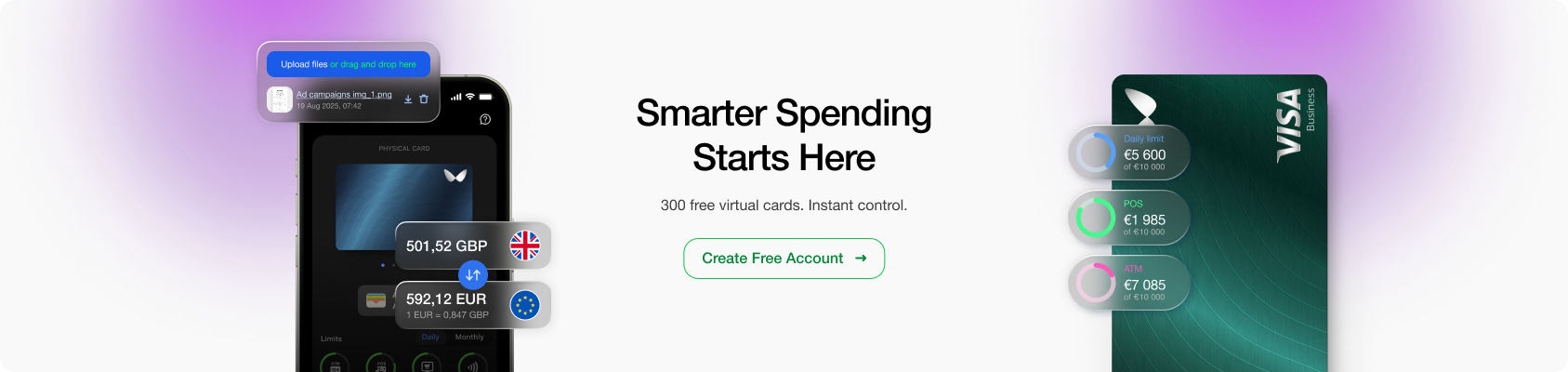
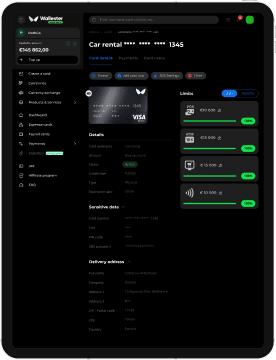
Wallester Business provides corporate cards and expense management tools for companies that need tighter control over business spending. Finance teams can set individual card limits, control merchant categories, monitor transactions in real time and freeze cards when necessary.
Companies can issue physical cards to employees and virtual cards for software subscriptions, digital advertising, supplier payments and other business expenses. Each card can have its own spending rules, giving finance teams control over how company funds are used.
Finance managers can set daily or monthly spending limits and restrict selected merchant categories from a central dashboard. Real-time transaction monitoring provides an immediate view of card activity, while card freeze controls allow teams to stop spending when required.
Employees can upload receipts through the mobile app, keeping supporting documents with the relevant transactions. Wallester Business also provides accounting integrations that transfer transaction data to accounting software, helping finance teams reconcile card expenses with their financial records.