There are plenty of expense management products on the market, but too many of them work in the same order. The money gets spent first, and then the software is supposed to help finance teams make sense of that spending.
That’s the weak point, because by the time the software records a payment, the money has already left the account. Someone then has to work out what happened, usually from a merchant name and an amount, often weeks after the fact.
Companies respond by buying better tools. The tools get faster and the dashboards get cleaner, but the underlying issue remains: finance teams still learn about spending too late to do much about it.
Where expenses go wrong
Picture a marketing team that shares one or two cards for advertising platforms and software subscriptions. Five people use them, and the statement lists dozens of charges each month. When a charge looks unfamiliar, nobody can say who made it or what it was for. Finance sends an email around the department and waits for an answer.
Or consider a free trial that rolls over into an annual subscription. The card on file belongs to someone who left the company in the spring. Nobody cancels the subscription because nobody knows it exists. Finance discovers it on the statement, after the money has left the account.
Neither example necessarily involves carelessness, let alone fraud. Both happen because the card provides no clear link to a person or purpose, and has no restrictions on what it can be used to buy.
Expense management software can document these problems, but the root cause lies in how the cards are issued and controlled.
Why better software doesn’t fix it
Expense management software usually steps in after a card payment has been made. It can sort transactions and request receipts, but it cannot prevent a payment that has already gone through.
The work therefore moves to the end of the process. Someone has to match each transaction to a receipt and a business purpose, asking colleagues for details they may have long forgotten. Better software can make this process faster, but it does not eliminate the work itself.
The cost is easy to underestimate. It shows up in hours spent by finance, and in purchases that were never approved because nobody was asked first.
Expense management starts at the card level
Both problems can be prevented before a payment is made. A shared company card often has no clear owner or defined purpose. It draws on a shared limit, leaving finance to reconstruct the context afterwards.
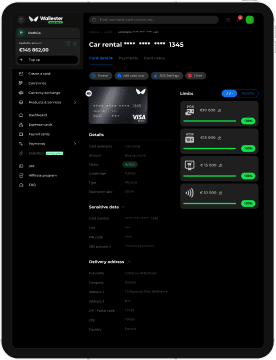
Now give every employee or supplier their own card. Set an individual limit and restrict each card to the merchants it needs to pay. A payment that falls outside those rules can be declined, leaving nothing to investigate later.
The transaction record improves as well. Each payment appears in real time and is already linked to a named cardholder. When the receipt is uploaded straight away, the transaction is documented as soon as it clears.
Seen this way, expense management is really a card-issuing question. It comes down to who holds which card and what that card is allowed to do. Get those decisions right before the money moves, and much of the work at month end never arises.
How does this work in Wallester Business?
Wallester Business runs on Wallester’s own card-issuing infrastructure, so spending controls are built into the payment process.
Again, consider an agency running paid campaigns for twelve clients. It issues one virtual card per client, with a monthly limit that matches the client’s budget. Each card can be restricted to the relevant advertising platform.
Spending is visible in real time for each client. When a client pauses a campaign, the agency freezes that card while the others continue to work. At month end, transactions are already linked to the right client and can flow into Xero, for example.
The same agency can give its account managers physical cards for client travel. Each card has its own limit, and employees can upload receipts through the mobile app on the day of purchase. When a trip involves another currency, the team can pay from a multi-currency account and convert within the platform.
What every business gets, from day one
Cards are where control starts, but Wallester Business runs the rest of a company’s finances alongside them. It all sits on one platform:
- A business account with its own IBAN.
- Multi-currency accounts and in-platform currency exchange for international spending.
- Virtual and physical cards, each with its own limits and controls, and up to 300 virtual cards on the free plan.
- Expense management, with receipts attached to transactions straight from the mobile app.
- User roles and permissions for everyone who handles the company’s money.
- Xero and QuickBooks integrations that keep the books up to date.
- A web platform and mobile app, backed by customer support.
For many companies, this replaces a separate business account, card provider, expense tool and currency service, each with its own login and its own exports. Finance works from a single view of where the money sits and where it goes. The same product serves a freelancer and a company with staff spending in several currencies, so nothing forces a switch to a different product as the business grows.
Wallester Business is free to start. Open an account, issue your first cards and set their limits before the next payment goes out. The statement no longer has to be the first time finance hears about a transaction.