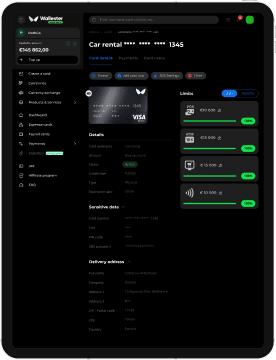
Not long ago, simply letting companies issue their own branded cards was enough for a provider to win business. Clearly, it is still the main requirement, but it no longer decides the deal. Virtual and physical cards, a mobile app, an API and a back office are now the standard package, and a platform comparing providers will find most of them offering roughly the same thing.
So what separates them?
Juniper Research has an answer. In its recent Competitor Leaderboard for Embedded Finance Vendors, the firm found that the providers leading the market share one trait. As Research Analyst Dr Manju Chhillar put it, “vertical specialisation, rather than horizontal breadth, is what differentiates success in embedded finance.” According to Juniper, it is depth of expertise, more than size, that gives platforms the confidence to embed financial services.
That doesn’t mean a provider has to pick one sector and stay there. Covering several verticals is fine, but what does matter is knowing each of them inside out.
The problem with shallow breadth
There is nothing wrong with a provider serving lenders, HR platforms and financial companies at the same time. The trouble starts when breadth means offering one generic card product and leaving each client to bend it to their sector.
Each vertical asks for something different. A lender needs a card that fits its credit product and can be in the borrower’s hands the moment a loan is approved. A benefits platform, on the other hand, needs spending rules that match what an employer has agreed to fund. A provider that knows these sectors has already solved these problems. A provider that doesn’t will solve them on the client’s time, and every week a platform spends explaining how its industry works is a week added to its launch.
What knowing a vertical inside out looks like
Depth shows up in two places: the product and the implementation.
In the product, the controls a sector needs already exist. Spending rules, card types and reporting are built for how that sector works. A benefits platform, for example, can define spend by category from day one, without waiting for a custom build.
In the implementation, the provider’s team has done it before. It knows which questions a lender’s compliance team will ask, how employers expect allowances to be structured, and what a gift card company will want on its cards. Market-specific needs get settled at the start of the project, before testing begins.
Where Wallester has built that depth
Cards issued through Wallester’s infrastructure now number more than 9.2 million, across 31 markets in the EEA and UK, for clients in very different sectors. Here are just two clients that can serve as an example of what depth looks like in practice.
Lending
GF Money, a Finnish consumer lender founded in 2011, needed a card product that could expand with it across its markets. Its previous card solution worked, but couldn’t support that growth. With Wallester White-Label, GF Money launched its own branded virtual Visa card in Finland and Denmark, then completed its rollout in Sweden in 2025. GF Money’s cards are issued instantly and work with Google Pay, so its customers can start using them straight away. GF Money has now issued more than 27,000 cards.
Employee benefits
Beneflo, a Latvian benefits platform founded in 2025, replaces fixed perks with flexible budgets. Employers set the categories, such as wellness, education or mobility, and employees choose how to spend within them. “Freedom of choice was non-negotiable,” says CEO and co-founder Alex Snurnitsyn. That meant an employee should be able to pay for a gym in Riga or a course in Berlin with no paperwork. Beneflo evaluated dozens of providers and chose Wallester because its API supported the granular, real-time spending rules the model depends on, along with multi-currency support for distributed teams. Beneflo has since been selected for the Visa Innovation Program Europe.
Each of these programmes runs on the same infrastructure. But what differs is how it was set up, and that setup is where knowing the sector pays off.
About Wallester White-Label
Wallester White-Label lets companies launch their own branded Visa card programmes without a banking licence and without building the infrastructure from scratch. Wallester handles the regulation and the technical stack, while the client keeps its brand, its product and its users.
With Wallester White-Label, companies can:
- Issue debit, credit and prepaid Visa cards, in virtual and physical formats
- Offer native iOS and Android apps under their own brand, with Apple Pay, Google Pay and Samsung Pay support
- Open multi-currency accounts, cards and payments in 10 currencies
- Set granular, real-time spending rules and limits through the API and back-office portal
- Integrate everything through a single REST API
- Choose a shared or dedicated BIN under Wallester’s sponsorship
- Run KYC, KYB and real-time fraud monitoring without building in-house systems
Wallester is a licensed payment institution and a direct Visa Principal Member, with card-issuing infrastructure built in-house. Wallester White-Label is available across 31 markets in the EEA and UK.