When Juniper Researchrecently set out what will drive embedded finance over the next five years, most of its list was expected: more consumers shopping online and the rapid digitisation of B2B payments. The less obvious item was regulation. Its September forecast names regulatory standardisation supporting open finance as one of the main forces behind the market’s growth.
That’s at odds with a familiar complaint in fintech about how regulation is slowing everything down. In card issuing, for example, common rules are making it easier to launch in more than one country. But a shared rulebook only opens the door. How quickly companies get through also depends on the infrastructure underneath.
What standardisation means in practice
When it comes to card issuing in Europe, the clearest example is passporting. A payment institution licensed in one EU country can offer its services across the European Economic Area under that single authorisation. With shared rules on payments and data protection, a card programme built for one market can extend to another without a fresh licence application in each country.
The rulebook keeps converging. DORA has applied across the EU since January 2025, setting common standards for how financial firms manage technology risk and outages. The EU’s Anti-Money Laundering Regulation is due to apply from July 2027. It is intended to replace a patchwork of national rules with a single regime and a new EU authority to oversee it. Open finance pushes the same logic further, extending the data-sharing rules that open banking introduced for payment accounts to a wider range of financial products.
None of this makes compliance lighter, and a single rulebook is usually a demanding one. But what does change is that the work only has to be done once, to one standard, before it applies across a whole region.
“The essence of embedded finance is the availability of turnkey financial solutions, provided by fully compliant, secure and resilient, regulated financial institutions, that enable business to operate and grow without having to become experts in regulation or payments technology. Regulatory harmonisation helps extend the scope of embedded finance solutions and simplify operational processes, which should translate to lower cost and quicker to deploy solutions”, says Julian Brand, CEO of Wallester UK.
The UK, on its own terms
Since Brexit, the UK has sat outside that system. A European licence no longer covers British customers, so serving them requires separate authorisation from the Financial Conduct Authority.
For firms operating in both markets, that means dealing with two regulators and maintaining two compliance programmes that are similar in principle but differ in important details. The UK has retained much of the EU framework it inherited, but it now sets its own rules on its own timetable.
Wallester UK received its FCA authorisation as an electronic money institution in May (and now preparing for the launch), giving Julian a close view of how the British regulator works.
“What was abundantly clear throughout the process of interaction with the FCA, is that the FCA is focussed on ‘outcomes’, evidence that UK regulated firms can be trusted to deliver good customer outcomes, to protect customer funds at all times, to have resilient systems and processes and to operate under strong, effective governance”, says Brand.
“At Wallester, we view these as foundational principles and as such are well aligned with FCA objectives. In my opinion these principles are as fundamental to business growth as they are to regulatory compliance and licence retention. The only way to go faster is to do things, including compliance, efficiently and effectively. Cut corners at your peril”.
A bigger market, and a more crowded one
Lower barriers work in both directions. If one licence and one rulebook make it easier to serve the whole of Europe, they also make it easier for new providers to enter. Juniper’s forecast points to plenty of demand. It will also draw more firms competing for it.
That leaves every card issuer and embedded finance provider with the same question. When more of them can offer branded cards and embedded payments, why would a client choose one over another?
Who comes out ahead
As we see it, the answer comes down to compliance and speed, and it’s not always easy to reconcile the two.
Compliance comes first. When a provider falls short, the consequences reach its clients too, because their card programmes run on its licence and controls. A provider that cuts corners to win business today puts every programme it runs at risk tomorrow.
Speed, though, is what wins the client. Full compliance gets a provider into the conversation. What a platform wants to know next is how quickly it can be live. Every week before launch is a week without the revenue a card programme generates, including interchange on cardholder spending.
The answer depends on how much of the stack the provider runs itself. One that relies on separate partners for processing or card production passes every extra integration and contract on to its client, along with the delay that comes with them.
Juniper’s own leaderboard reaches a similar conclusion. Its 2026 ranking of embedded finance vendors found that depth of expertise, more than size, separates the leaders.
“As the market grows and becomes more competitive, companies that succeed will be the ones that can demonstrate consistent excellence of execution, not quickly launching something flashy that breaks. Tech is often similar now; partnership and execution are the real differentiators. For me, success will come down to a threefold passion: first, a steadfast commitment to the customer, that is understanding and solving their actual real-world problems. Second, the product and tech, it has to be compliant, secure, scalable and resilient. And third, the people driving it, you need the best people in the team (whether that’s in business or in sport). That combination is what makes a business choose you and stick with you”, says Brand.
How does Wallester White-Label help?
Wallester White-Label is built to deliver both. Wallester is a payment institution authorised in Estonia and a Visa Principal Member, and it built its issuing platform in-house. Because those pieces sit under one roof, a partner deals with one provider and one integration, and can launch far faster than it could by assembling the stack from several suppliers.
Where a client has its technical and legal teams ready to move, Wallester has taken a project from start to launch in 28 days. Timelines vary by project, and physical cards take longer, since production only begins once Visa has approved the card design.
The compliance work sits inside the platform. Partners build on infrastructure that is certified to PCI DSS Level 1 and compliant with PSD2, GDPR and DORA, with KYC, KYB and AML checks built into onboarding.
Partners get:
- Branded Visa cards, including debit, credit and prepaid, in virtual, physical and disposable formats.
- BIN sponsorship, with a choice of shared or dedicated BIN.
- A REST API and native iOS and Android apps.
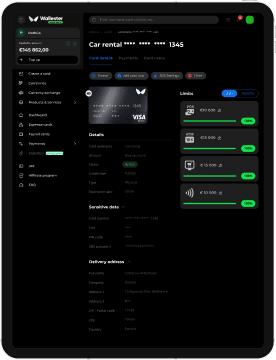
- A back-office portal for managing the card lifecycle, users and limits.
- Accounts, cards and payments in 10 currencies.
- Apple Pay, Google Pay, Samsung Pay, Garmin Pay and Fidesmo Pay support.
- 3D Secure authentication and real-time fraud monitoring.
- Transaction data enrichment, turning raw merchant strings into clean names and categories.
Wallester’s licence is passported across the EEA, so a programme launched in one market can grow into others under the same framework. In a market filling up with providers, that is the kind of ground a client wants to build on.
If you are planning a card programme in Europe, talk to our team about what launching would involve.