Over the past decade, banks and other credit institutions across Europe have rebuilt much of what their customers see. Loan applications have moved online, and mobile apps have become the main way many customers manage their money.
Yet the card programme has often been left behind. In many institutions, it still runs on a setup chosen years ago, sometimes spread across several providers, where adding a feature or a new card type turns into a long project. Customers notice the difference. A lender that approves credit in an app, then makes the customer wait for a plastic card in the post, feels slower than the rest of its product suggests.
Why cards fall behind
Cards depend on infrastructure that an institution rarely runs end to end. Issuing and processing, the connection to the card scheme, tokenisation for mobile wallets and card production may each sit with a different supplier.
Changing any part of that chain means coordinating all of it. That’s why card programmes change less often than the lending and digital banking products around them, even when the institution would like them to move faster.
What customers now expect from a card
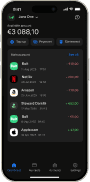
The benchmark has moved. A customer approved for credit today expects to use it straight away, on a virtual card that’s available in the app and ready to add to Apple Pay or Google Pay. They expect to see transactions in real time and to set their own limits from their phone.
For customers who travel or buy from abroad, paying in more than one currency without extra steps is becoming part of the same expectation.
None of this is unusual anymore. For an institution with an older card setup, though, each feature can mean a separate project with a separate supplier.
How white-label card issuing works for credit institutions
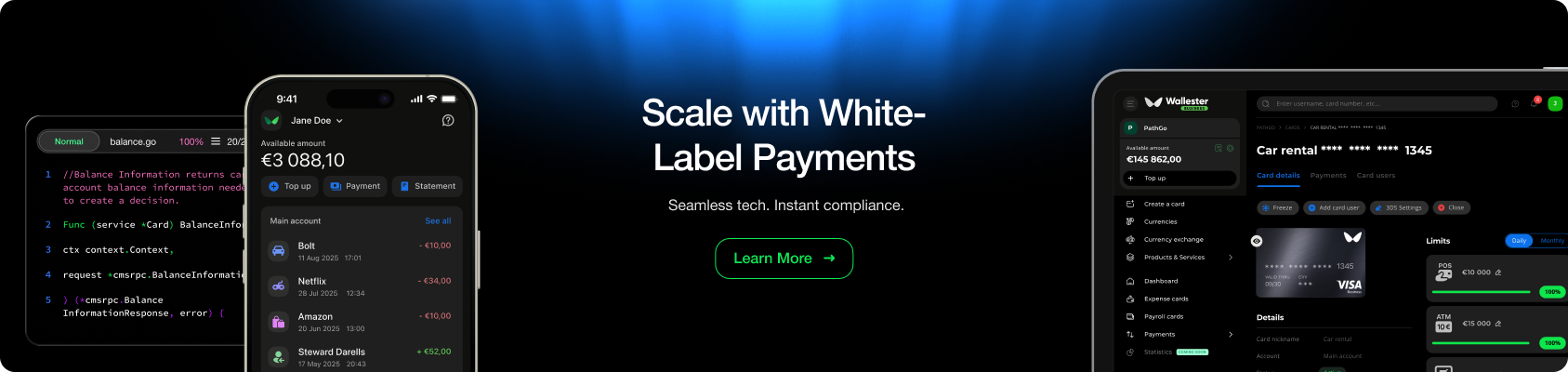
White-label card issuing takes that work into a single platform. The provider runs the issuing and processing infrastructure, including the connection to the card scheme, and the institution connects to it through one API.
For a credit institution, the important part is what stays in-house. As a regulated partner, the institution keeps its own licence and runs its own customer onboarding. The customer relationship stays with it too, and the cards carry its brand inside its own app.
It doesn’t have to be an all-or-nothing move either. An institution can upgrade an existing programme or add a new card product alongside it.
How GF Money did it
GF Money, a Finnish consumer lender founded in 2011, offers credit products and digital financial services in Finland, Sweden and Denmark. As the business grew, its existing card solution, while functional, could no longer support its plans. It needed one virtual card product that could run across all its markets and grow with it.
After evaluating several providers, GF Money moved to Wallester White-Label. It launched branded virtual Visa cards with instant issuance and Google Pay integration, first in Finland and Denmark, then completed the rollout in Sweden in 2025, all from one platform.
“Wallester White-Label has been a key enabler in scaling GF Money’s digital financial solutions across our international presence,” says Samuli Peltola, Portfolio Manager at GF Money. “Its flexibility, fast onboarding, and strong technical support have helped us to launch a modern virtual card product efficiently.”
Wallester White-Label for credit institutions
Wallester is a payment institution authorised in Estonia and a Visa Principal Member, and it built its issuing platform in-house. Credit institutions working with Wallester White-Label can:
- Issue branded Visa debit, credit and prepaid cards, in virtual and physical formats.
- Offer instant virtual cards with Apple Pay, Google Pay, Samsung Pay, Garmin Pay and Fidesmo Pay.
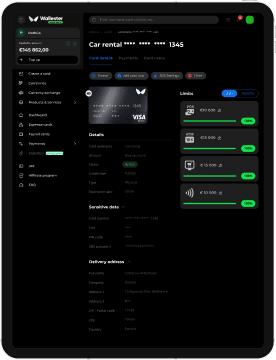
- Set real-time limits and controls through the API and back-office portal.
- Run accounts, cards and payments in 10 currencies.
- Choose from Visa tiers ranging from Classic to Infinite, subject to Visa approval, under a shared or dedicated BIN.
- Connect to existing systems through a single REST API.
- Launch in one EEA market and extend the programme to others under the same framework.
That’s how the card programme catches up with the rest of the offering. If your card offering is due for an update, talk to our team about what it would take.