Businesses around the world will make more than 612 billion B2B payments a year by 2031, according to a new study by Juniper Research. That is 15% more than the 532 billion forecast for 2026. These payments cover everything from supplier invoices and software subscriptions to fuel purchases. Each needs to be processed, recorded and accounted for, often across several different finance tools.
Juniper’s research also points to a shift in where those payments happen. As payment services become part of the platforms companies use for procurement, payroll and financial management, the providers behind those platforms gain greater influence over how businesses initiate and manage payments.
“Businesses are no longer willing to treat payments as a separate, administrative process,” said Shane O’Sullivan, the report’s author. “Providers which integrate payment execution with spend controls, reconciliation, and cross-border capabilities are better positioned to capture growth.”
The cost of keeping payments separate
In many companies, paying for something and accounting for it are two different jobs, done in two different places. Picture a 40-person agency. Its team pays for software and travel with cards from one provider, logs expenses in a separate app and keeps the books in accounting software. Receipts arrive by email, if they arrive at all.
None of these tools isn’t necessarily bad on its own, but the trouble starts at the end of the month, when someone in finance has to match card transactions with receipts and receipts with accounting entries. Every handover between systems creates another opportunity for information to be missed, leaving finance teams to search for receipts or clarify transactions.
That’s the administrative process businesses are tired of. The fix isn’t, as often said, to make payments faster, but to reduce the number of systems a payment has to pass through before the associated expense is fully recorded and reconciled.
What one roof means in practice
When cards, accounts and expenses sit in the same platform, the work around a payment happens alongside the payment itself. Limits and controls are set before an employee spends, reducing the need for finance to review spending after the fact. The receipt is attached to the transaction it belongs to, rather than sitting in an email thread. And when the platform connects with accounting software, transaction data can be transferred without having to enter everything manually.
The same principle applies across borders. A company that pays suppliers in several currencies needs a clear view of where its money sits and how it is being spent. When currency accounts, exchange and cards are managed within the same platform, finance teams can work from a more consistent picture of the company’s funds.
Who owns the payment relationship
Juniper expects competition in B2B payments to centre on who owns the payment relationship with the business. Its research suggests that banks will need stronger partnerships with payment providers or risk losing direct contact with business customers as specialist providers gain market share.
For a business, the question is simpler. The provider that matters most is often the one whose platform the finance team opens every morning. When that platform also issues the cards, provides the accounts and records the expenses, there are fewer systems to keep in sync and fewer opportunities for information to get lost.
How Wallester Business helps
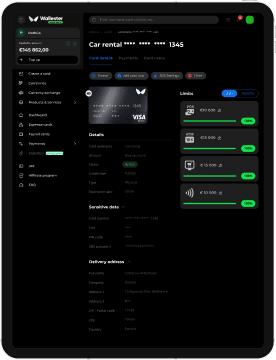
Wallester Business brings company spending and expense management together in one platform, built on Wallester’s own card-issuing infrastructure. Opening an account is free, and businesses get:
- A business account with an IBAN
- Virtual and physical cards, with 300 virtual cards included on the Free plan
- Card limits and controls that can be set before money is spent
- Multi-currency accounts and currency exchange within the platform
- Expense management, with receipts attached to transactions
- Roles and permissions for employees and approvers
- Integrations with Xero and QuickBooks
- Access through a web platform and mobile app
Juniper’s forecast describes a market that will keep growing in volume. For a finance team, the harder question is how many tools each of those payments has to pass through. Wallester Business is designed so the answer to that question is one. Bringing cards, accounts and expenses together can reduce the number of systems involved and make that work easier to manage.