When companies lose money in a big way, finance teams, of course, know about it. A contract that goes wrong or a product that fails always shows up in the quarterly numbers, and somebody has to explain to the board what has happened.
But smaller losses are more difficult to spot, simply because they sit inside routine business spending. It might be just a few hundred euros at a time, spread across cards and subscriptions. When there is no single line that looks alarming, people usually don’t check it twice. Yet over a year, those kinds of leaks can add up to serious amounts.
Here are six of the most common leaks, along with some thoughts on why they are so easy to miss.
1. Subscriptions nobody owns
Software is often bought on a card by whoever needed it at that moment. But projects end and people leave, and the subscription keeps renewing. Annual plans are the hardest to catch, as the charge appears once a year and looks familiar when it does.
Clearly, the underlying problem is ownership. If a subscription isn’t tied to a named person or a dedicated card, nobody has a reason to cancel it.
2. The same tool, paid for twice
As companies grow, teams buy their own tools. So, for example, sales and marketing teams end up with separate licences for the same type of design or scheduling software, on separate cards, each at full price. Neither team knows about the other, and finance sees two different and seemingly unrelated merchant names.
A single shared plan would often cost less, but spotting the duplicate means seeing all software spend in one place, with an owner attached to each payment.
3. Currency conversions you never see
When a company pays a foreign supplier from a home-currency account, the conversion usually includes a margin on the exchange rate that rarely appears as a separate fee. Instead, it might be built into the amount charged.
For a business paying contractors or for tools in dollars or pounds every month, those margins add up over time, and the cost is real. The problem is that it never shows up on the statement as a line of its own.
4. Receipts that never arrive
A missing receipt costs more than admin time. Normally, reclaiming VAT requires a valid invoice. Without one, the tax paid on a purchase might get lost.
Most missing receipts come down to timing. One requested on the day of purchase usually turns up, but one requested three weeks later often doesn’t.
5. Spending with no ceiling
Shared cards with a single high limit make budgets impossible to enforce. A campaign runs over, or a team books travel at short notice, and the overspend only appears at month end, when, obviously, it can’t be undone.
Even if the budget was there, nothing enforced it at the point of payment.
6. Hours spent rebuilding the month
As always, the least visible cost is time. Every month, someone matches transactions to receipts and asks colleagues to explain charges before the books can close.
Those hours come from finance staff who could be working on forecasting or analysis. The cost grows with every new purchase or supplier the company adds.
How does Wallester Business help?
All these leaks have the same origin: money moves before anyone can see or control it. Wallester Business brings that control to the start.
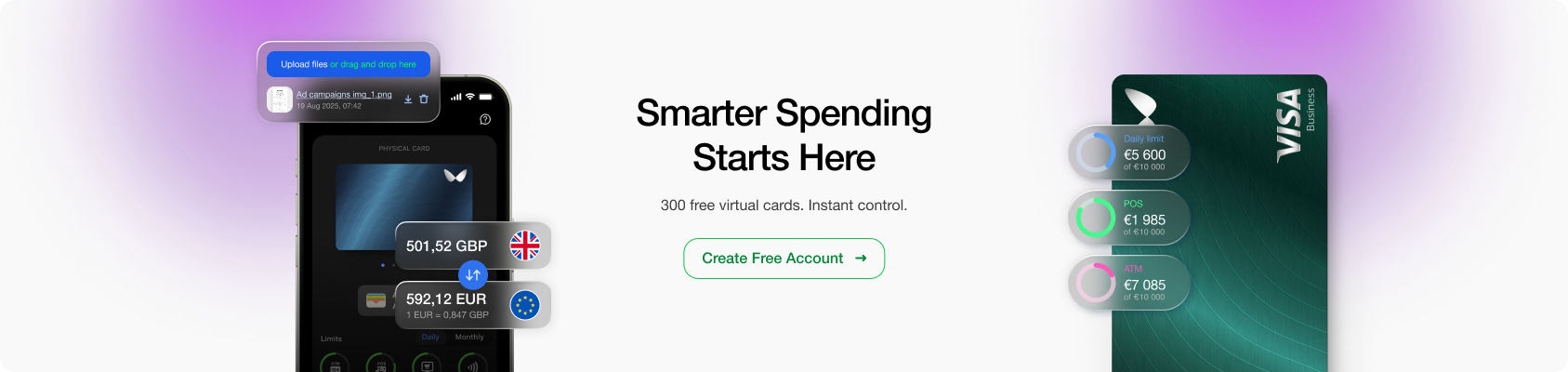
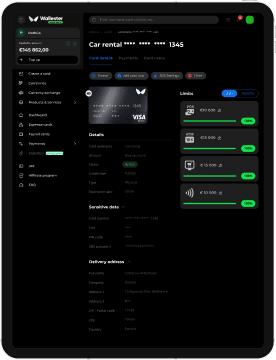
Every subscription and supplier can have its own virtual card, assigned to a named owner and capped at the appropriate amount. When a tool is no longer needed, its limit can be lowered so the next renewal won’t go through. Because every card sits in one view, two teams paying for the same software are easy to spot.
Multi-currency accounts also let the company hold and pay in the currencies it uses, with exchanges handled inside the platform at transparent rates. Receipts can be attached to transactions through the mobile app at the moment of purchase, so the paperwork for VAT is in place from the start. Limits set before the first payment enforce the budget, while real-time transaction data synced with Xero or QuickBooks shortens the month-end reconciliation process.
What every business gets, from day one
The tools that close these leaks all sit on one platform:
- A business account with its own IBAN.
- Multi-currency accounts and in-platform currency exchange.
- Virtual and physical cards, each with its own limits and controls, and up to 300 virtual cards on the free plan.
- Expense management, with receipts attached directly through the mobile app.
- User roles and permissions for everyone who handles company money.
- Xero and QuickBooks integrations that keep the books up to date.
- A web platform and mobile app, backed by customer support.
Leaks tend to hide where one system hands over to another: the account with one provider, the cards with a second, and the receipts in a third. Keeping everything on a single platform takes away most of those hiding places. That applies whether the business is a sole trader or a company with staff spending in several currencies.
Opening a Wallester Business account is free. A good place to start is with subscriptions: give each one its own card and see which ones nobody can account for.