This detailed guide explains the practical mechanics of building an accurate cash flow forecast and cash flow projection. It covers core forecasting methods, key differences between statements and models, factors affecting liquidity, best practices for financial planning, and how modern expense automation platforms support real-time financial control.
Maintaining financial stability requires absolute clarity over incoming and outgoing funds. A reliable cash flow forecast allows finance leaders to anticipate cash shortfalls, manage working capital effectively, and align operating expenditure with actual revenue timing. By establishing a structured cash flow projection, growing businesses protect liquidity, maintain supplier trust, and make confident investment decisions based on dependable, up-to-date transaction data rather than static accounting assumptions.
What is a cash flow forecast and why is it important?
A cash flow forecast estimates the money expected to enter and leave a business over a future period. It helps finance teams prepare for upcoming expenses, investment decisions and short-term liquidity needs.
Understanding future liquidity is fundamental for operational survival. While an income statement records profitability over a specific trading period, it includes non-cash items such as depreciation and uncollected invoices. In contrast, a cash flow forecast tracks actual cash movements in real time. This distinction is critical because solvent businesses can still face insolvency if cash remains locked in unpaid customer accounts while immediate operating expenses fall due.
A comprehensive cash flow model connects daily operating cash flow directly to broader financial goals. Short-term forecasts manage immediate payroll, supplier invoices, and tax obligations, whereas long-term models guide capital expenditure and debt financing. Data from theOffice for National Statistics shows that 25% of UK companies reported falling turnover in early 2026, underlining how quickly market movements press against cash buffers.
How different forecast timeframes support specific operational tasks across the finance function.
| Forecast type | Common time frame | Typical purpose |
| Short-term | Days to months | Day-to-day cash planning |
| Medium-term | Several months | Budget planning |
| Long-term | One year or more | Strategic decisions |
Regular cash flow forecasting protects working capital by highlighting potential deficits weeks before they occur. This advance notice enables finance managers to adjust spending, negotiate extended credit terms, or draw down short-term facilities under favourable terms.
Q&A: Is a cash flow forecast the same as a budget?
No. A budget sets target revenues and spending caps for a future period. A cash flow forecast estimates actual cash timing based on real-world payment behaviour and historical receipt patterns.
How do you create a reliable cash flow projection?
A reliable projection combines expected income, planned expenses, historical financial data and realistic assumptions that are reviewed regularly.
Building a dependable model starts with gathering accurate historical financial data and identifying recurring payment cycles. Finance managers must account for expected cash inflows from sales forecasts, recurring subscriptions, and asset disposals alongside expected cash outflows like payroll, rent, inventory purchases, and tax liabilities. Factoring in seasonality prevents overestimating revenue during slower trading months.
A structured process keeps cash flow planning consistent and accurate across trading cycles:
- Determine the forecast period, choosing daily, weekly, or monthly intervals based on operational needs.
- Estimate expected cash inflows using verified sales pipelines and historical payment performance.
- List all fixed and variable expected cash outflows alongside known debt service schedules.
- Calculate net cash flow by subtracting total outflows from total inflows for each period.
- Combine net cash flow with opening cash balances to determine closing liquidity positions.
- Run scenario planning exercises to assess cash positions under best-case and worst-case conditions.
Realistic assumptions form the foundation of effective finance forecasting. Assuming every customer pays strictly on 30-day terms creates artificial liquidity spikes. Instead, finance teams must adjust payment timelines based on actual accounts receivable collection history. Updating forecasts continuously maintains alignment with real-life bank balances and market changes.
Q&A: How often should a cash flow forecast be updated?
Finance teams generally update forecasts monthly. Companies with volatile revenue, rapid expansion, or tight working capital benefit from weekly or rolling 13-week forecast updates to keep liquidity visible.
What can affect the accuracy of a cash flow forecast?
Forecast accuracy depends on data quality, customer payment behaviour, supplier payment schedules and how frequently financial information is reviewed.
External and internal factors frequently create variances between projected cash flow and actual balances. Late customer payments remain a leading cause of liquidity pressure. Recent regulatory developments reported byICAEW highlight UK plans to cap payment terms at 60 days to prevent large firms from withholding funds from smaller suppliers. Unexpected expenses, such as emergency equipment repairs or sudden supply chain disruptions, further strain operating cash flow if balance buffers are insufficient.
The key factors that disrupt cash flow management and their direct financial impacts:
| Factor | Possible impact |
| Late customer payments | Lower available cash |
| Unexpected expenses | Forecast variance |
| Sales fluctuations | Income changes |
| Supplier payment timing | Outgoing cash changes |
| Poor data quality | Less reliable forecasts |
Managing supplier terms and inventory purchases carefully prevents working capital from stalling. Fast business growth can also stress liquidity when upfront operational costs outpace customer collections. Relying on outdated manual spreadsheets introduces human error and creates data delays that distort financial analysis. Modern finance software streamlines transaction recording and strengthens forecast reliability.
Adopting disciplined financial habits keeps cash models accurate and resilient:
- Review variance reports weekly to compare projected figures against actual bank balances.
- Separate fixed operational expenses from discretionary expenditure to identify swift spending cuts if revenue dips.
- Maintain clear communication between sales and credit control to track overdue invoice collections.
- Standardise expense management guidelines so outgoing payments align with monthly cash projections.
How Wallester Business supports cash flow forecasting
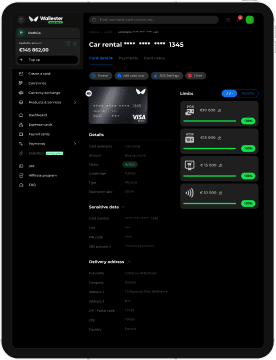
Wallester Business gives finance teams real-time visibility into company spending, helping forecasts reflect actual expenses and current financial activity more accurately.
Reliable cash flow forecasting depends directly on accurate, timely expense data. Outgoing payments carry equal weight to expected income when calculating business liquidity, yet finance teams frequently struggle to track decentralised corporate spending. Unrecorded card purchases, delayed receipts, and manual expense reports create blind spots that compromise cash flow analysis.
Wallester Business solves this visibility challenge through a centralised corporate card and expense management system. Finance teams can issue unlimited virtual Visa corporate cards instantly for team members or request physical business cards for field staff. Every card links directly to automated real-time expense tracking, giving controllers immediate transaction visibility the moment a purchase occurs.
Customisable spending controls and approval workflows allow management to set strict limit caps per card, project, or department. This prevents unapproved expenditure from derailing monthly budget limits. Integrated finance reporting and direct accounting integrations push cleared transaction data straight into financial software, eliminating manual entry errors and maintaining current balance accounts.