Let’s say a business owner decides a new warehouse hire needs a card to pay for fuel and parking. That’s a five-minute decision inside most finance software. It’s also a new line on the next invoice: another user fee, another card fee, sometimes a small charge just to give the hire a role with the right permissions. Now, multiply that by however many people a growing company brings on in a year, and the small decisions add up to a subscription that’s grown alongside the team.
None of what’s being charged for here is exotic. Typically, it’s just another user or a card or a role. These are the basic things almost every company ends up needing as it grows. But too often they are priced as if each one were a premium add-on.
Every Basic Step Comes With Its Own Line Item
A manager who knows that adding a new hire to the finance platform costs an extra ten dollars a month will sometimes simply not do it. As a result, the new employee borrows a colleague’s card for the first few weeks. Two people end up sharing one login because setting up a second one means another conversation about budget that nobody wants to have during someone’s first week on the job.
Those workarounds outlast the reason they were created. The shared login stays shared long after the new hire settles in, because nobody circles back to fix something that already works relatively well enough. But every expense the new employee makes in those first weeks gets logged under someone else’s name, which is exactly the kind of reconciliation mess the software was supposed to prevent in the first place.
This is a workaround, and it’s built around a pricing model that quietly punishes the kind of growth a healthy business wants.
Headcount Isn’t the Same as How Much a Business Is Doing
A five-person e-commerce operation might run thousands of transactions a month. They pay suppliers in three currencies and issue cards for a rotating cast of freelance marketers.
A fifty-person consultancy, by contrast, might have three people who ever touch a company card, with the other forty-seven billing hours and getting paid the same day each month.
If a provider charges for every employee at the same per-seat rate, the consultancy’s seat charges would be ten times those of the five-person e-commerce business. But some plans charge only for particular roles or active users. Check which people count as billable seats before treating headcount as the cost driver. The currencies, cards and transactions still need a separate comparison.
How to Compare Corporate Card Costs
Take one month of actual card use and price it under both plans. Count the users the provider bills for, the cards you keep active and the transactions you expect to make. Then repeat the calculation for the team you expect to have next year. A low headline subscription can produce a different result once those inputs change.
Copy this worksheet for each quote. For users and cards, record the included allowance and the price above it. For transaction charges, record both the fixed fee and any percentage, with the amount that percentage applies to.
| Cost item | Your usage or terms | Plan A | Plan B | Source and date |
|---|---|---|---|---|
| Subscription | Billing cycle and minimum term | Enter fee | Enter fee | Quote or tariff |
| Billable users | Number and roles charged | Allowance + rate | Allowance + rate | Quote or tariff |
| Active cards | Physical and virtual counts | Allowances + rates | Allowances + rates | Quote or tariff |
| Issue and delivery | New cards, replacements and shipments | Fees per card/order | Fees per card/order | Quote or tariff |
| Currency conversion | Amount converted and currency pair | Rate + markup | Rate + markup | Dated FX terms |
| Funding and transactions | Top-ups, payments, transfers and withdrawals | Fixed + % fees | Fixed + % fees | Quote or tariff |
| Other charges and tax | Minimum fees, extras and tax basis | Confirm items | Confirm items | Quote or tariff |
Use the same usage and tax basis for both offers. If quotes use different currencies, retain the original amounts and apply one stated exchange rate and date. Mark an unknown charge “quote required” and any affected total “partial”. A missing price is not a zero.
Separate three results: the recurring monthly equivalent, fees due at launch and total fees over the first year. Divide an annual subscription by 12 only for the monthly comparison; it is still payable on its contractual schedule. Count the subscription once in the annual total. Funds loaded onto cards and the purchases themselves are separate from provider fees.
Two Fictional Offers
The following offers are made up to show the calculation. They are not Wallester tariffs or competitor quotes. All figures are in GBP and exclude VAT.
Offer A costs £30 a month, including five billable users and eight active cards. Each additional user costs £3 a month; each additional active card costs £1 a month. Currency conversion costs 0.9% of the amount converted. Issuing a physical card costs £4.
Offer B costs £720 for a year, paid upfront, equivalent to £60 a month. It includes ten billable users and twelve active cards. Extra users cost £2 a month and extra active cards £0.50 a month. Currency conversion costs 0.4% of the amount converted; physical card issue costs £7.
In both examples, usage stays constant for twelve months and all physical cards are issued once at launch. Virtual card issuance, delivery, funding and other transaction fees are assumed to be £0. Additional-user, additional-card and currency-conversion fees are billed at month-end. Fees due at launch include the initial subscription payment and physical card issuance.
Example 1: a small team
Five billable users need four physical and four virtual cards. The business spends £10,000 a month, of which £1,000 requires conversion. Both offers cover the user and active-card counts within their allowances.
| Provider fees | Offer A | Offer B |
|---|---|---|
| Monthly equivalent | £39 | £64 |
| Fees due at launch | £46 | £748 |
| First-year total | £484 | £796 |
A’s monthly fee is £30 plus £9 for conversion. B’s is £60 equivalent plus £4 for conversion. Physical card issuance adds £16 for A and £28 for B. The first-year totals are therefore (12 × £39) + £16 and (12 × £64) + £28. A costs £312 less in this scenario.
Example 2: a growing team
Ten billable users need eight physical and four virtual cards. Monthly spend is £40,000, including £8,000 requiring conversion. A now charges for five extra users and four extra active cards. B still includes all the users and cards.
| Provider fees | Offer A | Offer B |
|---|---|---|
| Monthly equivalent | £121 | £92 |
| Fees due at launch | £62 | £776 |
| First-year total | £1,484 | £1,160 |
A’s monthly total is £30 + £15 for users + £4 for cards + £72 for conversion. B’s is £60 equivalent + £32 for conversion. Adding one-off physical card issuance gives (12 × £121) + £32 for A and (12 × £92) + £56 for B. B costs £324 less over the year, but requires more fees upfront.
These are two separate, constant-usage scenarios. If a team grows partway through a year, calculate each month at its expected usage and charge for new cards only when they are issued. Do not add the launch figure again to the first-year total: the subscription and issuance fees are already included.
What Wallester Business Does Differently
Wallester Business offers a Free plan with no monthly subscription. It includes an allowance of 300 virtual cards and free physical-card issuance. Additional virtual cards above the allowance, physical-card delivery and other operations can carry fees. Check the current UK pricing and fee schedule for the allowances, billing currency and charges that apply.
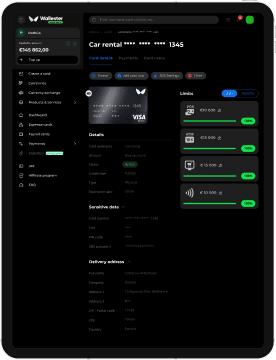
Access controls come built in as well. A company can add users, assign roles and permissions, and set individual card limits to control spending, without paying extra for that structure.
Adding a user, issuing another card and increasing foreign-currency spend are different cost questions. The worksheet helps a company separate them and see when its current plan still fits, or when another plan deserves a closer look.
What’s Included, Regardless of Headcount
Team size alone does not determine the bill. Check how many cards the business needs and how it will use them before choosing the Free plan or a paid plan.
The Free plan includes:
- Open a business account with no monthly subscription on the Free plan
- Issue physical and virtual cards to authorised cardholders, subject to plan allowances and applicable fees
- Assign user roles and permissions; the Free plan lists unlimited employee seats
- Set spending limits and controls on every card, whether it’s the first one issued or the fortieth
- Hold balances in ten supported currencies
- Attach receipts to transactions and connect Xero or QuickBooks Online; review the selected transactions and mappings before starting a sync.
- Manage accounts, cards and transactions from one dashboard, on web or mobile.
Growing the team and growing the bill don’t have to be the same event. A business that hires five people this quarter should be able to see which costs, if any, those hires add. Price their expected card use before deciding whether the existing plan still fits.