This guide covers how to calculate, monitor, and lower days sales outstanding to protect your business cash flow. We explore practical strategies to speed up customer payments, analyse industry benchmarks, and demonstrate how modern financial tools assist accounting teams in maintaining complete control over both incoming and outgoing company cash.
Late payments directly restrict working capital, preventing growing businesses from funding immediate operations or expanding into new markets. Tracking days sales outstanding helps financial controllers identify where collection processes stall and why customers delay payments. By adopting a systematic approach to accounts receivable, finance teams can shorten payment cycles, establish predictable income streams, and maintain healthier liquidity without damaging customer goodwill.
Further Reading: Accounts Receivable Process: Steps, KPIs, and Practical Examples
What is Days Sales Outstanding and why does it matter?
Days Sales Outstanding (DSO) measures how many days, on average, a business needs to collect payment after making a sale. A lower figure often points to faster cash collection and healthier liquidity, while a higher figure may signal collection issues or long payment terms.
Finance teams monitor days sales outstanding as a key performance indicator because it reflects credit management efficiency. When cash is locked in outstanding invoices, working capital declines, making it harder to cover day-to-day business costs. According to the July 2026 report by theUK Department for Business and Trade, large companies took an average of 32 days to pay suppliers in 2025, with 15% of all invoices settled late.
A high DSO indicates that credit terms are too generous or collection teams are slow. In contrast, a low DSO shows swift payment cycles. Certain industries naturally experience longer cycles; for example, construction projects require milestone payments that stretch timelines, whereas retail transactions settle instantly.
Evaluating your days sales outstanding requires comparing your business performance against standard credit control brackets.
| DSO range | General interpretation |
| Low | Faster collections |
| Moderate | Healthy for many businesses |
| High | Collection process may need attention |
Q&A: Is a low DSO always good?
While a low figure suggests cash flows quickly, excessively tight credit policies can deter prospective buyers and restrict sales growth.
How do you calculate days sales outstanding?
DSO uses average accounts receivable, total credit sales and the chosen accounting period. The result shows the average number of days needed to collect outstanding invoices.
Calculating this metric regularly allows businesses to spot billing issues before they threaten cash flow. Monthly calculations reveal short-term payment patterns, while quarterly tracking smooths out temporary fluctuations. Relying on a single calculation can mislead management; long-term trends provide a more accurate picture of debtor behaviour.
The standard calculation uses this mathematical formula:
DSO = (Average Accounts Receivable / Total Credit Sales) x Number of Days
To calculate days sales outstanding, follow these key steps:
- Determine the average accounts receivable balance for the period.
- Sum all credit sales completed during that timeframe, excluding cash payments.
- Divide average accounts receivable by total credit sales.
- Multiply the resulting decimal by the total days in the period.
Q&A: Should cash sales be included?
No, cash transactions settle instantly, so adding them artificially lowers the calculated average and distorts the true collection timeline.
Further Reading: Collections Strategy: How to Get Paid Without Damaging Customer Relationships
How can you lower DSO without affecting customer relationships?
Most businesses shorten DSO through better invoicing, clearer payment terms, faster follow-up and improved financial visibility, while keeping customer relationships intact.
Lowering days sales outstanding requires a balance between credit control and diplomatic customer relations. While late collections damage cash flow, aggressive tactics alienate partners. According to the 2025 Annual Report of theEU Payment Observatory, average European business payment periods exceed 60 days, making preventative measures essential.
A systematic approach prevents disputes and encourages prompt action. Key adjustments to credit policies can speed up payment cycles:
- Issue invoices immediately upon delivery to avoid payment delays.
- Check customer credit history before extending payment terms.
- Offer multiple payment options to simplify settlement.
- Monitor outstanding bills weekly using automated software.
Implementing consistent collection routines helps businesses manage days sales outstanding efficiently.
| Practice | Expected effect on collections |
| Faster invoicing | Earlier payment cycle |
| Payment reminders | Fewer overdue invoices |
| Credit reviews | Better payment reliability |
| Regular monitoring | Earlier issue detection |
Q&A: Can stricter payment terms always lower DSO?
While tighter deadlines clarify expectations, they may lead to disputes if clients lack the operational capacity to process payments that quickly.
How can Wallester Business support healthier cash flow?
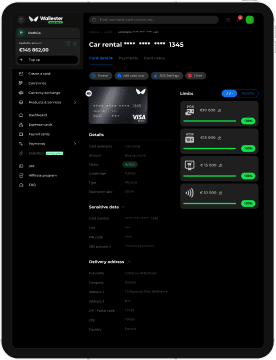
Wallester Business gives finance teams real-time visibility into company spending, corporate cards and expenses, helping maintain stronger financial control while receivables and payables are managed together.
Companies can issue unlimited virtual corporate cards and physical Visa business cards under strict corporate guidelines. Spending controls and approval workflows prevent unauthorised purchases, while instant card issuing lets teams handle urgent transactions.
Automatic monitoring and categorisation simplify bookkeeping, and direct accounting integrations export clean data to ledger systems. By unifying company spending controls, Wallester Business provides centralised financial oversight needed to coordinate outgoing expenses with incoming credit collections.
Explore how Wallester Business can help your company streamline expense tracking, coordinate outbound spending with your days sales outstanding cycle, and regain complete visibility over your corporate finance today.