A company’s finance setup rarely gets designed from scratch. Instead, it’s built one tool at a time, with each addition solving a real problem at the moment. So there’s a card for hotel bills, a transfer tool because a supplier won’t take cards, accounting software once the books need doing, an expense app once receipts start arriving as phone photos, invoicing software once a client wants something that looks professional.
Each of those decisions makes sense on its own. But string five of them together and company money now moves through five systems that don’t talk to each other.
Where the Handoffs Break Down
Take, for example, a single €340 charge at a hardware supplier. The card platform sees the amount and the merchant. The expense app has the receipt, assuming whoever made the purchase remembered to upload it. The accounting system needs a category before it can post the entry at all. None of these three systems finds the others on its own, meaning someone has to match them by hand.
At 300 transactions a month and thirty seconds of matching each, that’s two and a half hours of admin just to get everything where it belongs. Add a missing receipt, a statement that only arrives as a PDF, or a supplier billing in a currency the accounting system doesn’t recognise, and the number climbs quickly.
Errors follow the same route. A charge gets filed under the wrong project because a merchant name was the only clue available, or a refund lands back in the card system but never gets reattached to the original expense. None of it is really dramatic on its own. But it’s the kind of mismatch that only gets noticed in a quarterly review, well after the point where fixing it was still easy.
The Cost You Don’t See Until It’s Too Late
At least admin hours are visible and easy to put a number on. The more expensive problem is timing, because nobody sees it until it’s already cost something.
Picture two different departments paying for the same €89-a-month subscription. If it takes four months for anyone to notice, that’s €356 spent on nothing. Or a vendor who raises prices by 18%, and the increase isn’t caught until the eleventh invoice has already been paid.
The pattern repeats. Spend becomes visible once the month closes, which is when noticing it stops being useful. In short, budgets get approved on numbers that are already out of date.
There’s a weekly version of the same problem as well. A finance lead who wants to know how much money the business has checks the balance in one place, pending spend in another, and unpaid invoices in a third, then adds it up by hand. Even then, the total is only an estimate, and most likely it’s wrong.
So What Replaces the Matching?
The instinctive fix is to swap in a stronger tool wherever the pain is worst. But look at where these problems happen: not inside the card platform or the accounting system, both of which do their jobs fine, but in the handoff between them, the person, the CSV export, or the half-built integration meant to bridge the two. Swap in a better tool and the seam just moves somewhere else. Five good tools still leave four seams, and every seam still needs someone who understands how it fails.
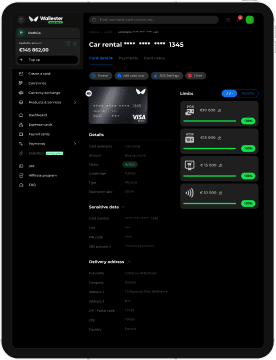
The other option is to remove the handoffs altogether. Wallester Business, for instance, keeps the account, the card, the receipt, and the ledger entry as one record from the moment a payment happens, so there’s nothing left to match afterwards. A card is issued with its purpose already attached. The receipt gets added at the point of spend. The transaction reaches the accounting system already labelled. That €340 hardware charge stays a single entry from start to finish, instead of three separate ones stitched back together weeks later.
What Every Business Gets, From Day One
That structure comes built into a Wallester Business account from day one, the same account a company uses to hold money, issue cards, and keep the books straight.
From day one, a company can:
- Open a business account with its own IBAN, no subscription required to get started
- Issue virtual and physical cards for employees, teams, projects, or a single purchase
- Set spending limits and real-time controls on every card, so an unexpected charge shows up the moment it happens
- Assign roles and permissions for who can spend, who can approve, and who can only view
- Hold and pay in 10 currencies, with premium plans for businesses that need more
- Attach receipts to transactions and sync everything with Xero or QuickBooks
- Manage every account, card, and transaction from one dashboard, on web or mobile
A broken stack never announces itself as a problem. It just quietly costs time and money until someone checks closely enough to notice. Bringing everything under one system doesn’t make the underlying work disappear. But it does remove the part that only existed because the money had to change systems on the way through.