This article covers the structured credit assessment process, customer credit checks, and essential evaluation criteria. It outlines practical approaches to business credit decisions. Financial teams can find detailed methods to evaluate risk and protect cash flow when offering payment terms to new customers.
Extending payment terms to commercial clients carries inherent financial risks. Granting trade credit without proper scrutiny can damage business cash flow and result in unpaid invoices. A thorough verification before approving a commercial relationship helps protect your business capital. Companies must verify the financial health of prospective partners before agreeing to deferred payments. This proactive step helps establish secure, sustainable trading relationships across different commercial sectors.
What is a credit assessment?
A credit assessment is a formal evaluation of the financial stability of a prospective buyer before granting trade credit. It determines whether a commercial customer can pay invoices on time.
This procedure evaluates customer creditworthiness using historical payment data and financial records. Businesses use this information to make safe trade credit decisions and protect their accounts receivable. While individual credit checks look at personal borrowing habits, a business customer credit check evaluates company performance, cash flow, and industry risk. This systematic financial risk evaluation protects companies from bad debt. Official data from the Insolvency Service shows that one in 196 companies on the register entered insolvency in the year ending May 2026. This highlight demonstrates why trading partners require structured evaluation.
Key factors used during a credit assessment
| Assessment factor | Why it matters | Example evidence |
| Payment history | Demonstrates historical payment reliability | Filed record of old invoices, credit bureau reports |
| Financial statements | Reveals profitability, cash reserves, and solvency | Balance sheets, profit and loss statements |
| Existing debt | Highlights existing financial commitments | Bank statements, outstanding loan documents |
| Credit reports | Provides external risk ratings and public records | Credit bureau assessments, court judgements |
| Trading history | Verifies long-term market presence and reliability | Company registration details, trade references |
Q&A: Does every customer need a full credit assessment?
Yes, every new buyer who requests payment terms deserves evaluation. However, the depth of the check can vary. High-value accounts require detailed financial audits, while smaller clients can undergo basic customer credit check procedures to save time without compromising risk protection.
Further Reading: Accounts Receivable Process: Steps, KPIs, and Practical Examples
How does the credit assessment process work?
The credit assessment process is a multi-step workflow that verifies customer identity, analyses financial solvency, and establishes appropriate payment limits. This sequence protects cash flow throughout the client lifecycle.
The process begins when a prospective client submits a credit application. Finance teams verify company identities to prevent fraud. They then review financial information, obtain credit bureau reports, and complete an internal risk assessment. This workflow concludes with credit limit decisions. During tight credit conditions, meticulous reviews are critical. For instance, the Bank of England Credit Conditions Survey for Q2 2026 noted that credit availability decreased for small and medium businesses. This reality means companies must monitor client portfolios carefully.
The credit assessment process follows six distinct stages:
- Credit application: The client submits trade references.
- Identity verification: The controller confirms company registration.
- Financial analysis: The team reviews balance sheets.
- Credit bureau checks: The business obtains credit scores.
- Credit limit decisions: The manager sets the maximum balance.
- Ongoing monitoring: The team conducts periodic reviews.
Q&A: How often should customer credit checks be updated?
Credit checks must occur at least once a year for active clients. High-value buyers or those in volatile sectors deserve quarterly reviews. Any noticeable change in payment behaviour should trigger an immediate credit evaluation to prevent unexpected financial losses.
Which factors influence credit approval decisions?
Credit approval decisions depend on a combined analysis of a buyer’s payment behaviour, cash reserves, and prevailing sector risks. Credit controllers weigh these elements against established company credit guidelines.
A business examines cash flow and profitability to verify whether the buyer generates sufficient capital to clear debts. Outstanding liabilities show how much cash the applicant owes to other lenders. Sector risk matters because certain industries suffer higher default rates. Finally, the requested credit amount must align with the customer’s actual trading history. All decisions must match internal credit policies to maintain consistent risk standards.
Risk indicators in credit decisions
| Factor | Higher risk indicator | Lower risk indicator |
| Payment history | Late payments, unresolved county court judgements | Consistent on-time payments, positive trade references |
| Cash flow | Negative operating cash flow, frequent overdrafts | Positive cash flow, healthy cash reserves |
| Industry risk | High insolvency rates, seasonal market instability | Stable market demand, low sector default rates |
| Trading history | Newly incorporated business under two years old | Long-established business with proven trading history |
| Credit limit | Requested limit exceeds annual company turnover | The requested limit is proportional to current revenues |
Q&A: Can a business approve credit without a perfect credit history?
Yes, companies can approve credit with terms that mitigate risk. This includes setting lower credit limits, requiring upfront deposits, or demanding shorter payment terms. These measures allow safe trade while protecting cash flow from prospective default risks.
How does Wallester Business support financial control alongside credit assessment?
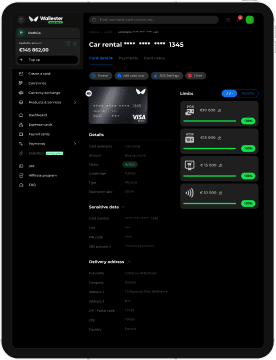
Wallester Business is a comprehensive payment platform that helps companies maintain tight financial control after credit decisions have been finalised. The platform does not perform customer credit scoring or credit bureau checks. It serves as a tool to manage company spending and monitor outgoing trade credit payments.
The platform provides business accounts and corporate cards that offer complete transaction visibility. Finance managers use real-time spending data and automated expense management to track company outlays instantly. Accounting integrations allow smooth data sync with existing credit management systems. Multi-user access and financial transparency help teams monitor cash flow and invoice collection processes. By utilising transaction reports and payment monitoring from Wallester Business alongside your credit policy, your team maintains comprehensive financial oversight.
Explore how Wallester Business supports payment monitoring, transaction reporting, and financial management alongside existing credit management processes to secure complete visibility across company finances.