This article outlines key accounts payable KPIs, and their practical application in finance reporting. It explains how tracking these metrics assists organisations in monitoring cash flow, assessing transactional processing efficiency, and preparing structured accounts payable reporting documents for corporate leadership.
Accounts payable performance requires measurable indicators. Poor visibility over invoice and payment activity disrupts corporate cash planning, weakens supplier relationships, and distorts final financial reporting. Tracking key indicators lets finance departments identify operational friction points before they damage supplier trust. Consistent observation of transaction pipelines helps the business secure better supplier payments terms and maintain cash flow control.
Which accounts payable KPIs should finance teams track?
Finance teams should track invoice processing time, cost per invoice, on-time payment rate, invoice exception rate, duplicate payment rate, payment error rate, and early payment discount capture rate.
These accounts payable KPIs show processing efficiency and financial health. Measuring invoice processing time reveals where invoices stall. Tracking cost per invoice highlights manual expense weights, while monitoring on-time payment rate supports healthy supplier relationships. High invoice exception rates indicate purchase order mismatches. Duplicate payment rate and payment error rate check payment accuracy. Capturing early payment discounts lowers procurement costs.
According to the HM Land Registry prompt payment report 2025 to 2026, the organisation maintained a 100% on-time payment rate for invoices paid within 30 days in multiple quarters. This standard highlights the efficiency achievable through structured payment schedules.
Q&A: Does every finance team need to track the same AP KPIs?
KPI selection reflects transaction volume, payment processes, and corporate finance priorities. Small enterprises prioritising cash preservation focus on early payment discounts, whereas larger organisations processing thousands of monthly invoices prioritise invoice exception rates and automation efficiency to monitor structural workflow friction.
Further Reading: The Complete Guide to Accounts Payable Automation: Process, Tools, and ROI
How do you measure accounts payable performance?
Measure accounts payable performance by establishing baseline metrics over defined reporting periods, checking data consistency across accounting records, and tracking performance trends.
Finance teams compare AP metrics across defined reporting periods to identify operational trends. This process requires precise tracking of invoice volumes and payment volumes. Establishing KPI baselines allows the business to measure progress over time. System data from accounts payable reporting tools must align with core accounting records to maintain data consistency. Analysing these indicators helps teams understand if AP automation tools are functioning correctly.
How to build an AP KPI reporting process
- Define standard reporting periods such as monthly cycles.
- Extract invoice volumes and payment volumes from accounting systems.
- Establish baseline metrics for processing time and cost.
- Compare current metrics against historical baselines.
- Review data consistency between systems and the ledger.
- Share reports with finance managers and CFOs.
Q&A: How often should AP metrics be reported?
Monthly reviews suit operational teams tracking invoice volumes and payment cycles. Quarterly reviews serve senior leadership focusing on strategic trends like cost per invoice. Real-time monitoring of cash-sensitive metrics like on-time payment rate helps to maintain daily working capital balance.
Further Reading: AP Fraud Prevention: Practical Strategies for Safer Business Payments
What do AP metrics reveal about payment processes?
AP metrics reveal operational issues, approval delay points, vendor management friction, payment inaccuracies, and missed financial savings across your payment workflows.
Performance data exposes hidden cracks in your daily operations. For instance, when invoice cycles drag, approval chains have likely stalled or manual data entry has slowed down. Frequent invoice exceptions signal mismatches between purchase orders and bills. If on-time payments drop, check for cash constraints or chaotic schedules. Duplicate payments expose weak ledger controls, while missed discounts point to sluggish validation cycles.
| Metric change | Possible process issue | What to review |
| Rising invoice processing times | Delays in internal approvals | Approval rules and staff response times |
| High exception rates | Mismatches between invoices and orders | Matching procedures and supplier compliance |
| Falling on-time payment rates | Processing delays or cash constraints | Approval speed and cash schedules |
| High duplicate payment rate | Lack of automated checks | Invoice receipt channels and controls |
| Low early payment discount capture | Slow invoice validation cycles | Discount terms and processing speed |
| High payment error rate | Weak verification or entry errors | Details verification and file generation |
Q&A: Can AP metrics identify payment fraud?
These metrics indicate process weaknesses and do not directly prove fraud. A sudden rise in duplicate payment rates or payment error rates suggests workflow vulnerabilities where fraud could happen. Finance departments must use dedicated fraud prevention controls to verify supplier bank changes and authenticate payment files.
How does Wallester Business support AP reporting and payment visibility?
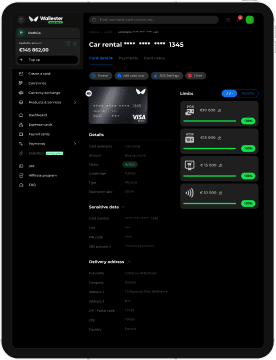
Wallester Business helps finance teams capture clean, instant payment data and provides real-time transaction visibility for card expenses. Using physical and virtual corporate cards allows organisations to track and control employee spending. The platform provides card-level spending limits and detailed user controls to prevent unauthorised outlays.
Receipt management tools let employees upload invoices immediately, matching them to transaction data. Integrating this corporate card payment data directly with accounting platforms maintains accounting data consistency. Teams export transaction reports to their main systems, helping with accounts payable reporting. The API capabilities facilitate secure data transfer.