This guide outlines accounts payable fraud schemes, highlighting effective AP fraud prevention methods. It explains practical supplier verification, invoice validation, and payment fraud detection techniques. This analysis provides a clear understanding of spend controls, financial oversight, and business payment security practices to protect capital.
Unauthorised outgoing transactions present major risks to modern companies, making business payment security an immediate priority for finance leaders. Financial departments face complex risks when processing corporate expenditures, from altered supplier invoices to internal misappropriation. Implementing structured payment fraud detection processes throughout the purchase cycle protects corporate assets. Clear, multi-step review procedures protect the business, making sure payment processing remains completely accurate and free from deceptive interference.
What are the most common types of AP fraud?
Accounts payable fraud is an illegal activity where criminals or employees manipulate business payment processes to steal corporate funds.
Invoice fraud occurs when fake bills are submitted for services never delivered, bypassing standard checks. Business email compromise represents an even larger threat. TheUK Finance Annual Fraud Report 2026 indicates that criminals stole £1.28 billion through payment fraud in 2025. Bad actors compromise legitimate email corporate accounts to send requests that redirect company transfers.
Supplier impersonation and banking alterations also lead to high losses, where criminals intercept vendor communications. Internal employee fraud and deceptive phishing emails further compromise payment systems.
| Fraud type | Common warning signs | Possible impact |
| Business email compromise (BEC) | Discrepancies in sender email addresses, sudden bank detail changes, urgent payment requests | Extreme financial loss and direct payment redirection |
| Invoice fraud | Mismatched purchase orders, missing vendor details, rounded total amounts, manual invoice overrides | Unauthorised funds leakage and cash flow depletion |
| Supplier impersonation | Unverified calls confirming account modifications, altered PDF invoices, requests to bypass protocols | Large-scale payments routed to illicit accounts |
| Duplicate payments | Identical billing numbers, multiple invoices for a single purchase order, similar currency amounts | Overpayment of suppliers and financial tracking errors |
Q&A: Are duplicate payments always fraudulent?
No, many duplicate payments stem from clerical entry errors, manual receipt processing, or system synchronisation issues. Bad actors occasionally exploit these administrative mistakes to disguise deliberate duplicate payments, making regular invoice verification and automated matching systems necessary to prevent financial losses.
Further Reading: Accounts Payable Metrics and KPIs: What Finance Teams Should Track
How can businesses strengthen payment fraud detection?
Businesses strengthen payment fraud detection by establishing supplier verification protocols, segregating duties, and performing three-way matching.
Payment fraud detection relies on rigorous verification during supplier onboarding. When vendors request detailed modifications, finance departments must perform independent vendor verification. TheUK Finance Half-Year Fraud Report 2025 indicated that criminals stole £629.3 million through authorised and unauthorised fraud in the first half of 2025. This shows the critical need for tight review procedures.
Enforcing strict invoice verification and monitoring database change logs protects company accounts from unauthorised administrative overrides.
Six practical AP fraud prevention measures:
- Verify new supplier onboarding details independently.
- Enforce strict segregation of duties.
- Require three-way matched invoice verification.
- Implement tight user permissions.
- Employ automated accounts payable automation.
- Audit bank change logs quarterly.
Q&A: Should every supplier bank account change require verification?
Yes, verifying every account modification is a core defence against payment fraud. Fraudsters frequently intercept legitimate business emails and present fake bank change letters. Confirming these requests through an independent, secondary contact method prevents funds from being sent directly to criminal accounts.
Further Reading: The Complete Guide to Accounts Payable Automation: Process, Tools, and ROI
Which payment controls help prevent AP fraud?
Effective payment controls comprise transaction limits, multi-level payment approval workflows, virtual corporate cards, real-time transaction monitoring, and role-based permissions.
Active spending controls are essential to manage corporate risks. Setting specific payment limits on physical and virtual corporate cards prevents unapproved large-scale outlays.
A secure payment approval workflow mandates multi-level approvals for all high-value transactions. This blocks single-user overrides. Virtual corporate cards isolate transactions, keeping individual vendor details secure, while real-time transaction monitoring permits swift payment monitoring.
| Payment control | Fraud risk addressed | Business benefit |
| Spending limits | Uncontrolled employee spending and large unauthorised bank transfers | Sets clear spending boundaries and prevents massive capital losses |
| Multi-level approvals | Single-user overrides and unauthorised internal payments | Establishes a multi-step audit path and collaborative oversight |
| Virtual corporate cards | Card credential theft and merchant overcharging | Isolates payments to single vendors and blocks extra charges |
| Real-time monitoring | Slow response to unauthorised transactions | Allows immediate discovery of suspicious activity and fast card freezing |
Further Reading: Vendor Management: Onboarding, Communication, and Payment Methods
How does Wallester Business support AP fraud prevention?
Wallester Business provides companies with an integrated platform to govern business spending, heightening payment control and transaction visibility. While not dedicated fraud detection software, the platform serves as a spend management system that strengthens overall business payment security and aids in AP fraud prevention.
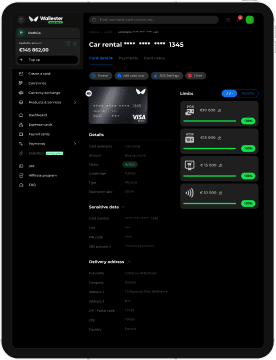
Through the system, companies issue virtual corporate cards and physical corporate cards to employees. Each card is configured with custom spending limits and merchant category controls, stopping unauthorised usage before it occurs. The system features strict approval controls, allowing managers to approve card funding requests as they arise. Real-time transaction visibility allows finance teams to monitor card activity immediately. Every transaction is logged instantly, permitting instant card freezing if suspicious activity is spotted.
Employee card management is backed by automated receipt collection, where staff upload invoices directly via a mobile app. This links proof of purchase to the ledger, simplifying invoice verification and making sure duplicate payments are avoided. User roles and permissions restrict system access to authorised personnel.