A business almost never looks the same from one year to the next. Take a freelancer as an example. A freelancer takes on a regular client, then a second, and then hires someone to help. Or a small team that adds a department, a few contractors, and a budget that suddenly needs managing. Growth is the whole point of the exercise, and yet the tools a business runs its money through often treat each of these steps as a reason to change or rebuild your finance setup.
Let’s dive into this more concretely. Consider a freelance designer who has been invoicing a handful of clients and paying for a few subscriptions on a single card. But now she takes on two employees and a contractor. Almost overnight she needs shared cards, spending limits, someone else able to see the numbers, and a way to approve what gets bought before it gets bought.
The structure that worked last month simply no longer fits, and the standard advice is the same one she heard when she started: go and find the right tool for where you are now. A year later, when she has fifteen people and a finance hire, she will probably hear it again.
The Real Cost of Switching Isn’t the New Tool
Moving to a new finance system is rarely as clean as the sales page suggests. Account history has to be exported and re-imported, or quietly abandoned. Cards get reissued, which means every subscription and every ad account tied to the old numbers has to be found and updated by hand, while the ones that get missed fail at the worst possible moment. People have to learn a new interface and still do their job. So for a week or a month the business runs on two systems at once, trusting neither of them completely.
None of that appears on a pricing page, and all of it draws down the one resource a growing business has least of, which is time and attention. The finance lead who spends a fortnight migrating tools is a finance lead not chasing revenue or tightening margins.
The deeper problem is that this is not a one-off tax. It tends to happen again and again. The tool that suits a solo freelancer gets outgrown by a five-person team. The one built for a small team strains under fifty. If every stage of growth triggers another migration, a business ends up paying the switching cost repeatedly, and it pays it precisely because things are going well. Success becomes the trigger for disruption, which is a strange way for financial infrastructure to behave.
One System That Changes Shape as You Grow
There is a more rational way to set this up. It’s to choose one system that changes shape as the business does, so the account a freelancer opens is the same account the fifty-person company still uses. What changes over time is not the platform but how much of it is switched on.
At the start, a freelancer might use only the essentials: an account, a card, and a clear view of what is being spent. When the first employees arrive, teams and roles can be added in place, without moving anything. When spending starts to need oversight, budgets and approvals come into play. Through all of it the transaction history stays intact, the existing cards keep working, and nobody has to relearn the tool from scratch. Capabilities a business does not need yet stay out of sight until the day it does, at which point they are already there.
What Grows With You, From Day One
Wallester Businessis built around exactly this idea, so the same account serves a freelancer and the company that freelancer eventually becomes.
From day one, a business can:
- Open a business account with its own IBAN, with no subscription needed to get started
- Issue virtual and physical cards for one person or a whole team, adding more as it hires
- Create teams and departments, assign roles, and set budgets when the structure calls for it
- Set spending limits and controls on every card, from the first one issued to the fortieth
- Add approvals so the right person signs off on spending, once informal control stops being enough
- Hold and pay in 10 currencies, and sync everything with Xero or QuickBooks
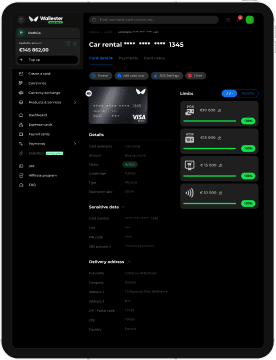
- Manage all of it from one dashboard, on web or mobile
The account, the cards, and the basics are free to open, with premium plans for businesses that need more.
Plenty of things a growing business depends on will need replacing along the way: a bigger office, more people, heavier suppliers. The system it runs its money through does not have to be one of them. When finances grow by adjusting a setting rather than by switching platforms, growth stops being the event that breaks the setup and becomes the thing the setup was designed to absorb.