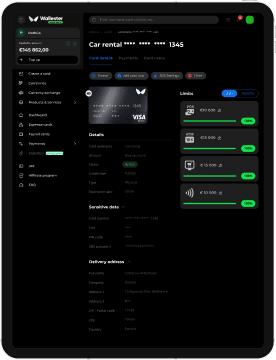
Choosing between Wallester Business and Revolut Business starts with the work your finance team needs to do. An agency may need a separate card for each advertising campaign. A company paying overseas suppliers may care more about transfer allowances, while its accountant needs receipts and transaction records in the right place.
Wallester combines a business account and Visa cards with expense management. Revolut combines business accounts with international payments, cards and additional business tools. This comparison examines their allowances, controls and fees for UK company owners and finance teams.
Wallester’s published tariffs are shown in EUR; Revolut’s UK tariffs are shown in GBP. Prices have not been converted, and similarly positioned plans are not identical packages.
Business Accounts, Cards and Payments: What Are You Comparing?
A business account holds company funds, while card and expense tools control how employees spend and record them. A company may need both functions in one service or use a spending platform alongside its existing bank.
Wallester Business provides a business account with IBAN, multi-currency balances and currency exchange alongside its cards and expense tools. Its personal vIBAN availability depends on industry and country of incorporation. Confirm the account details and permitted funding routes for your UK company before arranging a transfer. Holding a GBP balance does not by itself establish that you receive a UK sort code and account number.
Revolut Business supports local and international payments. Its UK bank-account terms describe a GBP current account with sub-accounts in other available currencies. Revolut also offers invoicing and merchant payment acceptance, subject to separate conditions and processing fees.
Wallester AS is an Estonian licensed payment institution. Revolut Bank UK Ltd provides business current accounts with FSCS protection for eligible deposits, subject to the scheme’s limits and exclusions. Revolut’s transition guidance says those bank terms apply when an account moves from Revolut Ltd to Revolut Bank UK Ltd. Check the provider and protection stated in your own agreement before deciding where to hold operating cash.
Which Should You Shortlist?
A large pool of cards. Wallester is worth shortlisting when you want a separate card for each ad campaign or software subscription. Its Free plan includes 300 virtual cards, so a team can test that structure before taking on a monthly platform subscription.
International Supplier Payments. Revolut is worth shortlisting when transfer destinations and a wider choice of currency balances determine your requirements. Its paid tiers increase payment and exchange allowances and add approval controls.
Expense Records for Your Accountant. Both providers connect to Xero and QuickBooks. Test a purchase and its receipt through the connection your team will use, then compare the subscription and any extra charges for that workflow.
Wallester Business vs Revolut Business at a Glance
| Feature | Wallester Business | Revolut Business – UK |
|---|---|---|
| Business account | Business account with IBAN; personal vIBAN eligibility depends on industry and country of incorporation. | UK business account with local and international payments; check the provider named in your agreement. |
| Currency balances | 10 supported currencies. | 25+ supported currencies. |
| Virtual cards | 300 included in Free; larger company allowances on paid plans. | 50 active virtual cards per team member and 50 active company cards; applied limits are shown in-app. |
| Physical cards | Free issuance; delivery charges apply. | Up to three active physical cards per team member; delivery and additional-card fees may apply. |
| Team access | Unlimited users; roles and permissions. | Unlimited team access; custom account permissions depend on plan. |
| Subscription | Free, Premium, Platinum and custom Enterprise plans, priced in EUR. | Basic, Grow, Scale and custom Enterprise plans, priced in GBP. |
| Spend management | Card and account limits, transaction visibility and receipt collection. | Card controls on all plans; custom spend and expense approvals from Grow. The Expenses app has a separate charge. |
| Accounting connections | Direct Xero and QuickBooks Online connections, plus API access. | Xero and QuickBooks integrations; Business API from Grow. |
Card allowances use different units. Wallester’s plan allowance is a company allocation; Revolut lists limits for each team member and for company cards. Compare the number and ownership of the cards you need before treating those figures as equivalent.
Wallester pricing: start with card volume
| Wallester plan | Monthly subscription (EUR) | Included virtual cards | Additional virtual card per month |
|---|---|---|---|
| Free | €0 | 300 | €0.35 |
| Premium | €199 | 3,000 | €0.20 |
| Platinum | €999 | 18,000 | €0.10 |
| Enterprise Suite | Custom | Custom | Agreed individually |
Free means no monthly subscription for that plan. Card delivery, funding and currency conversion can still affect the amount you pay. An industry fee applies in certain cases. Published delivery prices are €5 for standard delivery and €20 for express delivery.
Funding charges depend on the route and currency you use. Check the applicable tariff for your UK company’s account before funding it regularly.
Use the Wallester price list to build a budget around the transactions you expect. Include the cost of getting funds into the account and spending in the currencies your suppliers charge.
Revolut Pricing: Separate Billing Terms and Usage
| Revolut UK plan | Monthly billing | Annual billing | Monthly FX allowance |
|---|---|---|---|
| Basic | £10 | Not listed in the current fee schedule | £1,000 |
| Grow | £35 | £360/year (£30/month equivalent) | £15,000 |
| Scale | £125 | £1,080/year (£90/month equivalent) | £60,000 |
| Enterprise | Custom | Custom | Custom |
The advertised starting prices of £30 for Grow and £90 for Scale are monthly equivalents of the annual charges. A company paying month by month should budget for £35 or £125 respectively.
Team invitations are unlimited. The Expenses app costs £8 per active member per month; under the fee schedule, a member becomes active after submitting their first expense and remains active until access is removed.
Basic, Grow and Scale include 10, 100 and 1,000 UK domestic payments respectively per billing cycle; additional payments cost £0.20. International payments have separate allowances and charges. A business with frequent supplier transfers should model these alongside its subscription.
Cards and Spend Controls: Match the Structure to the Work
For an agency, a separate card for each advertising project can make ownership and budgets easier to track. For a software company, one card per subscription can make renewal costs easier to identify. Wallester’s company-level virtual-card allowance is useful for these patterns, particularly where the number of cards is much larger than the number of employees.
Wallester provides individual card and account limits, user roles, transaction records and receipt tools. Merchant restrictions are also listed, with activation handled through the client relationship manager. Ask to see the exact controls you plan to use in a demonstration.
Revolut also supports virtual and physical cards, with controls for limits, categories, accounts, currencies and spending periods. Custom spend and expense approval workflows are listed from Grow upwards. Its per-member card allocation can suit teams organised around employees who each need their own purchasing access.
For either platform, test a small set of real purchases before moving a critical campaign or recurring service. Card availability is not a promise that every merchant will accept every transaction. Check who can create cards, change limits and remove access when an employee leaves.
Currency Exchange: Compare the Transaction You Will Make
Currency exchange within an account and conversion during a card payment are different operations. Wallester supports currency exchange, but the cost depends on the operation and the relevant tariff conditions. Check the quoted rate and applicable fee for your intended transaction. Avoid treating a free account subscription as a promise of free conversion.
For regular foreign-currency purchases, examine the cost of funding the relevant balance as well as the charge when a card payment requires conversion. A low exchange fee can be outweighed by the cost of repeatedly topping up in another currency.
Revolut uses its variable interbank rate with applicable fees. Exchange above the plan allowance incurs a 0.6% fee, and exchange outside standard FX market hours incurs a 1% fee.
Build a representative month with the currencies received, amounts converted and payment dates. Include any outgoing transfer costs. Compare the amount that reaches the destination after all relevant fees.
Accounting Integrations and the Month-End Workflow
Wallester offers direct connections to accounting software, including connections to Xero and QuickBooks Online through the Client Portal. Its documented workflow lets you choose accounts, map categories, suppliers and tax codes, review transactions and then sync selected items or a batch. That gives finance staff a review step before posting data to the accounting system.
An API is available for custom integrations, alongside the direct connections. Confirm any accounting system other than Xero and QuickBooks Online with Wallester before you rely on it.
Revolut lists accounting integrations, including Xero and QuickBooks, across its plans; Business API access starts at Grow. Its optional Expenses app is a separate part of the cost calculation.
A useful trial follows one purchase all the way through: payment, receipt, categorisation, export and reconciliation. Check that your accountant receives the tax treatment and attachments they need, and establish how corrections will be handled. A connector logo alone cannot answer those workflow questions.
Advantages and Trade-Offs
Wallester Business
Advantages:
- 300 virtual cards are included in the Free plan.
- Users are unlimited.
- Receipts attach to transactions, and the Xero and QuickBooks Online sync runs from the Client Portal.
Trade-offs:
- 10 supported currencies against Revolut’s 25+.
- Personal vIBAN eligibility and the funding routes available to a UK company need checking.
- A free subscription does not remove funding, delivery or card-conversion costs.
Revolut Business
Advantages:
- 25+ currency balances against Wallester’s 10, plus local and international payments.
- Unlimited team invitations, with cards and accounting connections available across the plan range.
- Higher tiers provide larger payment and exchange allowances and additional approval controls.
Trade-offs:
- A subscription is required, with different monthly and annual billing options.
- Expenses charges increase the bill as more people use that app.
- FX allowances, market hours and payment charges affect costs as transaction volumes change.
Which Is a Better Fit for Your Business?
An Agency Managing Many Advertising and Software Purchases
Start by testing Wallester if your main operational problem is keeping a large number of cards organised. Map each card to a responsible person or project, agree its spending limit and confirm the funding currency. The Free allowance can support that pilot without a subscription commitment.
A UK Company with Frequent International Supplier Payments
Evaluate Revolut’s currency coverage and transfer allowances against your usual destinations and monthly volumes. Check your agreement and quote for the payment routes you intend to use. Choose using the complete funding-to-payment cost and the account details your suppliers require.
A Growing Team That Needs Clearer Expense Ownership
Test both providers with your finance team. Decide whether card limits and receipt records meet your needs, or whether a purchase also needs a formal approval chain. Wallester provides card controls and receipt tools; Revolut lists custom spend and expense approvals from Grow. Include Revolut’s active Expenses users in the cost of that workflow.
A Business Keeping Its Existing Main Bank
Either platform can be assessed for a defined role alongside an existing account. A limited card pilot lets you check reconciliation and spending controls before changing wider operations. Consider the extra administration and funding transfers created by running more than one provider.
Further Reading: Wallester Business vs Pleo: Which Spend Tool Works Best in 2025?
Put Your Own Spending Workflow to the Test
If your team needs more control over cards and business spending, start with a small set of representative purchases. Confirm account eligibility and fees, set user permissions and spending limits, and take the transactions through to reconciliation.
Explore Wallester Business to see how its business account, cards and expense tools fit the way your team spends.
Frequently Asked Questions
Wallester Business has a Free plan with no monthly subscription and 300 included virtual cards. Delivery, certain funding methods, currency conversion and other operations can carry charges. Budget from the price list and your intended usage.
Wallester Business provides a business account with IBAN. Personal vIBAN availability depends on the industry and country of incorporation. Confirm the account details and funding routes available to your UK company before transferring money.
Revolut Business monthly billing is £10 for Basic, £35 for Grow and £125 for Scale. Grow also costs £360 per year and Scale £1,080 per year, equivalent to £30 and £90 per month when paid annually. Enterprise pricing is agreed individually, and transaction or app charges can add to the subscription.
Revolut Business allows unlimited team invitations without a separate invitation charge. The Expenses app has its own fee of £8 per active member per month. Under the fee schedule, submitting a first expense activates that member for billing until access is removed.
Revolut lists a limit of 50 active virtual cards per team member and 50 active company cards. The limits applied to an account can be checked in the app. Wallester uses a different measure: its Free plan includes a company allowance of 300 virtual cards.
Wallester and Revolut both offer connections to Xero and QuickBooks. Wallester documents a Client Portal workflow in which you map records, review transactions and trigger a sync. Check that the connection carries the data and receipt records your accountant needs.
Wallester Business supports 10 currencies, while Revolut Business lists 25+ for account balances. The number of currencies available for a card purchase can differ from the number you can hold in an account. Check the balances and payment currencies needed for your suppliers before choosing a provider.
Revolut Bank UK Ltd provides UK business current accounts, but check the entity named in your own agreement. Revolut says its bank-account terms apply when an account transitions from Revolut Ltd to Revolut Bank UK Ltd. Eligible deposits with the bank are protected by the FSCS, subject to its limits and exclusions.