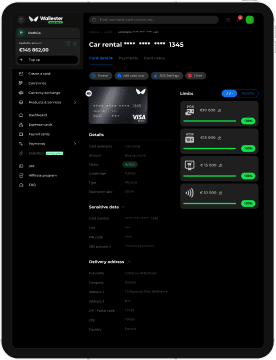
This article explains the main principles of REST API design for card issuing platforms. It covers endpoint structure, HTTP methods, request and response formats, authentication, versioning, error handling and developer practices that support reliable API integrations for virtual and physical payment cards.
Developers often form an opinion about an API after the first few requests. Confusing endpoint names or inconsistent responses slow integration from the outset. A well-designed REST API follows clear conventions, so each request behaves as expected and the documentation answers questions instead of creating them. That consistency becomes even more valuable as new endpoints and features are added.
What makes a well-designed REST API for card issuing?
A well-designed REST API for card issuing establishes predictable contracts between fintech applications and payment processing engines.
It structures payment card operations around clear resources while enforcing security protocols and deterministic execution across card creation and management workflows.
Resource-oriented architecture forms the foundation of modern payment card APIs. Every entity, such as a card, cardholder, account or transaction, receives a distinct URI path using plural nouns rather than action-oriented verbs. Operations perform actions through HTTP methods, keeping endpoint URIs simple and readable. Predictable URI structures allow backend engineers to navigate card lifecycle management routines intuitively.
API authentication relies on secure protocols such as Bearer tokens, OAuth 2.0 or Mutual TLS to restrict resource access. According to the PCI Security Standards Council, payment security requirements under PCI DSS v4.0.1 emphasise strict access management and continuous authentication across API endpoints to safeguard account data during execution. Major versioning numbers belong in the URI path to prevent breaking changes when updating schemas. Idempotency keys in request headers prevent accidental re-execution of payment commands during network retries.
| API element | Good practice | Example |
| Endpoint | Use plural nouns for resources | /cards/{id} |
| Method | Align HTTP methods to standard actions | GET retrieves data, POST creates resources |
| Patching | Update selected fields partially | PATCH modifies limits or status |
| Deletion | Remove or deactivate resources safely | DELETE revokes a card token |
| Versioning | Indicate major versions in URI path | /v1/cards |
Q&A: Why does endpoint consistency matter?
Consistent naming helps developers understand API behaviour without reading extensive documentation for every resource.
Which endpoints and HTTP methods should a card issuing API include?
A comprehensive card issuing API exposes dedicated endpoints for cardholder onboarding, card creation, card lifecycle management and real-time balance enquiries. Using standard HTTP methods allows backend engines to execute state changes, manage card activations and retrieve transaction histories safely.
Payment card API design requires clear separation between resource paths. Card issuance endpoints accept details to mint virtual card instances or order physical cards. Lifecycle management endpoints control card states, allowing applications to activate new plastic, suspend compromised cards or terminate expired credentials. Account endpoints handle cardholder records, balance checks and token management for mobile wallets. Webhook registration endpoints allow client platforms to subscribe to asynchronous transaction events.
Typical REST endpoints include:
- POST /cards – Issue a new payment card
- GET /cards/{id} – Retrieve details for a card
- PATCH /cards/{id} – Update card controls or status
- POST /cards/{id}/activate – Activate a physical card
- POST /cards/{id}/freeze – Suspend card permissions
- GET /transactions – Fetch card transaction records
Predictable endpoint naming limits integration friction and implementation errors. When paths follow a clear hierarchical pattern like /cards/{id}/tokens or /cardholders/{id}/cards, backend developers infer URI paths without referencing documentation constantly. Custom state transitions use verb sub-resources attached to the primary noun resource to maintain RESTful principles.
Q&A: How do custom actions fit into standard REST endpoints?
Custom actions like card activation or freezing use verb sub-resources attached to the primary noun resource, such asPOST /cards/{id}/freeze.
Further Reading: Developer’s Guide to Card Issuing APIs: Architecture, Integration, and Best Practices
How should API responses and error messages be structured?
API responses and error messages must maintain uniform JSON structures across success payloads and failure conditions. Standardised JSON schemas with explicit error objects, ISO-8601 timestamps and correlation identifiers enable client applications to parse system states and handle errors gracefully.
Consistent JSON API responses use predictable field naming conventions, such as camelCase or snake_case, across all endpoints. Success payloads return requested resource objects alongside metadata, timestamps and pagination attributes for large transaction lists. Structured error objects contain actionable details, including error codes, affected parameters and user-friendly error messages that aid fast debugging.
Data published in Visa Developer Documentation demonstrates that standardised callback payloads maintain processing efficiency across authorisation decisions and high-volume transaction searches. Standard HTTP status codes communicate transaction outcomes clearly: 200 OK for successful requests, 201 Created for new cards, 400 Bad Request for validation errors, 401 Unauthorised for bad API keys, and 500 for internal gateway issues. Guidelines from IETF RFC 8594 highlight header standards like Sunset to signal upcoming API resource deprecation cleanly to client applications.
| Response type | HTTP status | Recommended content payload |
| Success | 200 OK / 201 Created | Resource ID, status string, ISO timestamps, payload data |
| Validation error | 400 Bad Request | Error code, field name, actionable description |
| Authentication error | 401 / 403 | Error status code, security message, correlation ID |
| Server error | 500 Internal Error | Generic error code, system request ID, help link |
Q&A: Why should API error objects include a correlation ID?
A correlation ID links client-side failures to internal server log traces, accelerating troubleshooting during payment processing errors.
How Wallester White-Label supports card issuing API integration
Wallester White-Label provides a REST API designed for swift deployment of custom card programmes. The platform supports virtual and physical card issuance, full card lifecycle management, transaction management and structured authentication within a scalable card issuing infrastructure.
Engineering teams access developer documentation alongside a sandbox environment to test REST API endpoints, configure webhook support and evaluate payload structures before live deployment. This clean architectural setup allows seamless integration with existing banking or fintech platforms while maintaining compliance across payment operations.
Organisations that plan card issuing projects benefit from an API that follows predictable design principles and supports efficient integration. Wallester White-Label provides a REST API, developer documentation and a sandbox environment that help engineering teams build and launch card programmes with confidence.