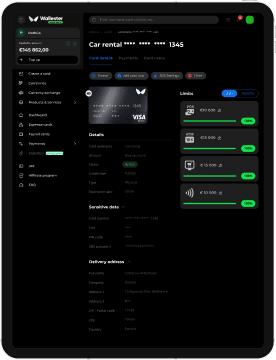
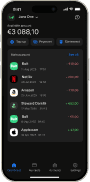
Andrey Davidovich is Wallester’s Head of Design. He joined in 2024 and built Wally, the design system that now runs across the entire B2B card-issuing platform, the merchant tools, and the partner-facing products.
He brings more than fifteen years in design, with senior roles at Accenture, Revolut, Gcore and Superside, and earlier brand work for the likes of Porsche, Diageo and Red Bull. At Gcore he grew a design team from three people to fifteen. Alongside his in-house work, he runs a strategic design practice for fintech, SaaS and Web3 companies from Tallinn.
In this interview, Andrey talks about what a design system actually does for a company, why so many fintechs are starting to look alike, how AI is changing the way his team works, and what design leadership means when a small team can ship what used to take a large one.
Interviewer: You’re Head of Design at Wallester. For someone outside the field, what does that role actually cover day to day?
Andrey: Honestly, it’s less about designing screens and more about designing the conditions for good design to happen. I lead three teams: Product Design (Mobile App and Client Portal), Growth Design and Brand Design, eleven designers in total.
My time goes to three things: people (one-to-ones, critiques, hiring), product (deciding with product and engineering what we build next and making sure it feels like one platform), and the standards that let eleven people work as one team. In short, my job is to make sure every detail a customer sees was decided on purpose, not by accident.
Interviewer: You built Wally, the Wallester design system. What is a design system, in plain terms, and what problem does it solve inside a company like ours?
Andrey: A design system is a shared language for building the product. On the surface it’s a library of components, designed once and built once in code. Underneath, it’s the rules: spacing, colour, typography, how we write an error message. Wally is ours.
Without a system, every team solves the same problem slightly differently. You end up with five date pickers and three shades of blue, and customers feel that as a less trustworthy product. In finance, trust is everything. Wally lets us move faster, keeps quality consistent and frees designers for the problems that are actually new.
Interviewer: You’ve led design at Accenture, Revolut, Gcore and now Wallester. What’s different about designing for a B2B card-issuing platform compared with a consumer app?
Andrey: The biggest difference is who you’re designing for. A consumer app has one user. At Wallester there are layers: the business building a card programme on top of us, their operations teams who live in the Client Portal, and cardholders who often see our product under our client’s brand.
Consumer design optimises for delight and retention. B2B card issuing optimises for confidence and control. An ops manager freezing a hundred cards doesn’t want charm. They want to finish quickly and know they got it right, because mistakes cost real money. Here, the delight is in things working exactly as expected.
Interviewer: A lot of your work is making complex financial products feel simple to use. Where does that difficulty usually come from, and how do you deal with it?
Andrey: Mostly from everything behind the user’s task: regulation, card scheme rules, legacy banking rails and often the company’s own org chart. If three teams own three parts of a process, the customer usually sees three screens.
You can’t delete that complexity, but you can decide where it lives. I start from what the person is trying to achieve and push the rest down a layer: sensible defaults, plain language, detail only when it’s needed. And we listen to support and operations, because every recurring ticket is a design brief.
Interviewer: You’ve said every fintech is starting to look the same. Why is that happening, and does it matter?
Andrey: Open five fintech apps and you’ll see the same soft gradients, rounded cards and friendly micro-copy. The industry optimised for safety: teams copy what converts, templates spread the same patterns, and now AI generates the average of everything that exists. The brief quietly becomes “make it look like Stripe”.
It matters because features have converged. When products work the same, what’s left to choose and trust one is how it feels. For Wallester that’s a double question: how we stand out, and how we help clients build card products that feel like their own.
Interviewer: How do you balance a consistent system against the freedom designers need to solve a new problem well?
Andrey: The rule on my teams is simple: use the system by default, break it on purpose. If a designer needs something Wally doesn’t do, that’s a signal, not a violation. Either the problem is unique or the system has a gap. The designer makes the case, we test it, and if it holds up it goes back into Wally for everyone.
What I push back on is breaking it for taste alone. Consistency is something customers feel, even when they can’t name it.
Interviewer: At Gcore you grew a design team from three to fifteen. What changes about the work when a team scales like that?
Andrey: At three people, design is a conversation: everyone knows everything and quality comes from individuals. At fifteen, context stops travelling on its own, and without structure you get fifteen versions of the product.
So the work shifts from doing design to designing the team. At Gcore that meant a design system for 25+ products and 500+ components, clear rituals like critiques and design reviews, leads who owned their areas, and hiring for gaps. The hardest shift is personal: you start measuring yourself by how good the work is when you’re not in the room.
Interviewer: How do you work with engineering and product so design is a decision at the start rather than a polish at the end?
Andrey: By showing up earlier and speaking the same language. Product, design and engineering look at a problem together from discovery, before there’s a spec, while ideas are still cheap to change.
I also frame design in business outcomes: fewer support tickets, faster onboarding, fewer operational errors. That’s what earns a seat in roadmap conversations. And at Wallester we’ve written down how design works, from discovery to design QA, so early involvement isn’t a favour. It’s simply how a feature gets made.
Interviewer: You’ve talked about AI collapsing the distance between design and engineering. What does that look like in your team’s actual work right now?
Andrey: We’re still early, and I’d rather be honest about that. But some things have changed. Designers now prototype close to real code: instead of a clickable flow with fake data, we can build a working prototype in a day or two and test something that behaves like the real product.
The design system matters even more, because when Wally exists as tokens and coded components, AI tools build with it consistently. There’s also less handoff with engineering and more working in the same material. What hasn’t changed is judgment. AI makes options cheap; choosing the right one is still the job.
What hasn’t changed is judgment. AI makes options cheap. Deciding which one is right for a business moving real money is still the job.
Interviewer: When a three-person team can ship what used to take thirty, what does design leadership become?
It becomes about judgment, not headcount. When a small team can ship what a large one used to, output stops being the constraint. Deciding what’s worth building becomes the constraint.
So the leader’s job is taste and standards, holding the line against “merely fine”. It’s direction, making sure a fast team is moving toward the right problem. It’s systems, the guardrails that let a small team move fast without the product falling apart. And it’s growing people who can make great calls on their own.
Interviewer: What’s your advice for a designer who wants to move from executing tasks to leading design?
Andrey: Start caring about why, not just what. A designer who leads asks what problem a task solves, for whom, and how we’ll know it worked. Sometimes the answer is “we shouldn’t build this”.
Learn how your company makes money, explain your work clearly to non-designers, own something beyond your tickets, and make the people around you better. My own path wasn’t conventional: I came from medicine and taught myself design from sixteen. What moved me into leadership was taking responsibility for outcomes before anyone asked.
Interviewer: Outside of work, what do you spend your time on?
Andrey: Mostly I’m on a bike. I’ve been riding competitively for more than seven years and usually do around 200 kilometres a week. In summer I ride every evening after work; in the off-season it’s more gym, boxing and indoor training.
I also co-founded TLN.CC, the Tallinn Cycling Club. Our line is “No race. No drop. Just the road.” Our Saturday social ride starts from Jahu, and it’s grown into a real community. I also run a small cycling apparel brand, PANGU, which does kit drops with the club, so even outside work I end up designing things.