Estimates of how European businesses use AI usually come from surveys, which record what executives say, or from vendors, which, of course, have commercial interest in the answer. Card data, on the other hand, shows something more concrete: what companies pay for, month after month, to keep their tools running.
That’s why we analysed card-settled payments to AI tools across Wallester Business accounts registered in France and Germany, EU’s two largest economies, between January and September 2026.
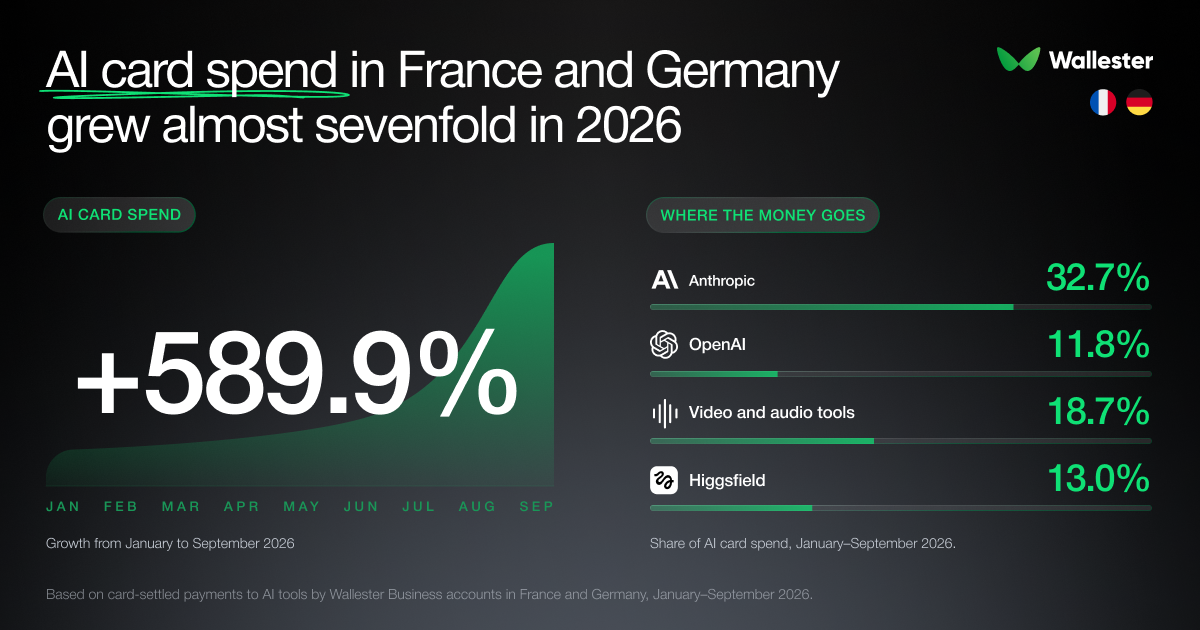
Over that period, monthly card spend on AI tools grew by 589.9%, to almost seven times its January level. What started the year as scattered individual subscriptions has clearly become a regular operating cost.
Anthropic leads on spend and on payments
Anthropic is now the largest single destination for AI card spend in those two markets. It accounted for 32.7% of the total, almost three times OpenAI’s 11.8%. It also led on the number of payments, with 31.1% of card charges against OpenAI’s 23.2%.
The two companies are paid for in very different ways. OpenAI’s share of spend is about half its share of payments: many small, fixed charges, the typical pattern of individual ChatGPT seats spread across a company. Anthropic’s shares of spend and payments are almost equal, which makes its average payment roughly twice the size of OpenAI’s.
The gap is widening. Monthly card volume to Anthropic grew by 615.1% between January and September, against 288.5% for OpenAI. Payments of that size point to team plans and usage-based billing, the way companies pay once a tool becomes part of daily work.
Coding tools take a growing share
Cursor, an AI code editor, took 10.6% of AI card spend and 8.1% of payments, after barely registering at the start of the year.
Its rise shows AI moving into the code editor itself, where developers spend most of their working day. It also brings usage-based charges that can change sharply from one month to the next.
Video and voice tools claim almost a fifth of spend
Generative video, voice and audio tools accounted for 18.7% of AI card spend. Higgsfield, a video generator, made up 13.0% on its own, with ElevenLabs at 2.4% and HeyGen at 1.3%.
These are tools for marketing and content work, from localised video to advertising assets, and companies are paying for them on business cards like any other software.
Germany spends more per payment
Growth was almost identical in the two markets: 592.5% in Germany and 584.7% in France, but the spending mix was not.
German accounts made 62.2% of payments but 70.5% of spend, so their average payment was larger. French accounts made 37.8% of payments and 29.5% of spend, a pattern of more subscriptions at lower values.
Mistral’s small footprint
Paris-based Mistral AI, Europe’s best-known AI model developer, accounted for 0.8% of AI card spend and 1.4% of payments across its two closest markets.
The low figure reflects how Mistral is sold. ChatGPT and Claude rely heavily on self-serve checkouts paid by card. Mistral’s models are widely bought through the major cloud platforms, and its open-weight models can run on a company’s own servers. That spending is usually billed on cloud invoices and never reaches a card.
Why AI is a hard line to budget
For finance teams, AI has become one of the hardest costs to manage. A single company can pay fixed monthly seats for one tool and usage-based charges for another, typically in US dollars. Auto-renewals and plan upgrades raise the bill without anyone signing off.
How does Wallester Business help?
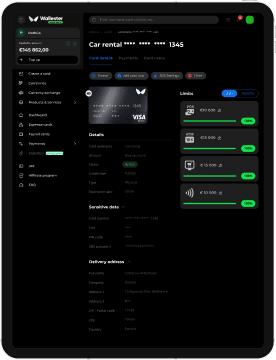
Wallester Business gives finance teams control over AI spending from the first payment:
- A dedicated virtual card for each AI tool, so every vendor’s charges sit on their own line.
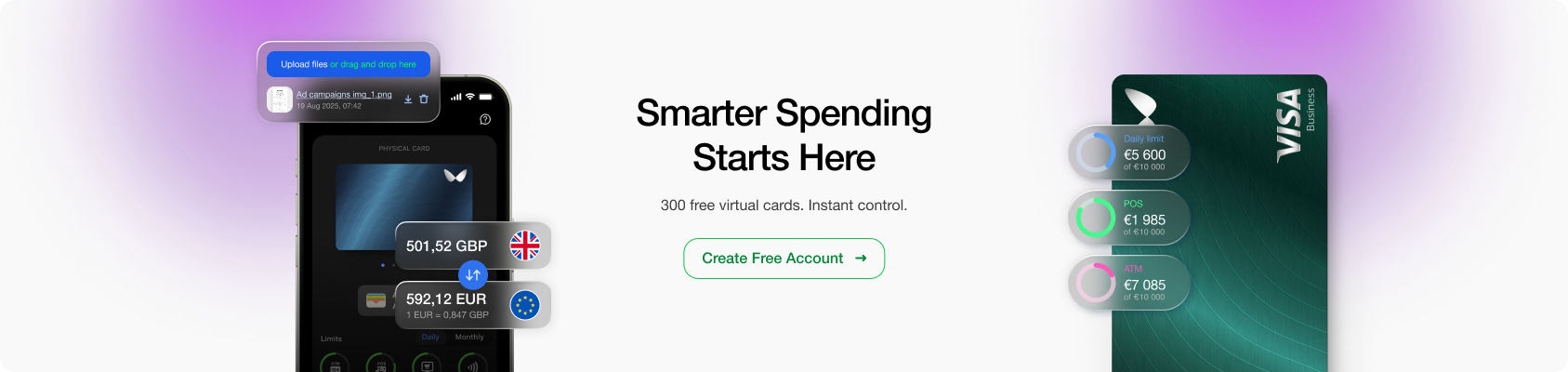
- Spending limits on each card, so a usage-based bill can’t run past the budget set for it.
- Card controls that restrict where each card can be used.
- Multi-currency accounts and in-platform currency exchange for tools billed in US dollars.
- Receipts attached to transactions, with Xero and QuickBooks integrations that keep the books current.
These sit alongside a business account with its own IBAN, all on one platform. AI tools and their prices change quickly. With its own card and limit, each tool can be adopted as fast as the team wants, and finance still sees exactly what it costs.
Methodology
This analysis is based on anonymised, aggregated card transaction data from Wallester Business accounts registered in France and Germany, covering 1 January to 30 September 2026. All figures are shown as shares or growth rates to protect client data. Merchants are classified using merchant category codes and merchant descriptors. Spending settled outside card payments, such as invoices or cloud marketplace credits, is not included. The data reflects Wallester Business customers and does not represent all businesses in either country.