Last month, Visa announced a partnership with Pinwheel to build a subscription management tool for card issuers. The idea is simple: give cardholders one clear view of their recurring payments. Also, the tool should help them spot duplicate subscriptions and easily cancel the ones they no longer need. The rollout to North American issuers is planned for this summer.
This makes sense, and if the world’s largest card network thinks subscription management belongs inside financial infrastructure, the problem is clearly real. Many businesses and consumers already know this from experience. The number of subscriptions worldwide is expected to reach 12 billion by 2030, which means recurring payments are only going to become harder to follow.
How the Problem Builds Up
Companies collect software subscriptions in much the same way households do, but obviously on a larger scale. A team needs a tool, so someone signs up. Then the project ends, the team changes, or the person who bought it leaves. Too often, the subscription stays.
According to available data, 49% of provisioned software licences go unused. The average company also runs more than a dozen duplicate project management tools, alongside nearly as many collaboration platforms that have similar or same features.
This usually happens through normal business activity. It is not always carelessness. The problem is that recurring payments are quiet: a direct debit goes out, and finance checks it against last quarter’s number. Nobody stops to ask whether anyone still uses the product. By the time renewal comes around, the person who knew why the tool was bought may no longer be involved.
“This is one of the most common issues we see with clients,” says Luigi Gentile, Client Relationship Manager at Wallester. “Software subscriptions often stay active long after a project ends or an employee leaves. Our role is to help clients spot unused tools, reduce duplicate subscriptions, and avoid unnecessary spending.”
There is also an organisational dimension. Because software procurement is rarely centralised, different teams sign up for different tools. Finance sees the charge but not the context. Without a clear view across subscriptions and their owners, the spend becomes a structural problem rather than an oversight one.
The Fix
The solution is simpler than the numbers make it look. Start by exporting all recurring payments from the past quarter. Then assign each one to an owner and check whether it is actually being used.
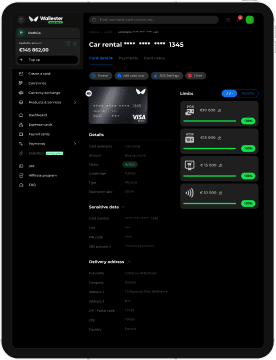
And this is where tools like Wallester Business become useful. If every software subscription has its own card and that card is assigned to a specific team, the spend is clear from the start. Finance can see who owns the payment, what it is for, and whether it still makes sense.
“That’s the value of virtual cards,” explains Gentile. “Every subscription becomes visible, trackable, and easy to control. In short, finance teams can instantly limit, pause, or stop recurring spend when needed.”
Clearly, there is demand for this. Subscriptions have grown quickly, but the tools for managing them have not kept up. That is true for consumers, but it is just as true for companies. Finance teams that solve this problem will spend less and understand their software costs much better.
What that looks like with Wallester Business:
- One virtual card per subscription. Every recurring charge tied to a named team, owner, and budget. Up to 300 free virtual cards on the basic plan.
- Hard limits per card. Set a monthly cap before the spend happens. Surprise renewals or price increases get blocked, not chased.
- Real-time visibility. Every transaction appears in the dashboard the moment it is authorised, with team and owner attached.
- Instant cancellation. Lock or close a card in seconds. The simplest way to stop a recurring charge is to remove its payment method.
So this is what makes the audit stick. Without this kind of setup, the spreadsheet is only accurate on the day it is finished. A quarter later, the same problem starts building up again.