This article explains how an API sandbox and payment testing environment allow technical teams to evaluate payment flows without processing live transactions. It covers simulated transactions, API behaviour, webhooks, error handling, security verifications, and criteria for determining when test workflows must transition to production setups.
Payment integrations require thorough software testing before real money and live customer transactions enter the workflow. A payment testing environment gives software developers a controlled space to execute API calls, inspect response payloads, and evaluate different transaction outcomes. Testing an API integration verifies local code logic, while verifying a live payment setup proves that the complete technical payment infrastructure functions correctly under real operational conditions without commercial financial risk.
What is an API sandbox?
An API sandbox is an isolated test environment where developers can send API requests and receive simulated responses without creating live financial transactions.
In payment technology, an API sandbox acts as a mirror of a provider payment gateway. It accepts incoming REST requests, evaluates payload formatting, authenticates API credentials, and returns synthetic JSON responses. Rather than connecting to clearing networks or card schemes, the sandbox uses mock engines to produce payment states such as approved, pending, or declined.
Sandbox credentials differ completely from live production keys. Test credentials authenticate requests against sandbox endpoints, preventing software bugs or test scripts from reaching real financial networks. Developers configure test accounts, virtual test cards, and synthetic customer records within the sandbox. Specific card numbers or parameters trigger predefined platform responses, allowing engineers to verify how local applications handle success and failure signals.
Local development environments allow developers to test internal code execution on isolated machines, but they cannot replicate third-party API behavior. An API sandbox provides a shared, remote endpoint that simulates true provider reactions. Keeping test data strictly isolated from production databases prevents simulated customer details or dummy transactions from contaminating live accounting ledgers and operational reports.
An API sandbox validates request formats, header authentication, status code handling, payload parsing, and asynchronous webhook receipt. It cannot replicate live issuing bank decisions, production network latency, real settlement cycles, or actual clearing house behavior.
Q&A: Is a sandbox the same as a test account?
Not exactly. A test account is an identity or account within an environment; a sandbox is the broader isolated environment used for testing API behaviour and transaction flows.
| Area | API sandbox | Production |
| Funds | Simulated | Real |
| Credentials | Test credentials | Live credentials |
| Transactions | Test transactions | Real transactions |
| Customer data | Test data | Live customer data |
| Failure scenarios | Can be deliberately triggered | Depend on real conditions |
| Settlement | Simulated or absent | Real settlement process |
| Purpose | Integration and QA | Live payment processing |
What should you test in a payment testing environment?
A payment testing environment should cover the full payment lifecycle, including successful payments, declines, authentication, refunds, API errors and webhook events.
Testing must span both standard transaction flows and deliberate failure states to verify system resilience. Teams must validate the following scenarios within the payment testing environment:
- Successful payment authorisation and the expected API response.
- Declined transactions and the application’s handling of failure responses.
- Authentication flows, including 3D Secure where the payment provider exposes a test scenario.
- Refunds, reversals and other post-payment operations.
- Invalid API requests, missing parameters and malformed payloads.
- Authentication failures caused by invalid or expired credentials.
- Webhook delivery, event types, signatures and duplicate events.
- Timeout, retry and idempotency behaviour.
- Currency and amount handling.
- Transaction status changes across the payment lifecycle.
Webhook testing requires careful inspection during integration. An initial API call may return an intermediate status while the final payment outcome arrives seconds later via an asynchronous webhook event. The sandbox allows developers to simulate HTTP posts, verify cryptographic signature headers, confirm retry logic for dropped connections, and prevent duplicate processing of retransmitted events.
Q&A: Can a sandbox test declined payments?
Yes, if the provider supplies predefined test scenarios or test values that simulate declines and other failure states.
How does sandbox testing differ from testing live payments?
Sandbox testing validates integration logic and simulated payment scenarios; live testing validates behaviour under real production conditions and must follow the provider’s rules for controlled transactions.
Passing all sandbox tests confirms that application code formats requests correctly and parses responses as designed. It does not guarantee that a live transaction will complete. Real issuers enforce dynamic risk rules, velocity checks, and strict balance verifications that synthetic test environments cannot replicate.
Production networks experience latency variations, temporary connection timeouts, and strict rate limits. Live authentication protocols, such as 3D Secure mandatory step-ups, interact with real customer devices and banking apps. Once code deploys to production, teams conduct controlled live verification using real credit cards or bank accounts with minimal monetary amounts to verify live routing, actual webhook delivery under production firewall settings, and genuine settlement entry.
Selecting a suitable sandbox environment requires evaluating how accurately test flows mirror production endpoints. Teams must assess whether the vendor offers isolated test credentials, thorough documentation, error injection controls, idempotency key verification, and clear separation between test and live data structures.
| Test area | What the sandbox can prove | What still needs production verification |
| API requests | Request and response logic | Live API behaviour |
| Authentication | Integration with test credentials | Production credentials and permissions |
| Payment status | Application handling of test states | Real issuer outcomes |
| Webhooks | Event-processing logic | Production delivery conditions |
| Refunds | Integration flow | Real settlement and reconciliation |
| Security | Some integration controls | Full production security configuration |
| Performance | Limited test behaviour | Production traffic and limits |
Q&A: Can a sandbox replace production testing?
No. It covers integration and simulated transaction scenarios, but selected production checks are still required before a live payment flow is considered ready.
How Wallester White-Label uses a payment testing environment
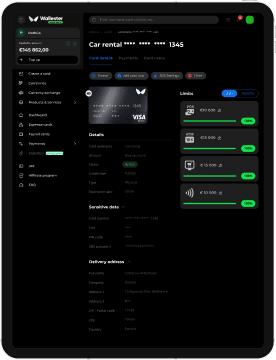
Wallester White-Label provides an API-based infrastructure for businesses that want to create branded financial products with payment cards and related functionality. Wallester’s API Developer Portal includes a private sandbox where developers can create and test payment cards before going live. The sandbox also allows transaction processing to be simulated, so teams can test an implementation and see how it responds to specific card behaviours.
The sandbox supports payment-card testing without using the live environment. Wallester states that developers can customise spending-control rules, simulate transaction processing, integrate their own authentication logic or use the platform’s default settings, and track cardholder data in real time within the sandbox. These functions give development teams a controlled environment for testing card and payment workflows before production.
Wallester’s API is REST-based and uses standard HTTP methods and response codes, token-based authentication and JSON responses. The API documentation also distinguishes between production and sandbox connectivity. This gives developers the technical setup needed to test API requests and integration behaviour against the sandbox before using the production environment.
For businesses developing a branded card programme, Wallester White-Label provides a direct route from API integration and sandbox testing to a live payment-card environment. The private sandbox can be used to test cards, spending rules and simulated transactions before the implementation goes live.