This article covers the role of fraud detection APIs in payment and card systems. It explains how these APIs assess transaction risk, how risk scoring supports fraud decisions, where fraud checks fit into a payment workflow, and what businesses need to consider when choosing an API. It also looks at how fraud controls relate to card issuing infrastructure and how Wallester White-Label fits into this setup.
Fraud checks need to happen quickly enough to assess a transaction before money moves. A fraud detection API connects this decision process to the systems that handle payments, cards or accounts. It can receive transaction details, assess risk signals and return a result that supports an approval, review or decline decision. Risk scoring gives businesses a practical way to interpret those signals without turning every fraud decision into a manual investigation in live payment environments.
What is a fraud detection API and how does it work?
A fraud detection API is an interface that lets a payment or financial system send transaction data to a fraud detection service and receive a risk assessment.
When a customer initiates a transaction, the host application transmits a structured data payload to the API endpoint. This payload contains payment values, currency codes, merchant category classifications, card numbers, billing addresses, device fingerprints, IP coordinates, and historical account patterns. The fraud service ingests these attributes to identify discrepancies between the present request and normal user habits.
Processing happens through algorithmic evaluation models and heuristic rule engines. The service checks the incoming signals against databases of confirmed illicit activity, analyses velocity metrics to detect card testing, and evaluates behavioral markers. Once the calculation finishes, the API delivers a synchronous JSON payload back to the client software. That response contains an overall risk score, risk level bands, attribute breakdowns, or direct recommendations such as permit, review, challenge, or decline.
Placement in the payment flow determines execution requirements. As pre-authorisation inspection happens while a buyer waits at checkout, the API must complete its round-trip assessment within 100 to 250 milliseconds. Latency spikes create friction, elevate cart abandonment, or cause gateway timeouts.
Q&A: Does a fraud detection API automatically block suspicious transactions?
An API returns an evaluation, risk score, or suggested action based on incoming transaction signals. The host payment platform or card management system evaluates that score against its own business rules to approve, flag, step up, or decline the payment.
How does risk scoring work in fraud detection?
Risk scoring assigns a numerical or categorical value to a transaction based on signals associated with fraudulent behaviour.
A risk score provides an estimated probability of deceit, not concrete proof of illegal activity. Fraud engines derive this figure by cross-referencing attributes such as spending deviations, abnormal device software, mismatched country identifiers, and recent failed authentication attempts. A consumer purchasing groceries in their home town produces a low risk score, whereas a midnight purchase from an unfamiliar foreign IP on a newly created account generates an elevated score.
Organisations set operating thresholds to automate transaction routing. Scores below a conservative cutoff proceed directly to settlement. Intermediate ratings trigger secondary verification steps, including cardholder challenges or manual compliance reviews. Scores exceeding high-risk parameters trigger immediate transaction refusal.
Historical account context alters scoring evaluations. A high-value card transaction appears normal for a verified commercial account with steady turnover, yet identical figures on a dormant consumer profile trigger immediate warnings. Different fraud models also generate contrasting scores for identical payments, as proprietary weighting systems prioritise device telemetry, geolocation, or behavioural velocity differently.
| Risk assessment | Possible business response | Example |
| Low risk | Approve | Familiar card, expected amount and normal transaction pattern |
| Medium risk | Request additional verification | Unusual location or transaction amount |
| High risk | Decline or investigate | Several strong fraud indicators |
Q&A: Is a higher risk score always a sign of fraud?
A higher score flags statistical anomalies, unfamiliar merchant categories, or irregular payment sizes, which may indicate suspicious activity. It reflects probability rather than definitive proof of deceit. Legitimate cardholders who travel abroad or make unusually large purchases often generate elevated scores, making clear verification pathways essential.
Payment fraud patterns demonstrate why automated risk assessments remain critical. In the 2025 Report on Payment Fraud published by the European Banking Authority and the European Central Bank, total fraudulent payment transactions across the European Economic Area reached 4.2 billion euros in 2024, with card fraud accounting for 1.3 billion euros and concentrating heavily in remote, card-not-present transactions.
How can a fraud detection API fit into a payment workflow?
A fraud detection API can sit at a defined decision point before or during payment authorisation, depending on the payment architecture and the type of fraud check.
A typical workflow executes in five sequential steps:
- A payment or card transaction generates relevant data during checkout.
- The core system sends the required information to the fraud detection API endpoint.
- The API evaluates the available risk signals against machine learning models and fraud rules.
- The host system receives the risk score or decision recommendation.
- The business applies its rules, such as approval, additional verification, review or decline.
Integrating an API requires balancing analytical depth against checkout latency. Engineering teams must confirm what payload parameters the fraud engine requires, such as raw device telemetry or verified identity hashes. Decision placement also defines transaction resilience. If an external fraud service suffers an outage, the payment gateway must have predefined fallback protocols to prevent customer lockouts.
Risk teams must also audit false positives regularly. Declining authentic customers damages customer retention and lowers lifetime merchant revenue. Periodic reviews allow operators to adjust risk thresholds, calibrate rules for holiday peaks, and refine verification triggers.
| Consideration | Question to ask |
| Data | What transaction and account information does the API require? |
| Response time | Can the result arrive before the transaction decision? |
| Risk rules | Who defines the thresholds for approval, review and decline? |
| False positives | How are legitimate transactions identified after a failed fraud check? |
| Monitoring | How are fraud outcomes reviewed after deployment? |
Q&A: Where should a fraud check happen in the payment flow?
Pre-authorisation checks inspect transactions before routing them to card networks, preventing fraudulent authorisations from occurring. Post-authorisation monitoring assesses settlements or behavioural anomalies after transaction approval, catching settlement disputes or account compromise without adding latency to checkout.
What should businesses look for in a fraud detection API?
Businesses should assess the quality of risk signals, response speed, integration options, decision controls and reporting. The API should provide relevant transaction and customer data, return clear risk results, and fit into the existing payment flow without adding friction. Good documentation, testing tools and flexible rules can simplify integration. Reporting should help teams track fraud rates, declines and chargebacks, with appropriate data protection and PCI DSS controls.
How Wallester supports card payment risk management
Wallester White-Label provides scalable card issuing infrastructure through modern REST APIs, allowing companies to build, launch, and manage custom card programmes. In this ecosystem, fraud mitigation and transaction security operate as vital components of card operations and processing controls.
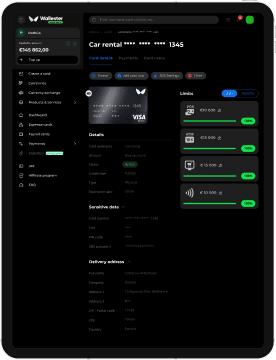
Businesses deploying white-label payment cards configure transactional parameters through Wallester API endpoints. Programme managers define regional spending permissions, establish single-transaction limits, activate contactless caps, and apply selective merchant category blocks. For digital commerce, Wallester delivers integrated 3D Secure protocols, providing cardholder verification flows that satisfy European regulatory standards for strong customer authentication.
Wallester transmits transaction data via real-time webhooks, feeding authorisation requests directly into a company core system. This architectural connectivity allows businesses to route live card spending events into dedicated fraud prevention services, risk scoring algorithms, or internal ledger tools. Fintech teams maintain complete oversight over transaction lifecycles while utilising Wallester card processing capabilities.
Companies building or expanding a branded payment card programme can explore Wallester White-Label to access developer-friendly card issuing infrastructure and secure transaction controls.