As the saying goes, two things can be true at the same time. Just look at spreadsheets. Yes, they can be incredibly powerful, but they’re probably also holding your finance team back.
The truth is, for many companies – even in 2026 – Excel and Google Sheets remain the default tools for tracking spend. And it’s not just small businesses. Everyone from startups to mid-size enterprises to multinational teams still ends up relying on spreadsheets because their finance stacks are fragmented.
For example, there’s a card provider. Then there’s an accounting system. Not to mention shared email inboxes and multiple dashboards. So what finance teams end up doing is actually stitching all of it together manually in a spreadsheet.
How Did We Get Here?
Spreadsheets are not bad by themselves. The problem is that they should not carry all the weight they do today.
Most finance teams aren’t using spreadsheets to run simple budgets. They have to manage real spend, revenue flows, reconciliations, and audits. Often, they also have to do all of this across multiple currencies, entities, and platforms. And somehow the system of record still ends up being a shared file on someone’s desktop.
In an interesting recent article on spreadsheets in Bloomberg, one former consultant described it perfectly:
“If I went to a company to train them on the Oracle system, they kept asking me Excel questions… The finance departments I was training all worked with Excel. Excel is just always there.”
Now, that might be true – and probably is. But it doesn’t necessarily mean it has to stay like that.
What Needs to Change
To finally move away from spreadsheets, three things need to be in place:
- Real-time visibility
Finance teams should see spend in real time, meaning as it happens. This data also needs to be sorted by team, user, and card. Most teams, however, still sort this data two days later – when the statement comes in.
- Full control
Instead of trying to enforce expense policy through obligatory reading of PDFs, the rules should be embedded in the setup itself. In other words, limits, permissions, and approvals should all be defined directly in your expense management tool. Simply put: if something shouldn’t be spent, then it shouldn’t be spent.
- Clean integrations
Importing or exporting files is no one’s idea of a good time. Accounting tools need to sync automatically – and correctly – with all spending channels, with full oversight before anything is booked.
This should be the base. It all boils down to building a system that finance teams can trust – one that keeps the process clean and consistent from the start, instead of requiring rework at the end.
Now’s the Moment: Direct Integrations Are Finally Here
At Wallester, we’ve seen how some clients still defaulted to spreadsheets even after setting up Wallester Business – our corporate card and spend management platform. That’s why we decided to build something that respects how finance teams actually work.
Last month, we launched direct integrations with Xero and QuickBooks, two accounting platforms used by thousands of businesses across the UK and Europe. And there are more coming.
This means every transaction can now be reviewed, categorised, and synced to your accounting software automatically. Receipts can be attached in real time and nothing gets pushed through unless you approve it. In short, every transaction is tracked from the card to the ledger.
So, no more exporting files or chasing updates across systems. You’re managing spend where it happens and syncing it only when it’s complete and correct. That’s what builds confidence in the numbers. It also reduces the need for endless checks and manual rebuilds at month-end.
Everything You Need to Track and Control Spend – Under One Roof
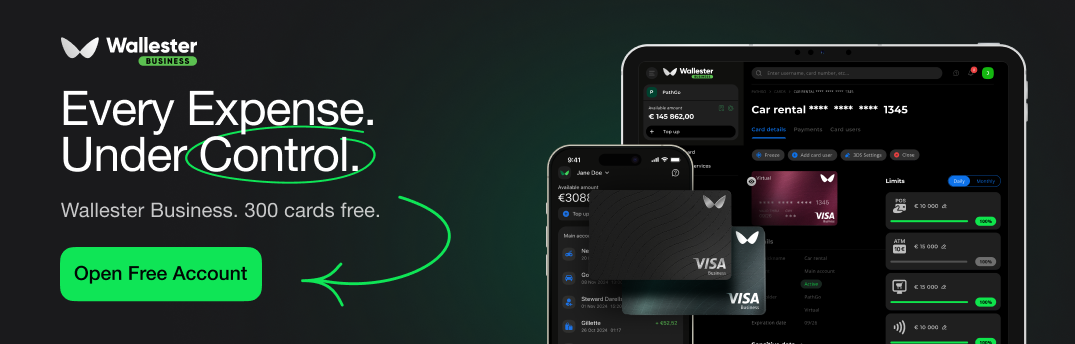
Wallester Business is a full card issuing and expense management platform designed to simplify how companies track, control, and account for spend. It’s built around three principles: real-time visibility, complete control, and clean integrations.
Alongside direct integrations with Xero and QuickBooks, here’s what you get at no cost:
- 300 free virtual Visa cards – assign to teams and users, set limits
- Unified dashboard – real-time visibility across every card and transaction
- Tokenised cards – works with Apple Pay, Google Pay, Garmin, and more
- 24/7 currency exchange – transparent rates, no service fees, 10 supported currencies
- Payroll & team cards – send up to 1,500 transactions in one click
- REST API access – connect to internal systems and automate reporting
- BIN sponsorship — reduce declines and improve platform compatibility
- Merchant whitelisting – skip security checks at trusted merchants
- No subscription fees – only pay for what you need
Setup is typically completed within hours and you can start issuing cards and track spend the same day. Yes, 2026 is the right time to stop relying on spreadsheets.
Try Wallester Business and rebuild your process around a system your finance team can actually trust.