There is a moment when a new category of spend stops being something companies experiment with. One way to recognise that moment is to take a look at the balance sheet and flag what has started regularly appearing on it over, let’s say, a yearly period. But it can take longer or it can happen quickly. For cloud infrastructure, the moment came gradually over five or six years. For example, AWS (Amazon Web Services) became a standard budget line slowly, and then all at once, as companies migrated workloads and locked in the infrastructure they needed to operate. For AI, though, the data suggests the same transition is happening much faster.
When we analysed corporate card transaction data across the EEA and UK for 2025, OpenAI subscriptions captured 0.56% of total corporate spend. AWS, the dominant cloud infrastructure provider, came in at 0.58%. The gap between them is marginal. For a category that barely existed as an organisational budget line two years ago, that is quite a number.
Two Years to Parity
First of all, let’s be clear about what 0.56% means here. The percentage was extracted from 4.6 million transactions representing more than €325 million in total corporate spend. So it is not a rounding error, nor is it being driven by a handful of large companies skewing the dataset. ChatGPT – and AI in general – has moved, in a pretty short period, from a tool that individuals used on personal accounts to something companies are paying for at an organisational level. What’s more important is that they are paying for it consistently enough that now it sits alongside infrastructure that has been a balance sheet mainstay for a decade.
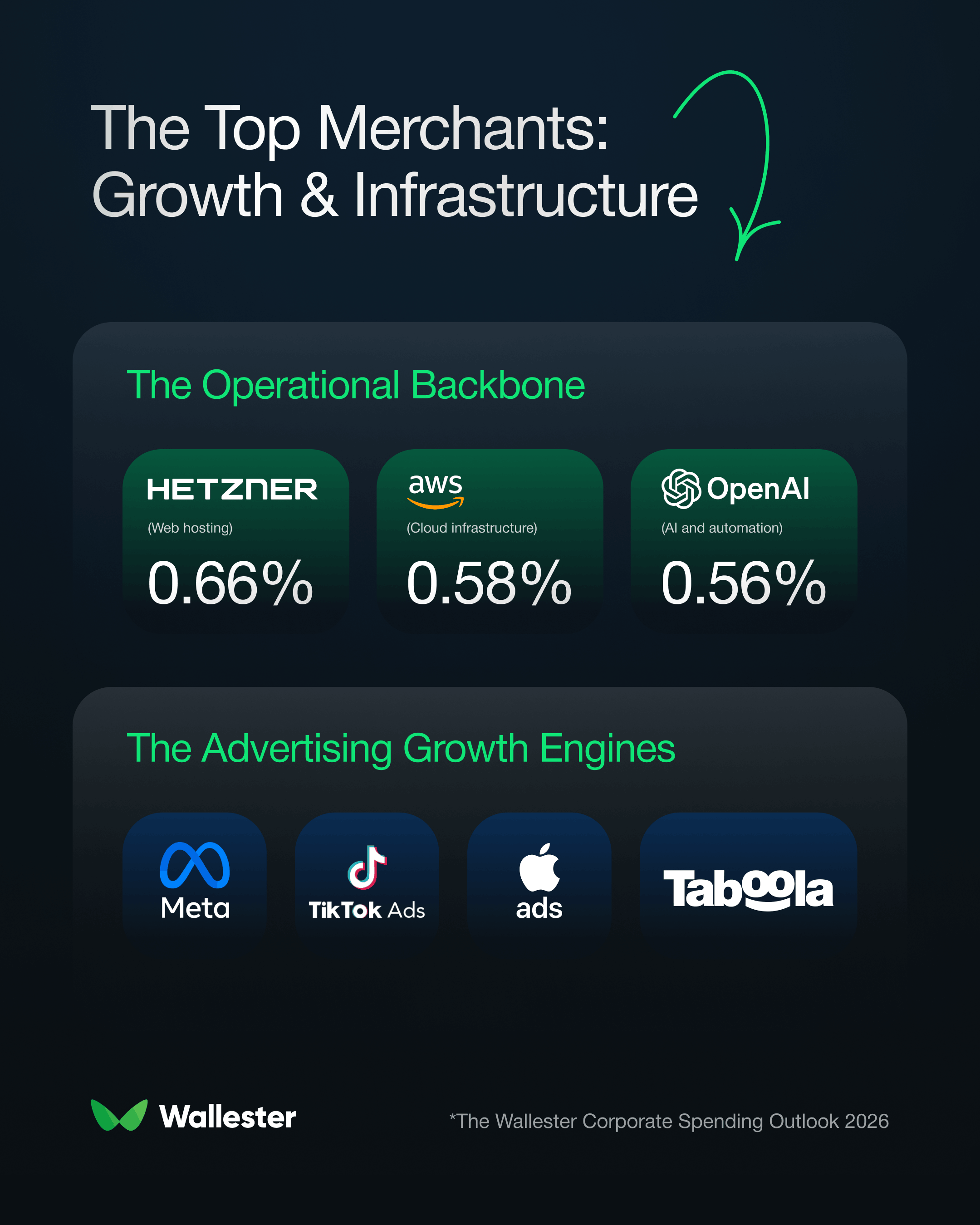
The top merchants overall split cleanly into two groups. On one side, operational infrastructure: Hetzner at 0.66%, AWS at 0.58%, OpenAI at 0.56%. On the other, growth and customer acquisition: Meta, TikTok Ads, Apple Ads, and Taboola. These are the two things companies spent on in 2025. Clearly, there are the tools they use to run the business and the platforms they use to grow it. Everything else is secondary. The fact that OpenAI sits in the infrastructure column, alongside web hosting and cloud compute, says something about how quickly it has been reclassified from novelty to necessity.
The Survey Explains the Spend
Of course, the transaction data does not exist in isolation. When we surveyed SME founders and finance leaders for the same report, 55% identified “too many manual processes” as their biggest operational challenge in spend management. It’s hard to interpret that as a coincidence.
The companies in this dataset are not spending on AI because it is novel or because someone in the business read about it and then wanted to try it. They are spending on it because it directly addresses the thing most of them said was slowing them down. Automating workflows, reducing manual reconciliation, and speeding up processes that previously required headcount are the use cases driving the subscriptions that show up in the data.
Put differently, the AI bill is not a discretionary line but an operational response to a documented problem. And if 55% of leaders are still citing manual processes as their top challenge despite a year of AI spending, then it is reasonable to expect the subscriptions to keep growing.
The Management Problem Businesses Should Keep in Mind
Compared to AI subscriptions, cloud infrastructure spending is relatively straightforward to manage. Usually, there is one account, one invoice, and one team responsible for it. The finance team knows how much it costs, roughly at least, even before the bill arrives.
AI spending doesn’t really work that way, because it tends to proliferate. The marketing team is using one tool, while operations signs up for something else. Then there are individual contributors expensing subscriptions that may or may not have gone through an approval process. By the time finance sees the month’s transactions, there are a dozen line items across teams, currencies, and use cases, with no clear picture of what was sanctioned and what was not.
Put simply, the problem compounds as adoption accelerates. Usage-based pricing means costs can scale unexpectedly mid-month. New tools appear constantly, and teams adopt them faster than procurement can review them. Without visibility at the point of spend, finance is always reconstructing the picture after the fact. So they spend their time matching card charges to tools that may no longer even be in use, chasing down who approved what, and trying to consolidate spend that was never centralised in the first place.
The answer is control that lives at the card level before the problem occurs. One card per tool or per team, with a limit set before the subscription renews or usage spikes. Every charge visible in real time, attributed correctly, reconciled before anyone has to ask.
Wallester Business is built precisely for this type of corporate spend. That means 300 free virtual Visa cards to start with, pre-set limits by card or category, and a real-time dashboard showing every transaction the moment it clears. There are no monthly fees, and no waiting on expense reports. Also, there are native integrations with Xero and QuickBooks, tokenised cards for Apple Pay and Google Pay, and payroll for up to 1,500 transactions in a single click.
The AI budget is already here, obviously, and the question now is whether it is managed or simply paid.
We surveyed SME founders and finance leaders across Europe, then cross-referenced their answers against 4.6 million real transactions. The full picture is in the Wallester Corporate Spending Outlook 2026.