This article examines how invoice financing, factoring, and discounting provide liquidity for trading businesses. It details operational mechanics, compares debt collection models, evaluates decision criteria, and outlines spending controls.
Commercial credit terms often tie up cash in outstanding accounts receivable for 30, 60, or 90 days. Trading enterprises seeking consistent working capital use asset-backed facilities to bridge this cash flow gap. Immediate liquidity unlocked from unpaid customer ledgers maintains daily operational stability. Clear knowledge of invoice finance mechanisms helps financial directors choose appropriate funding solutions tailored to their specific business models and commercial buyer relationships.
What is invoice financing and how does it work?
Invoice financing is a commercial funding arrangement where a business uses its unpaid accounts receivable as security to draw immediate cash from a lender.
Trading companies generate invoices when delivering goods or services to corporate clients on credit. Without waiting weeks for client settlement, companies submit these receivables to an invoice finance provider. The funder advances between 70% and 90% of the gross invoice value upfront, transferring cash into the company account within 24 hours.
When customers pay their outstanding invoices, funds go into a designated bank account. The funding partner deducts interest costs and service charges before remitting the remaining balance to the business. This mechanism creates a continuous cash flow funding stream tied directly to sales volume. Data from the British Business Bank Small Business Finance Markets Report 2025/26 shows gross SME bank lending reached £68 billion in 2025, driven by expanding adoption of alternative finance solutions including debtor finance and asset-backed facilities.
B2B enterprises in manufacturing, wholesale, logistics, and professional recruitment rely heavily on working capital finance to cover payroll, purchase inventory, and manage supplier payment terms.
| Feature | Invoice financing |
| Funding source | Unpaid B2B invoices |
| Security | Outstanding accounts receivable ledger |
| Customer payments | Paid directly to a designated facility account |
| Repayment | Settled upon customer payment minus provider fees |
| Common use cases | Bridging cash gaps, funding inventory, supporting sales growth |
Q&A: Can small businesses use invoice financing?
Yes, small and medium enterprises with B2B clients can access invoice funding provided their customers hold verifiable credit standing.
Further Reading: Working Capital Optimisation: Strategies for Healthy Business Cash Flow
What is the difference between invoice factoring and invoice discounting?
Invoice factoring transfers unpaid invoices to a provider that manages credit control and debt collection, whereas invoice discounting provides funding against receivables while the business retains ledger control confidentially.
Factoring agreements assign responsibility for credit management to the factoring services partner. The lender communicates directly with buyers, issues statements, and collects payments. This setup gives small firms dedicated credit control support.
In contrast, confidential invoice discounting keeps the financing arrangement undisclosed to buyers. Customers continue making payments directly to the business bank account without knowing a trade receivables finance facility exists. The company retains full control over sales ledger administration and customer communication.
Funding costs reflect these operational differences. Factoring incurs higher administration fees because the provider handles collection management, while discounting charges focus primarily on interest rates for advanced funds. Selective invoice finance allows businesses to fund specific high-value invoices as opposed to committing their entire ledger.
| Criteria | Invoice factoring | Invoice discounting |
| Customer contact | Managed by the finance provider | Handled internally by the business |
| Collections | Provider conducts credit collections | Internal team maintains collection control |
| Confidentiality | Facility disclosed to buyers | Fully confidential facility |
| Business suitability | Suitable for growing firms without collection teams | Suitable for established SMEs with credit controls |
| Control over sales ledger | Assigned to lender | Retained by business |
Q&A:Can companies switch between factoring and discounting?
Yes, businesses frequently start with factoring and transition to confidential invoice discounting as internal credit control capacity expands.
Further Reading: How to Build a Reliable Cash Flow Forecast for Your Business
When does invoice financing make business sense?
Invoice financing makes business sense when a financially stable company needs quicker access to cash tied up in unpaid invoices, particularly during periods of long customer payment terms, seasonal demand, or business growth.
Long payment windows of 60 to 90 days create liquidity shortages when suppliers require payment within 30 days. Accessing trade receivables finance early bridges this timing mismatch, allowing management to settle supplier bills promptly and secure early payment discounts.
Seasonal demand and large customer contracts often require upfront spending on raw materials, labour, and day-to-day operations. Debt finance structures scale automatically alongside rising invoice volumes, providing cash flow funding during expansion phases.
Finance managers must review contracts carefully before selecting an invoice finance provider. Agreement terms, service fees, interest margins, concentration limits, and termination clauses require thorough evaluation. Invoice funding does not suit companies with narrow profit margins, high dispute rates, or direct consumer sales.
Questions to ask before choosing invoice finance
- How stable are customer payment patterns?
- What percentage of invoices qualifies?
- How are fees structured?
- Who manages collections?
- Are there minimum contract periods?
- What reporting is available?
Q&A: Does every invoice qualify for funding?
No, providers exclude disputed invoices, overdue debts, and invoices issued to consumers or overseas clients lacking credit coverage.
Further Reading: Seasonal Cash Flow Management: How to Prepare for Revenue Peaks and Quiet Periods
How Wallester Business supports companies that use invoice financing
Wallester Business offers a comprehensive expense management platform that helps companies organise, monitor, and deploy funds unlocked through invoice financing facilities.
Wallester Business is not an invoice financing provider or lending institution. Instead, it serves as an operational partner that helps management direct capital efficiently after receiving cash from accounts receivable funding.
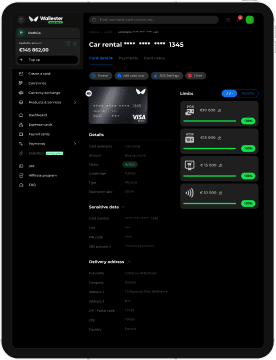
Companies utilising invoice finance receive capital advances that must be controlled and allocated across operational expenses. Wallester Business provides physical and virtual business Visa cards that allow finance teams to issue corporate payment cards to staff instantly. Individual spending limits, real-time transaction visibility, and automated expense control prevent unauthorised expenditures across departments.
Centralised spend management gives finance managers complete clarity over incoming funding and outgoing business expenses. Through API connectivity and seamless accounting integrations with ERP systems, card transactions synchronise automatically with financial software. This streamlines supplier payments, simplifies reporting, and maintains complete financial transparency across the enterprise. Businesses seeking total spend control can integrate Wallester Business into their broader finance management ecosystem to streamline operations.