Corporate cards were built for a different era.
A small number of employees. Centralised spending. Manual approvals. Monthly reconciliation.
That model breaks quickly once a company starts scaling—especially if spend is distributed across teams, campaigns, or markets.
The result is familiar:
- Shared cards across multiple users
- Delayed visibility into spend
- Constant reimbursement workflows
- Limited control over how money is actually used
Virtual card platforms solve this by turning company spending into something programmable, trackable, and scalable.
This guide compares the best virtual card solutions in Europe in 2026, based on how they perform in real operational environments—not just feature lists.
What is a virtual card platform (and why it matters now)
A virtual card platform allows businesses to issue and manage payment cards digitally, without relying on physical cards or traditional banking processes.
Each card is generated instantly and comes with its own unique number, expiry date, and security code. More importantly, it can be created for a specific purpose. That might be a single transaction, a supplier relationship, or an ongoing budget for a team or project.
This is where virtual cards start to differ from traditional corporate cards.
In many companies, corporate cards are still shared or reused across teams. One card might be used for multiple tools, subscriptions, or employees. Over time, this creates familiar problems. It becomes harder to track who is responsible for each transaction. Visibility is delayed. Finance teams are left reconciling spend after it has already happened.
Virtual card platforms take a different approach.
Instead of limiting access to a small number of cards, they allow businesses to create as many cards as needed and assign each one to a defined use case. A marketing team can create separate cards for each campaign. A finance team can allocate budgets at department level. A one-off supplier payment can be handled with a card that is used once and then closed.
Spending becomes easier to track because each transaction is tied to a specific context from the start.
This matters because the way companies spend money has changed.
Spending is no longer centralised. It happens across teams, tools, and markets. Advertising budgets shift daily. SaaS subscriptions are managed by different departments. Finance teams are expected to maintain control without slowing down the business.
Traditional card systems were not built for this level of complexity.
Virtual card platforms address this by giving businesses more control at the point of spend. Limits can be set in advance. Usage can be restricted to specific merchants or categories. Transactions are visible in real time rather than at the end of the month. Cards can be created or closed instantly as needs change.
These capabilities have made virtual cards a practical tool across several areas of the business.
They are used to manage SaaS subscriptions so billing issues are contained. They are used to give teams access to budgets without relying on reimbursements. They are used for supplier payments where tighter control is needed. They are increasingly used in media buying, where each campaign requires its own budget and payment method.
In each case, the goal is the same. Spending is clearly defined before it happens, not explained afterwards.
Virtual cards are not just a digital version of a corporate card. They reflect a broader shift in how businesses manage money, moving from reactive expense tracking to structured, real-time control.
When a virtual card platform is the right solution
A virtual card platform becomes necessary when:
- You manage spend across multiple people or teams
- You run paid advertising across multiple platforms
- You need real-time control over budgets
- You want to eliminate reimbursements
- You operate across multiple markets or currencies
If none of these apply, a traditional corporate card may still be enough.
How we evaluated the platforms
To make this comparison useful, platforms were evaluated based on:
- Card issuing speed
- Card volume and scalability
- Spend control granularity
- Acceptance rates (especially for advertising platforms)
- Integration with accounting tools
- Pricing structure and transparency
Best virtual card platforms in Europe (2026)
#1 Wallester Business
Best for: high-volume virtual card issuing and real-time spend control
Overview
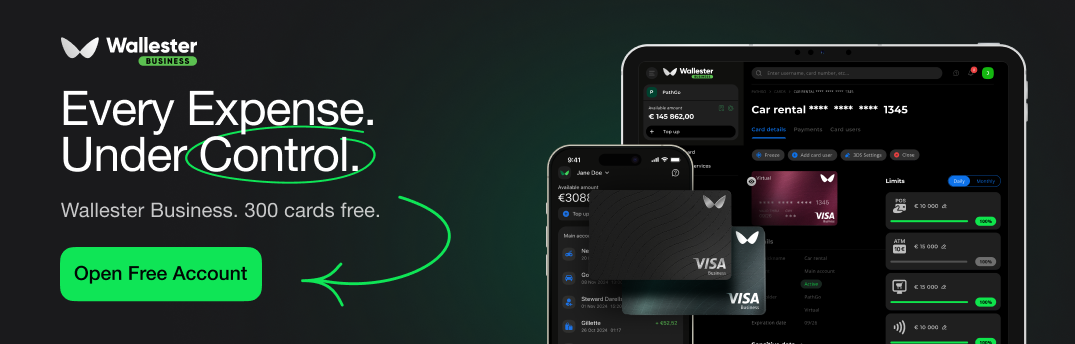
Wallester Business is designed for companies that need to issue and manage virtual cards at scale. Unlike traditional banking products, it combines instant card issuing with real-time spend controls and built-in expense management, making it particularly effective for decentralised teams and high-frequency spending environments.
Where it stands out
- Issue hundreds of virtual cards instantly
- Real-time controls (limits, merchant restrictions, whitelisting)
- Strong acceptance across major ad platforms (European BINs)
- Built-in expense management and accounting integrations
- Fast onboarding with no setup fees
Where it may not fit
- Businesses looking for credit lines or lending products
- Companies prioritising bundled banking features over spend control
Real-world scenario
A media buying team managing campaigns across Google, Meta, and TikTok assigns a dedicated virtual card to each campaign. Budgets are controlled in real time, eliminating overspend and card-sharing risks.
Verdict
A strong choice for companies that treat spend as an operational system, not just a finance function.
#2 Payhawk
Best for: enterprise-grade expense management and control
Overview
Payhawk positions itself as a finance platform for larger organisations, combining cards, expense management, and ERP integrations. It’s particularly strong in structured environments where finance teams require visibility and approval workflows.
Where it stands out
- Advanced approval flows and policy enforcement
- Deep ERP integrations
- Strong reporting capabilities
Where it falls short
- Slower card issuing compared to newer platforms
- Less flexibility for high-volume card use cases
- Higher cost base
Real-world scenario
A multinational company managing multiple departments and cost centres benefits from structured approval chains and centralised reporting.
Verdict
Best suited to finance-led organisations prioritising control over speed.
#3 Spendesk
Best for: controlled team spending with approval workflows
Overview
Spendesk focuses on helping finance teams manage employee spending through pre-approved budgets and structured processes. It blends cards, reimbursements, and invoice payments into one system.
Where it stands out
- Strong approval workflows
- Clear budget ownership per team
- Good visibility for finance teams
Where it falls short
- Less suited to fast-moving environments
- Limited flexibility for campaign-based spend
- Card issuing not optimised for scale
Real-world scenario
A SaaS company with department-level budgets uses Spendesk to control employee spending and approvals.
Verdict
Reliable for structured environments, less effective for dynamic spending needs.
#4 Soldo
Best for: predefined budgets and departmental control
Overview
Soldo provides prepaid cards combined with budgeting tools, allowing companies to allocate funds to teams and track usage.
Where it stands out
- Strong budget allocation tools
- Clear departmental spending visibility
Where it falls short
- Less modern UX compared to newer platforms
- Limited scalability for large card volumes
- Slower innovation cycle
Real-world scenario
A logistics company assigns cards to drivers or departments with fixed budgets.
Verdict
Solid for controlled environments, but less adaptable to complex or fast-scaling businesses.
#5 Pleo
Best for: employee-friendly expense management
Overview
Pleo focuses on simplifying expenses for employees, offering smart company cards with automated receipt capture and categorisation.
Where it stands out
- Strong user experience
- Automated expense tracking
- Popular with small to mid-sized teams
Where it falls short
- Limited depth in advanced controls
- Not designed for large-scale card issuing
- Less suited for complex operational spend
Real-world scenario
A small startup gives employees individual cards to handle travel and daily expenses without reimbursements.
Verdict
Great UX, but not built for high-complexity financial operations.
#6 Revolut Business
Best for: all-in-one financial platform
Overview
Revolut Business offers a wide range of financial services, including accounts, payments, FX, and corporate cards.
Where it stands out
- Broad feature set
- Strong FX capabilities
- Recognised brand
Where it falls short
- Cards are not the core product
- Limited advanced spend controls
- Support and stability can vary
Real-world scenario
A startup uses Revolut for banking, payments, and basic card usage.
Verdict
Convenient, but not specialised for spend management.
#7 Wise Business
Best for: international payments and low-cost FX
Overview
Wise Business is built around international transfers and multi-currency accounts, with card functionality as an extension.
Where it stands out
- Transparent FX pricing
- Strong global payment infrastructure
Where it falls short
- Limited spend control features
- Not designed for team-level card management
- Minimal expense management functionality
Real-world scenario
A company paying international suppliers uses Wise for low-cost transfers.
Verdict
Excellent for payments, limited for operational spend control.
#8 Airwallex
Best for: global businesses with multi-entity operations
Overview
Airwallex offers a global financial infrastructure platform with cards, FX, and payment capabilities.
Where it stands out
- Multi-entity support
- Global reach
- API-driven capabilities
Where it falls short
- More complex setup
- Overkill for smaller teams
- Cards not always the primary focus
Real-world scenario
A global e-commerce company manages payments and currencies across regions.
Verdict
Powerful, but better suited to larger international operations.
#9 Moss
Best for: finance teams combining cards and invoice management
Overview
Moss integrates card payments with invoice handling and expense tracking, targeting finance teams looking for consolidation.
Where it stands out
- Invoice + card combination
- Strong reporting tools
Where it falls short
- Less flexibility in card issuing
- Smaller ecosystem compared to leaders
Real-world scenario
A mid-sized company centralises spend and invoices in one system.
Verdict
A good hybrid solution, but not a leader in card scalability.
Detailed comparison (2026)
Virtual card platform comparison
| Platform | Card Issuing | Card Volume | Acceptance (Ad Platforms) | Pricing Model | Best For |
| Wallester | Instant | Very high | High (EU BIN optimised) | Free tier + scaling | Media buying, scaling teams |
| Payhawk | Same-day | Medium | High | Subscription | Enterprise finance |
| Spendesk | Same-day | Medium | Medium–High | Subscription | Structured SMEs |
| Soldo | Same-day | Low–Medium | Medium | Subscription | Budget control |
| Pleo | Instant | Low–Medium | Medium | Subscription + fees | Small teams |
| Revolut Business | Instant | Medium | Medium | Tiered plans | General use |
| Wise Business | Instant | Low | Medium | Pay-as-you-go | FX + payments |
| Airwallex | Same-day | Medium | Medium–High | Custom pricing | Global ops |
| Moss | Same-day | Medium | Medium | Subscription | Finance teams |
What the data actually tells you
Most platforms fall into three categories:
Employee expense tools
Pleo, Soldo
→ Built for convenience, limited scalability
Finance-controlled systems
Payhawk, Spendesk, Moss
→ Strong approvals, less flexibility
Operational spend platforms
Wallester (and partially Airwallex)
→ Built for speed, scale, and real-time control
This is the real dividing line in the market.
Virtual cards vs traditional corporate cards
| Capability | Virtual Cards | Corporate Cards |
| Issuing speed | Instant | Manual |
| Spend control | Granular | Limited |
| Visibility | Real-time | Delayed |
| Scalability | High | Restricted |
For modern businesses, virtual cards are not an upgrade – they are a replacement.
How to choose the right virtual card solution
- Running ads → prioritise acceptance and card volume
- Scaling teams → prioritise real-time controls
- Global operations → prioritise FX and multi-entity support
- Finance-heavy structure → prioritise approvals and reporting
Common mistakes to avoid
- Choosing based on brand, not use case
- Ignoring card acceptance rates
- Underestimating future scalability
- Overpaying for bundled features you don’t use
Final verdict
There is no single “best” platform—only the right fit for how your business operates.
But the direction is clear.
Companies are moving away from static corporate cards toward programmable, controlled, and scalable spending systems.
The only real question is how quickly you make that shift.
What is the best virtual card solution in Europe?
Are virtual cards better than corporate cards?
Note on data
Exact issuing limits, acceptance rates, and pricing vary by provider, region, and plan. Where not publicly available, comparisons are based on typical usage patterns and market positioning.