This article compares the 10 best expense tracker apps for UK and EEA businesses in 2026. It covers card-based and claims-based tools, as well as key compliance considerations, including Making Tax Digital for Income Tax, VAT coding, and multi-currency support. Each tool is reviewed with pricing, key features, integrations, and limitations. A comparison table and FAQ section help readers match the right solution to their business size, structure, and regulatory requirements.
If your business is still tallying expenses through spreadsheets and a pile of paper receipts, April 2026 is your wake-up call. Making Tax Digital for Income Tax (MTD for ITSA) now requires UK businesses with annual gross income over £50,000 to maintain digital records and file quarterly updates with HMRC via compatible software. Your expense process has officially shifted from an admin headache to a legal requirement.
Outside of the UK mandate, companies throughout the EEA are dealing with multi-currency reconciliation, cross-border VAT reclaim, and increasingly complex approval layers. The right expense tracker simplifies everything. The wrong one just adds to the mess.
What should a business expense tracker do in 2026?
Before comparing tools, it helps to agree on the baseline. A solid expense tracker in 2026 should capture receipts automatically via mobile, categorise transactions without manual input, and enforce your spending policy in real time rather than after the fact. It should connect digitally to your accounting software, whether that is Xero, QuickBooks, Sage, or NetSuite, without any manual re-keying of data.
If you’re a UK business, you need to get the VAT coding right the moment an expense is logged. If you’re running teams across Europe, being able to handle different currencies and local tax rules is a must. For any growing company, you need clear approval processes, department-level budget tracking, and a digital trail that keeps you safe during an audit.
Pricing models vary significantly. Some tools charge per user per month; others offer flat-rate plans or, in Wallester’s case, a genuinely free core tier. Factor in total cost across your headcount, not just the headline figure.
Further Reading: Top 10 Prepaid Business Cards in the UK: A Market Comparison
Does your expense app need to be MTD-compliant?
Expense software does not submit MTD returns directly; your accounting software does that. But under MTD rules, every step in the data chain must be digitally linked, meaning data must flow electronically from your expense tool into your accounting system with no manual re-entry in between. If you are exporting a CSV and copying figures into Xero by hand, that breaks the digital link and puts you outside compliance.
VAT-registered businesses have been under MTD for VAT since April 2022. MTD for Income Tax applies from April 2026 for those above the £50,000 threshold, dropping to £30,000 in April 2027 and £20,000 in April 2028. Non-compliance carries fines of £400 per VAT return for failing to use compatible software, plus further penalties for inadequate digital record-keeping. Check that any tool you adopt has a native, API-based integration with your accounting platform, not just a CSV export.
The 10 best expense tracker apps for UK and EEA businesses in 2026
Wallester Business
Best for: EEA and UK businesses that want card-based expense control with no subscription cost.
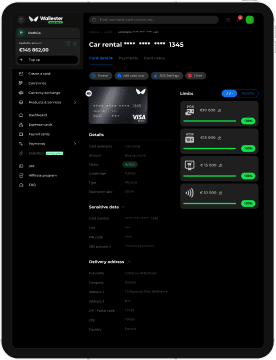
Wallester Business is an Estonian-licensed, Visa principal member platform that combines physical and virtual card issuance with real-time expense tracking in a single dashboard. Every card transaction appears instantly in the portal and mobile app, employees receive push notifications prompting them to photograph receipts immediately after purchase, and finance teams can set spending limits by day, week, or month at the individual card level. The platform supports major EEA currencies, including SEK and PLN, offering an edge for Nordic and Eastern European operations.
Accounting integration runs via REST API, connecting to existing ERP and accounting systems without manual data entry. The core platform, including up to 300 cards, real-time tracking, and automated reporting, is free.
Pleo
Best for: SMEs that want to eliminate employee reimbursements.
Pleo’s card-first model means employees spend on company-funded cards rather than personal ones, removing the reimbursement cycle altogether. Receipts are matched to transactions automatically, and the platform flags missing documentation before month-end rather than at it. Pleo has strong EEA coverage and integrates natively with Xero, QuickBooks, Sage, and NetSuite. VAT recovery features are built in, which matters for businesses with significant cross-border spend. Pricing starts at around £45 per month for small teams, scaling by user count. The main drawback is that Pleo works best when the whole team adopts it; partial rollouts create reconciliation gaps.
Expensify
Best for: Businesses with frequent travel and high receipt volumes.
Expensify’s SmartScan technology reads and categorises receipts in seconds via mobile camera, and its integrated travel booking feature means itineraries and expenses sit in the same system. It handles multi-currency reimbursements across most major currencies and integrates with all the major accounting platforms. For UK businesses, it supports HMRC mileage rates. Pricing starts at around $5 per user per month, though the full feature set sits at $9 per user. The interface has more depth than most competitors, which is an advantage for power users but can slow down onboarding for larger teams.
Zoho Expense
Best for: Budget-conscious teams, particularly those already using Zoho’s broader software suite.
Zoho Expense is the lowest-cost dedicated expense tool in this list, with plans starting at around £3 per user per month and a functional free tier for very small teams. It supports HMRC VAT coding, UK mileage rates, and standard accounting integrations. For businesses already using Zoho Books or Zoho CRM, the data flow between modules is tight and requires minimal configuration. The limitations are real: approval workflows are less flexible than Pleo or Spendesk, and multi-entity support is thin for businesses with subsidiaries across multiple EEA countries.
Xero Expenses
Best for: Businesses already on Xero accounting that want zero friction between expenses and their books.
Xero Expenses is an add-on to a Xero accounting subscription, not a standalone product. That is its biggest strength and its main constraint. If you are already on Xero, the integration is as tight as it gets: expense data flows directly into your chart of accounts with full VAT coding, the digital link for MTD is unambiguous, and there is nothing to configure. If you are not on Xero, this tool is not worth evaluating. Pricing is included in Xero’s higher-tier plans or available as a paid add-on from around £2.50 per user per month.

QuickBooks Expenses
Best for: SMEs that want accounting and expenses managed in a single subscription.
QuickBooks includes expense tracking across its core plans, with receipt capture via mobile, mileage tracking, VAT categorisation, and MTD for VAT and ITSA connectivity built in. It connects to over 750 third-party apps and is on HMRC’s list of recognised MTD software. The expense features are competent rather than best-in-class; businesses with complex approval workflows or high card-transaction volumes may find the tools limited compared to dedicated platforms. Pricing starts at £16 for Simple Start; £38 for Essentials (required for multi-currency).
Spendesk
Best for: European mid-market businesses managing multiple entities or cost centres.
Spendesk combines corporate cards, invoice management, and expense claims in one platform, with approval workflows that can be configured at a granular level by team, cost centre, or spend category. It is particularly strong for EEA businesses with several subsidiaries, where keeping entity-level spend visibility without losing consolidation at the group level is genuinely difficult. Its procurement features go beyond what most expense tools offer. Pricing is not published; Spendesk works on a quoted model based on company size and feature requirements, which makes it less suitable for businesses that want to self-serve the buying decision.
Payhawk
Best for: Cross-border businesses with multiple subsidiaries and currencies.
Payhawk handles multi-entity, multi-currency expense management better than almost anything else in this list. Finance teams at businesses operating across several EEA countries get consolidated group-level reporting alongside entity-specific compliance controls. AI-powered spend analysis flags anomalies and produces category-level insights without manual intervention. It covers corporate cards, reimbursements, accounts payable, and budget management in one platform. Implementation takes longer than lighter tools, and the pricing reflects the feature depth. Payhawk is better suited to businesses with a dedicated finance function than to early-stage teams.
Rydoo
Best for: Businesses with high international travel spend and per-country compliance requirements.
Rydoo supports local compliance rules across more than 100 countries, including per diem rates, mileage reimbursement rules, and tax requirements. It integrates with Bolt, Uber, and Wise, which means travel-related expenses can flow into the system without manual receipt entry. For UK businesses with travelling sales or consulting teams, the mileage tracking and HMRC-rate support are solid. Pricing starts at around £8 per user per month. Rydoo’s strength is travel. Businesses without significant travel spend may find they are paying for features they rarely use.
SAP Concur
Best for: Enterprise businesses that need deep customisation, complex audit trails, and full system integration.
SAP Concur is the most comprehensive tool in this list and the most demanding to implement. It supports over 100 system integrations, handles global compliance requirements across every major market, and is the default choice for businesses already running SAP ERP. Approval workflows, audit rules, and reporting can be configured to a degree that smaller tools simply cannot match. Implementation usually requires external consultancy, and ongoing costs are significant. For mid-market businesses without SAP infrastructure, the overhead is hard to justify. For large enterprises with complex structures, nothing else comes close.
Card-based vs claims-based: which model suits your business?
| Tool | Best for | MTD digital link | Multi-currency | Pricing from | Free tier |
| Wallester Business | SMEs, EEA/UK cross-border | Via API | Yes | Free | Yes |
| Pleo | SMEs, reimbursement-free | Yes (native) | Yes | £45/month | No |
| Expensify | Travel-heavy teams | Yes (native) | Yes | $5/user/month | Limited |
| Zoho Expense | Small teams, Zoho users | Yes (native) | Yes | £3/user/month | Yes |
| Xero Expenses | Xero accounting users | Yes (native) | Yes | £2.50/user/month | No |
| QuickBooks Expenses | SMEs, all-in-one | Yes (native) | Yes | £14/month | No |
| Spendesk | Mid-market, multi-entity | Yes | Yes | On request | No |
| Payhawk | International, multi-entity | Yes | Yes (extensive) | Starter plan from €25/user. Enterprise quote-based. | No |
| Rydoo | Travel-intensive businesses | Yes | Yes | £8/user/month | No |
| SAP Concur | Enterprise | Yes | Yes | On request | No |
Tools like Wallester Business, Pleo, Soldo, Spendesk, and Payhawk are card-based: employees spend on company-funded cards, so there is no reimbursement cycle and no gap between the transaction and the record. Expensify, Zoho, Rydoo, and SAP Concur are primarily claims-based: employees spend on personal cards and submit claims afterwards. Card-based tools give finance teams real-time visibility and remove the trust gap inherent in after-the-fact submissions. Claims-based tools are more flexible for businesses where staff already have established card arrangements or where spend is irregular and unpredictable.