It’s been a while since virtual cards stopped being seen as some sort of esoteric, side tool in corporate finance. In fact, adoption is skyrocketing. According to recent Juniper research, global virtual card payments in 2025 reached $5.2 trillion – and 76% of that value came from B2B spending.
Essentially, virtual cards have become one of the core payment rails – if not the most dominant – for businesses worldwide. But what exactly is causing this trend?
Why Businesses Are Moving to Virtual Cards
In short, this massive shift to virtual cards has less to do with novelty and more to do with practicality. Companies see them as a means of solving structural problems that traditional payment methods not only struggled with, but in many cases created.
- Financial Agility
Whether they want to or not, most companies today operate across borders. Because suppliers, agencies, and software tools often sit in different markets, traditional payment methods are growing more and more inadequate.
On the other hand, virtual cards offer:
- Real-time payments without waiting for banking cut-off windows
- Built-in currency support, often with better visibility and fewer surprises
- Fast reconciliation, because every transaction carries clean metadata
Companies operate in environments where everything – costs, markets, supply chains – moves fast. For obvious reasons, then, the ability to pay instantly – and track payments instantly – becomes anything but a luxury.
- Stronger Security By Default
Security is another major factor. And security doesn’t mix well with physical cards or traditional bank transfers.
Virtual cards give businesses a whole new level of control. By going virtual, companies can:
- Issue disposable cards for one-off payments
- Use strict MCCs (Merchant Category Codes) rules to limit where a card works. For instance, block it from being used at restaurants or allow it only for travel spend.
- Assign cards directly to specific teams, suppliers, or subscriptions
- Reduce exposure to fraud because card numbers are unique and easily replaced
Sectors like healthcare, logistics, or travel, for example, are especially susceptible to risk because of high volumes and fragmented systems. Virtual cards are the perfect tool to mitigate these potentially very costly exposures.
- Accounting Integration and Clean Data
Finally, virtual cards help keep books clean and organised. When a company pays for things using virtual cards, they generate structured, exportable transaction-level data that often plugs directly into accounting systems.
So, instead of manually collecting receipts and guessing who spent how much on what and when, finance teams get:
- Supplier-level granularity
- Instant categorisation
- Clear audit trails
- Smooth month-end close
Taken together, all of this makes spending visible, searchable, and predictable.
What Comes Next
The virtual card trend shows no signs of slowing down. According to the same Juniper research, by 2029 B2B virtual card payments will reach $14.6 trillion, representing 83% of the total virtual card market globally.
This comes as no surprise. As global operations become more complex and margins tighten, companies will prioritise tools that improve control, speed, and security without adding any extra operational weight.
Seen from that angle, virtual cards are simply perfectly practical. And as more businesses standardise their usage of virtual cards across teams, suppliers, and workflows, the gap between adopters and non-adopters will only grow.
Wallester Business: Your Fast Track to Going Virtual
For companies considering virtual card adoption without added complexity, Wallester Business offers a direct and simple path forward.
Here’s what you get:
- 300 virtual Visa cards — instantly, for free
No monthly fees and no hidden costs. Cards – expense or disposable – can be issued in seconds and then assigned to any person, project, supplier, or tool. - Real-time control
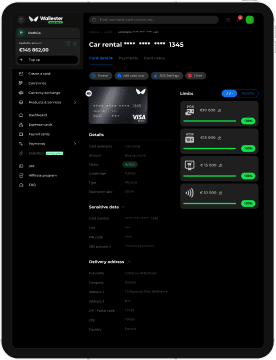
Set limits with a few clicks or taps. Track spend live on desktop or in the mobile app – no more waiting for statements. - Mobile wallet support
Add cards to Apple Pay, Google Pay, or Garmin, and let your team pay instantly from their phones. - Built-in security features
Disposable cards, user permissions, currency exchange and controls, and clear separation between teams and budgets. - Direct issuing, no middlemen
Wallester is a Visa Principal Member and that means higher stability and better acceptance rates.
For any company that cares about visibility, speed, and simplicity, virtual cards are the answer. They’re the new operating standard for controlling spend at scale, and with Wallester Business, you can start issuing yours today.