This article explains what virtual card straight-through processing is, how it works within B2B payment automation, where operational gaps tend to appear, what implementation looks like in practice, and how platforms like Wallester fit into the picture. It is written for finance teams, CFOs, AP managers, and procurement leads operating at intermediate to advanced level.
Finance teams managing high volumes of supplier payments are under mounting pressure to process more transactions with less manual effort. Payment automation has moved from a nice-to-have to a core operational requirement, and virtual card straight-through processing sits at the centre of that change. Understanding how STP works, where it breaks down, and what it takes to implement it well is now practical knowledge for any AP or finance operations function.
What is straight-through processing in payments?
STP is the automated processing of a payment from initiation to settlement without human intervention at any stage.
In a finance context, straight-through processing payments means a transaction moves through authorisation, matching, posting, and reconciliation entirely within connected systems. No manual keying, no approval queue for routine transactions, no separate data entry into accounting software.
For accounts payable, STP matters because it directly compresses the time between a purchase order, an invoice, and a cleared payment. A manual B2B payment workflow can involve five or more discrete human steps. An STP flow collapses those steps into an automated sequence triggered by pre-set rules.
How do virtual cards support straight-through processing?
Virtual corporate cards are purpose-built for STP because each card carries spend rules, merchant controls, and transaction metadata within the payment itself.
When a virtual card is issued via API, it carries pre-configured parameters: a spending limit, an authorised merchant category, a validity window, and an associated cost centre or purchase order reference. When the card is used, authorisation happens automatically against those parameters. No human approves the transaction at point of use. The rules embedded at issuance do that work.
The reconciliation data attached to each virtual card transaction flows back to the ERP or accounting system automatically, with the purchase order reference already embedded. This is what makes virtual card STP different from a generic card payment: the intelligence is built in at the point of card creation, not added manually afterwards.
Commercial card programmes including virtual cards, supported by STP, are increasingly being used by large corporates and SMEs alike to enable data-rich transactions with Level 3 data for reconciliation and automation-ready, API-driven settlement infrastructure.
| Process stage | Manual flow | Virtual card STP flow |
| Purchase approval | Email chain or paper form | Pre-set spend rules on card issuance |
| Card/payment issuance | Manually arranged | API-triggered, instant |
| Supplier payment | Manual bank transfer or cheque | Automated card transaction |
| Invoice matching | Manual cross-reference | Automated via embedded PO reference |
| Reconciliation | Manual data entry into ERP | Automatic transaction data posting |
| Audit trail | Assembled from multiple sources | Single card-level transaction record |
What blocks straight-through payment processing?
The four most common blockers are supplier card acceptance gaps, missing transaction references, ERP disconnects, and approval workflows that were never designed for automation.
Supplier acceptance is still the most significant constraint in European B2B contexts. According to the EU Payment Observatory’s 2025 Annual Report, 47% of B2B invoices across Western Europe are currently overdue, yet many of the suppliers carrying that exposure still lack the digital infrastructure or card acceptance capability needed to participate in automated payment workflows. A buyer can build a technically perfect STP system and still face manual workarounds at the supplier end.
Beyond acceptance, the second most common failure point is data quality at the point of payment. If a virtual card is issued without a purchase order reference, the downstream matching logic cannot reconcile it automatically. The payment goes through, but the reconciliation does not, defeating the purpose of STP.
ERP disconnects are a structural problem for organisations that have implemented virtual card programmes on top of legacy accounting infrastructure without API integration. The card transactions settle, but the data sits in a separate system until someone manually exports and imports it.
Q&A: Does supplier acceptance still matter for STP if the buyer side is fully automated?
Yes, materially. A buyer’s STP infrastructure can be well-designed, but if the supplier processes the payment manually, downloading card details from a portal, keying them into a terminal, or handling remittance separately, the straight-through element breaks on the receiving side. Supplier onboarding and acceptance capability remain practical prerequisites for true end-to-end STP.
Can virtual cards automate supplier payments?
Yes, for a well-defined subset of supplier relationships. Recurring vendors, controlled spend categories, and high-frequency low-complexity payments are the clearest fit.
The practical use cases where virtual card automation works well:
- Recurring SaaS subscriptions: A single virtual card per vendor, with a monthly limit matching the contract value. Authorisation, payment, and reconciliation happen without AP involvement.
- Managed travel spend: Hotel, airline, and ground transport bookings made via a travel management platform using virtual cards issued per trip, with spend limits and merchant category controls applied at issuance.
- Media and digital advertising: Campaign budgets distributed to agency or platform suppliers via individual virtual cards, each scoped to a specific campaign period and spend ceiling.
- Procurement tail spend: Low-value, high-frequency purchases from approved vendors where raising a purchase order for every transaction creates disproportionate overhead.
- Contractor and freelancer payments: Milestone-linked virtual cards issued on project completion, replacing manual bank transfer requests.
The use cases where STP is harder are large one-off payments, complex multi-line procurement with variable pricing, and suppliers who invoice in non-standard formats or require customised remittance data. These can still be processed via virtual card, but the straight-through element requires more configuration and supplier-side setup.
How does STP improve payment reconciliation?
STP improves reconciliation by attaching structured, machine-readable data to the payment at point of issuance, so matching logic can run automatically rather than relying on manual cross-reference.
Each virtual card transaction carries an identifier that ties back to the originating request. It can be a purchase order number, a cost centre, a project code, or a vendor ID. When the transaction clears, that identifier moves with the payment data into the ERP or finance system. The matching engine does not need a human to tell it what the payment was for.
The contrast with manual payment reconciliation is significant. In a manual flow, a payment reference might be added by the person processing the bank transfer, might be abbreviated or formatted inconsistently, and might not map cleanly to the corresponding invoice line in the ERP. Each mismatch creates an exception that someone has to investigate.
| Reconciliation issue | STP response |
| Payment reference missing or inconsistent | PO reference embedded at card issuance |
| Transaction not matched to invoice | Automated matching via card identifier |
| Multiple currencies creating posting errors | Per-card currency scoping at issuance |
| Duplicate payments | Spend limit and merchant controls prevent re-use |
| Month-end close delayed by outstanding items | Real-time transaction data reduces close backlog |
Q&A: Does STP remove the need to review payment data entirely?
No. STP handles routine, rule-consistent transactions automatically, but exception management still requires human review. Well-implemented STP programmes define clear exception thresholds: payments that fall outside pre-set parameters are flagged for review rather than auto-processed. The practical benefit is that finance teams spend time on genuine exceptions rather than processing every transaction manually.
Are virtual cards a practical option for payment automation at scale?
Yes, provided the implementation addresses API readiness, ERP integration, supplier onboarding, and programme governance from the outset.
Scaling virtual card STP is not primarily a technology problem. The card issuance, authorisation, and data infrastructure exists. The operational challenges are in programme design and supplier enablement.
Practical considerations for teams evaluating implementation at scale:
- API integration with ERP or AP platform: Virtual card data needs to flow into the accounting system automatically. Manual export/import processes recreate the data entry overhead that STP is meant to eliminate.
- Supplier acceptance mapping: Before programme rollout, finance teams benefit from auditing which suppliers accept card payments and which will require enablement support or an alternative payment method for non-card transactions.
- Spend rule design: The granularity of controls (per-transaction limits, merchant category restrictions, validity windows) should reflect actual purchasing patterns, not generic defaults.
- Approval workflow architecture: Approval steps should be configurable by payment type and value, so routine transactions process automatically while high-value or out-of-policy payments route for review.
- Compliance and audit requirements: Virtual card programmes generate detailed transaction-level audit trails by default. Finance teams should confirm that the data format is compatible with internal audit and tax reporting requirements before going live.
- Programme governance: Defining who can issue cards, under what conditions, and with what spend parameters is as important as the technical implementation. Governance gaps are where STP programmes drift back toward manual workarounds.
Organisations that get this right are seeing virtual cards and digital payment rails support straight-through processing and integrate with procurement, accounts payable, and treasury systems, treating digital payment adoption as a strategic tool rather than a back-office efficiency measure.
How Wallester fits into automated payment workflows
For finance teams building or extending a virtual card STP programme, the underlying platform matters. The card issuer needs to support API-based issuance, configurable spend controls, and clean data output that connects to ERP and AP systems without requiring custom integration work.
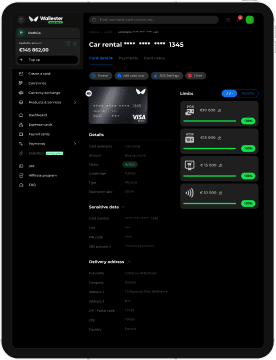
Wallester Business is a card issuing and processing platform built on Visa infrastructure, designed for business clients that need programmatic control over virtual card issuance and spend. The platform supports API-driven card creation, per-card spend limits, merchant category controls, and real-time transaction data: the building blocks of a functional STP workflow.
For accounts payable teams managing supplier payment automation, Wallester provides the card infrastructure layer: virtual cards issued on demand, scoped to specific vendors or spend categories, with transaction data available via API for downstream reconciliation. For procurement and travel finance teams, the same infrastructure supports controlled spend distribution without requiring manual card management.
Teams exploring STP implementation may find it worth reviewing whether Wallester’s issuing and control capabilities match their AP automation architecture, particularly where API integration with existing finance systems is a priority.