
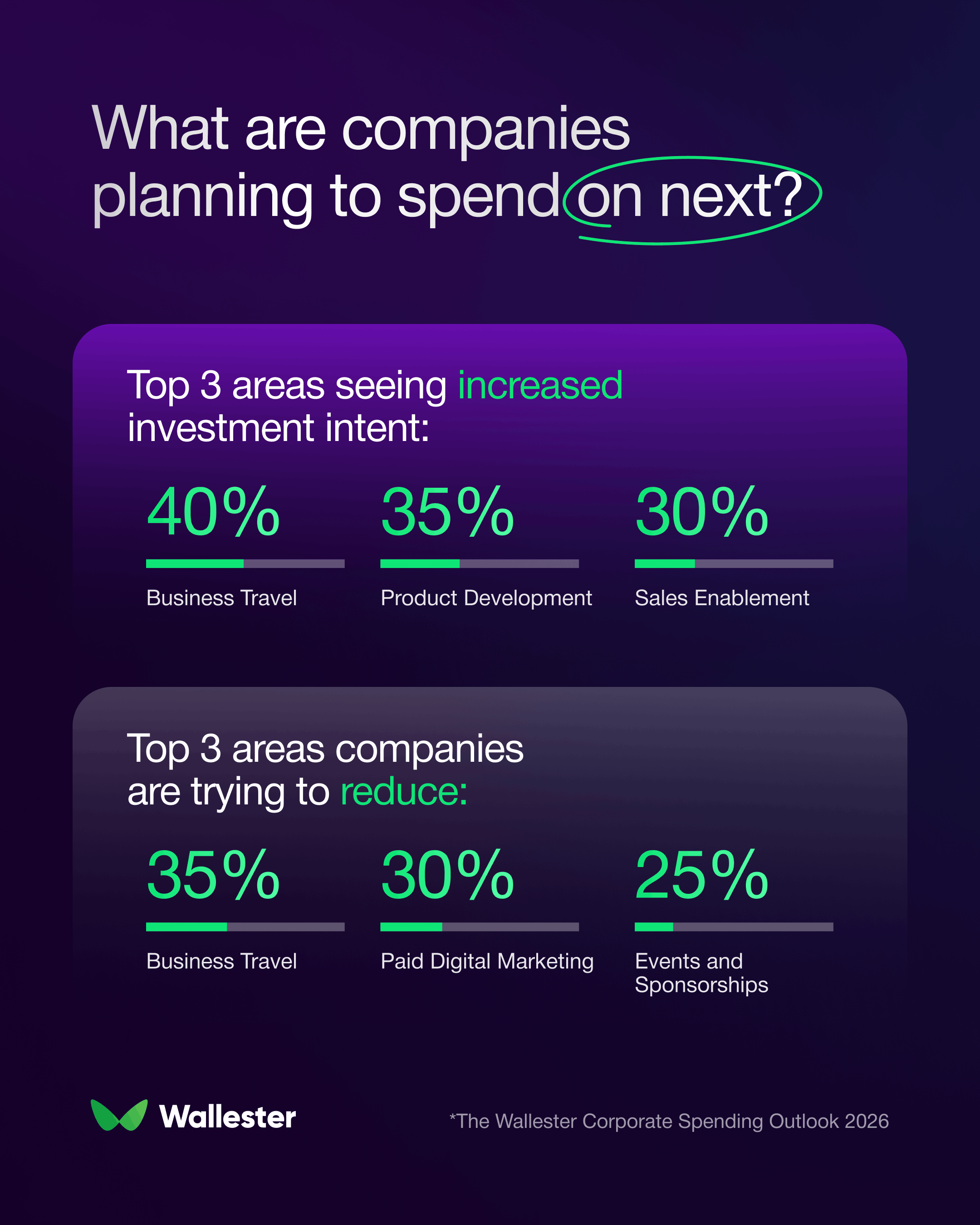
When we asked companies across the EEA and UK what they planned to increase spending on in 2026, what came out on top was business travel. More precisely, forty percent of respondents said they are planning to invest more in it. But then we asked the same companies what they were actively trying to reduce, and business travel came first again. Thirty-five percent put it at number one.
Needless to say, no other category appears at the top of both. It is clear that the market has genuinely split on the same question.
A Market That Has Divided
The data sheds light on two different strategic bets. They are being made simultaneously across the same companies and the same geographies. There are businesses that are leaning into a face-to-face approach, using travel to close deals, enter new markets, and build the kind of relationships that remote communication cannot really replicate. When people meet, sales cycles tend to get shorter and trust compounds. So companies that are in growth mode see travel as a revenue lever rather than a cost to manage.
On the other side, there are companies clearly treating travel as overhead. In environments where profitability has replaced growth as the main objective, travel is being cut with the aim of protecting margins. After years of expanding headcount and burning cash, more than one-third of the market now sees success in different terms. In that context, travel looks like one of the more visible and controllable discretionary lines.
Both positions are rational. The argument for each is strong enough that we’re seeing the market dividing rather than converging around the question of how to approach travel. Typically, most spending categories move one way as conditions change. But travel is truly contested, which means finance teams on both sides of that divide are managing it under pressure.
Also, it is worth noting what else appeared on the reduction list: paid digital marketing at 30% and events and sponsorships at 25%. These are customer-facing and revenue-oriented spend lines. Obviously, companies are making difficult choices about which growth levers to pull and which to pause or cut. The efficiency drive has reached categories that most companies, until recently, would not have touched.
What This Means for Finance Teams
Whether the budget is moving in one direction or the other, travel is one of the hardest spending categories to manage. Often, business trips are booked individually by employees from different teams and markets. Also, receipts tend to arrive late. For finance teams, this means that when enforcing travel policy through a shared spreadsheet or approval flow, they are working after the fact.
For the companies expanding travel budgets, the main issue is visibility. Spend is growing and being distributed across multiple people and platforms, so the margin for untracked or misallocated expenditure grows with it. Knowing what has been committed in real time – and not when someone gets around to filing an expense report – is the difference between a budget that is managed and the budget that is monitored retrospectively.
For the companies cutting travel, the challenge is enforcement. A policy that says spend less does not always translate into spending less in practice. Hard limits at the card level, set before the trip is booked rather than reviewed when the statement arrives, are what make a reduction target into an actual reduction.
In any case, the solution to both problems is the same, and that is control that lives at the card level. Unlike a policy document that someone reads once and forgets, such control is part of the spend management setup itself.
Travel is exactly the kind of spend pattern a card issuing and spend management solution like Wallester Business is built for. Whether it is a growth lever or a line to cut, it is the infrastructure that should make it visible and manageable before the month closes.
Wallester Business puts control at the card level, and it does so immediately. Here is what that looks like in practice – for free and without monthly fees:
- 300 free virtual Visa cards – Assign one to each traveller, market, or team budget. Spending stays visible and attributed from the moment it happens.
- Pre-set spending limits – Encode your travel policy directly into the card. No approval chains, no retrospective reviews.
- Unified real-time dashboard – See every transaction the moment it clears. Not at month-end, not after the receipts come in.
- Tokenised cards for the mobile workforce – Works with Apple Pay, Google Pay, and Garmin Pay. No physical card needed.
- Payroll and team payments – Up to 1,500 transactions in a single click.
- Native integrations – Xero and QuickBooks sync directly, or connect your own tools via REST API.
We surveyed SME founders and finance leaders across Europe, then cross-referenced their answers against 4.6 million real transactions. The full picture is in the Wallester Corporate Spending Outlook 2026.