This practical guide explains how to prepare card records for audit. Readers will learn the core stages of corporate card reconciliation, important audit requirements, and solutions to common reconciliation challenges. Discover how finance teams can organise transaction records before the year-end reconciliation begins.
Businesses now distribute corporate cards widely to speed up employee purchasing, but this expansion increases pressure on finance departments during audit periods. Complete transaction records are non-negotiable for external auditors. Accurate reconciliation and thorough supporting documentation are the only ways to satisfy compliance checks. This article outlines the exact process to ready card data for year-end review.
What is corporate card reconciliation, and why does it matter for audits?
Corporate card reconciliation is the process of matching card transactions against external bank statements and internal purchase receipts.
It builds a clear audit trail by linking every payment to a business expense. This practice confirms that financial records are complete, accurate, and ready for regulatory compliance reviews.
Inspectors verify that expenditures are authentic and correctly categorised. The main objective is to guarantee that company funds align with policy and tax laws. Auditors expect a direct link between every transaction and its receipt. Without proof, businesses face tax adjustments. The Institute of Chartered Accountants in England and Wales (ICAEW) Audit Monitoring Report 2026 highlights that 6% of audited firms require significant improvements in financial reportingdue to poor records during corporate card reconciliation.
Q&A: What are auditors looking for in corporate card records?
Auditors seek solid proof for every transaction. They verify physical or digital receipts to confirm the business purpose of each expense. They also inspect approval records to verify that managers authorised the spending. Finally, they cross-reference transaction evidence with the general ledger to confirm that tax coding, VAT details, and account classifications match established corporate policy compliance guidelines.
Further Reading: The Modern CFO’s Guide to Corporate Card Programme Management
What documents should finance teams collect before year-end reconciliation?
The year-end reconciliation requires gathering card statements, matching purchase receipts, and verifying internal approvals. This process requires compiling all transaction records and evidence. Complete records confirm that every card payment aligns perfectly with the primary general ledger, protecting the company from compliance risks.
Essential records for expense audit preparation
| Document | Purpose |
| Card statements | Transaction verification |
| Receipts | Proof of purchase |
| Approval records | Policy compliance |
| GL reports | Accounting validation |
| Expense reports | Expense review |
| Cardholder records | Responsibility tracking |
High-quality records prevent delays during year-end reconciliation. Under UK tax rules, companies must retain financial documents for six years. Presenting illegible receipts or missing approvals leads to compliance failures. Unsupported transactions represent a major audit risk, as inspectors may classify undocumented spending as taxable employee benefits.
How should finance teams reconcile corporate card transactions?
Applying strict accounting controls is central to corporate card reconciliation. Through systematic transaction matching, finance teams isolate anomalies, check coding accuracy, and prepare balanced reports. This discipline maintains transaction integrity before external examiners review the financial records during a compliance review.
Five steps in a corporate card reconciliation process
- Review transaction data: Cross-reference statements with the general ledger to locate variances.
- Match receipts: Pair every card transaction with its corresponding invoice.
- Validate approvals: Check that every transaction has the required manager sign-off.
- Verify GL coding: Confirm that VAT details and expense categories match the correct codes.
- Resolve exceptions: Flag duplicates, unapproved payments, or missing receipts for investigation.
Consistent transaction reviews keep the ledger updated and make year-end reconciliation straightforward. When handling exceptions, team members must contact cardholders immediately to resolve discrepancies. Strong exception-handling policies protect against unauthorised spending and maintain compliance.
Q&A: How often should card transactions be reconciled?
Finance teams should reconcile card transactions at least monthly to align with the month-end close. For a high-volume corporate card programme, weekly or even daily reviews are far more effective. Regular checks identify missing receipts early, speed up expense reporting, and prevent the accumulation of unallocated expenses.
What issues create problems during expense audit preparation?
Several common issues can disrupt the schedule during expense audit preparation. These problems include missing records, duplicate transactions, and direct policy breaches by staff. If finance teams do not resolve these issues early, the audit trail breaks down, leading to qualified audit opinions.
Common audit findings and corrective actions in expense audit preparation
| Audit issue | Corrective action |
| Missing receipt | Evidence request |
| Duplicate expense | Transaction review |
| Incorrect coding | Reclassification |
| Missing approval | Approval validation |
| Unsupported purchase | Investigation |
| Late submission | Documentation review |
Auditors uncover these issues during year-end reconciliation reviews. When transaction verification reveals incorrect GL coding, teams must perform reclassifications. The Association of Certified Fraud Examiners (ACFE) Occupational Fraud 2026: A Report to the Nations highlights that asset misappropriation schemes represent 90% of occupational fraud cases globally, with uncontrolled corporate card spending representing a notable risk.
Q&A: What should happen when documentation is missing?
If a receipt is missing, the finance team must trigger a formal escalation procedure. The cardholder must provide alternative evidence, such as a bank statement or a written explanation. Senior management must then sign off on the replacement documentation.
Which software features support an audit-ready corporate card programme?
Modern expense management software provides direct reconciliation support to maintain high levels of audit readiness. These systems automate transaction matching and secure receipts instantly at the point of sale. By replacing manual paperwork, digital tools keep the general ledger continuously updated to support corporate card reconciliation.
Features worth prioritising
- Receipt capture: Employees submit photos of invoices instantly through mobile applications.
- Transaction matching: Automatic pairing of card transactions with uploaded receipts.
- Approval workflows: Multi-level digital sign-offs for card expenses.
- Audit logs: Chronological tracking of every transaction edit, approval, and export.
- Accounting integration: Direct feeds that post reconciled items directly to the ERP.
- Card controls: Real-time limits on card spending and vendor types.
- Reporting tools: Automated generation of exception logs and reconciliation summaries.
- Document storage: Safe, cloud-based hosting of all transaction evidence.
These features assist with year-end reconciliation by centralising supporting documentation. Automated receipt capture prevents lost proof of purchase, while digital audit logs provide the history examiners demand. Real-time accounting integration prevents manual transfer errors, making the month-end close fast. This changes corporate card programme management from a reactive task to a controlled, continuous process to complete expense audit preparation.
How can businesses maintain an audit trail throughout the year?
Maintaining an audit trail is the most effective way to guarantee compliance across all financial records. When finance teams record every transaction, approval, and code correction in real time, financial records remain clean. This ongoing discipline makes year-end reconciliation a simple verification step.
Continuous record maintenance prevents chasing receipts in December. Enforcing expense policies provides total transaction traceability for every corporate card programme. In the ACCA Global Economic Conditions Survey Q4 2025, published in early 2026, almost two-thirds of accountants reported rising corporate operating costs. With rising costs, monitoring card payments is important to preserve margins.
How Wallester supports corporate card reconciliation and audit preparation
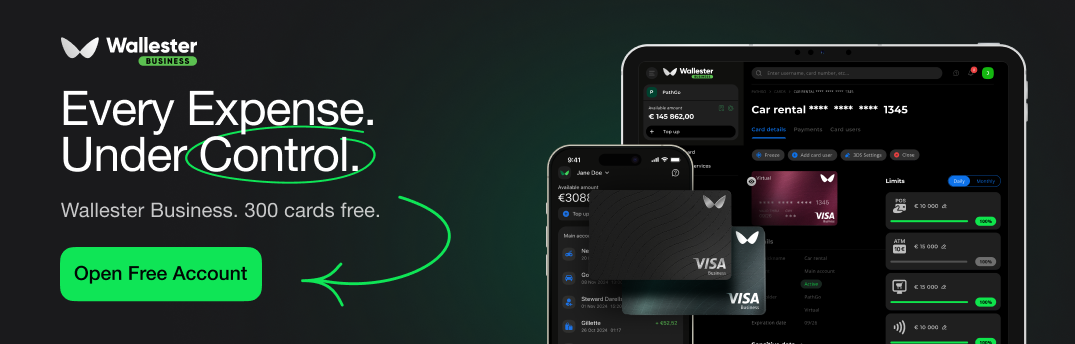
Maintaining an unbroken audit trail is simpler with a modern card system. Wallester Business offers a solution that gives finance teams real-time transaction visibility. Issuing virtual and physical cards lets managers control company expenses at the source.
The system simplifies receipt collection by prompting cardholders to upload proof of purchase after each transaction. Automated approval workflows let managers authorise expenses digitally, while custom rules support accurate expense categorisation. Wallester maintains detailed audit records, delivering the complete documentation auditors require. Additionally, its integration support allows data to flow into existing finance systems, strengthening oversight. Finance managers looking to simplify expense audit preparation can explore how Wallester fits into their current corporate card reconciliation and year-end reconciliation workflows.