This article explains how logistics companies use fleet cards to prevent unauthorised spending, track fuel consumption, and integrate electric-vehicle charging into their daily accounting. We will look at real-world telematics integrations, tax recovery methods, and step-by-step software rules to block driver fraud.
Managing commercial vehicles is becoming more challenging amid volatile diesel prices and the push toward electric trucks. Old company credit cards expose transport firms to driver fraud and slow down the accounting team. Finance managers want to block out-of-policy purchases before the bank clears them. Legacy payment methods fail here as they cannot read odometer data or match a transaction to a GPS location. Upgrading to a modern platform gives transport directors control over every penny spent on the road.
Key takeaways:
- Fraud prevention: Modern fleet card management systems use GPS telematics to verify that the commercial vehicle is physically sitting at the fuel pump before the bank approves the payment.
- Dynamic spend controls: Logistics administrators can restrict card usage to specific Merchant Category Codes. This stops drivers from buying food, alcohol, or personal services.
- Automated bookkeeping: API-driven fuel card programs automatically match fuel receipts to specific drivers and specific vehicles in the corporate accounting software.
- Electric vehicle integration: The latest cards offer unified billing. They cover both traditional diesel refuelling and commercial electric vehicle charging on a single corporate invoice.
Further Reading: Industry-Specific Embedded Finance: Tailoring Payment Solutions to Your Market
What exactly is a fuel card program?
A fuel card program is a specialised payment network built exclusively for buying vehicle fuel, electric charging, and approved maintenance services. These payment setups give fleet administrators real-time control over exact driver spending limits while automatically collecting deep transaction data for the local tax authority.
The commercial logistics sector relies heavily on these payment networks to maintain positive cash flow. General corporate credit cards only provide basic banking data, showing the merchant name and the total amount spent. If a driver spends £100 at a roadside garage, a standard bank card will not tell the finance manager if that £100 went towards diesel or a personal grocery shop. Dedicated fuel card programs solve this lack of visibility by capturing specific telemetry regarding the purchase. When a logistics company issues these cards to delivery drivers, the transport director gains absolute financial oversight over every mile travelled.
To understand how these setups stop expense fraud, transport managers need to look at the core components of modern fleet card management:
- Level-3 data capture: The payment terminal at the petrol station captures specific line-item details. This includes the exact type of fuel pumped, the unit price per litre, and the total volume of fuel taken.
- Telematics integration: The card software communicates via an API with the GPS tracker installed inside the delivery van to verify location matching.
- Driver identification prompts: Drivers must enter a unique PIN or a specific driver identification code at the fuel pump terminal before the system turns the physical fuel dispenser on.
- Dynamic restriction engine: The payment platform instantly checks the driver’s pre-set spending rules before approving the bank transaction.
- Consolidated tax invoicing: The card issuer groups all monthly fleet transactions into a single compliant invoice, allowing the finance department to reclaim Value Added Tax effortlessly without hunting for paper receipts.
How do fleet card management systems actually work?
These systems route every driver transaction through a central software engine that checks custom company spending rules before releasing money to the merchant. This cloud-based management software blocks out-of-policy purchases at the exact point of sale, rather than relying on finance teams to catch the bad spending weeks later during a manual audit.
The most critical upgrade for commercial logistics right now is the move to predictive spending controls. Traditional expense management is highly reactive. The driver spends the money, brings back a paper receipt, and the company audits that receipt later. Modern fleet card management is completely proactive. If a driver attempts to buy premium unleaded fuel for a vehicle that the fleet database registers as a standard diesel truck, the management system declines the transaction instantly at the pump.
The step-by-step sequence for a modern fleet card transaction happens in seconds:
- Purchase initiation: The delivery driver inserts the corporate fuel card into the payment terminal at the commercial filling station.
- Data prompt: The payment terminal asks the driver to type in their unique driver code and the vehicle’s current dashboard odometer reading.
- Rule verification: The fleet card management platform analyses the requested transaction against the company’s approved merchant codes and daily spending limits.
- Telematics match: The payment system pings the vehicle’s onboard GPS tracker to check if the physical truck is sitting at the same geographic coordinates as the fuel station.
- Approval and settlement: If all parameters match the corporate policy, the system authorises the fuel pump to dispense fuel. The transaction then syncs straight into the company’s accounting software.
By using this strict sequence, transport companies lock in their corporate funds. The driver never touches personal cash, and the finance team never processes a physical paper receipt.
Further Reading: Top 10 Embedded Finance Platforms in 2026
Why are fuel cards better than normal corporate credit cards?
Normal credit cards allow employees to buy goods anywhere, whereas fuel cards strictly limit purchasing power to vehicle-related terminals. Fuel card programs provide logistics companies with Level-3 data capture for tax compliance, a feature that standard corporate credit cards do not offer.
When a transport company hands out standard Visa or Mastercard corporate cards to fifty different drivers, the finance team takes on a massive fraud risk. Drivers can easily use general corporate cards to buy personal groceries, pay for unauthorised hotel stays, or buy electronics. The finance manager will only spot these purchases at the end of the month when the bank statement arrives. By that time, the money is already gone. Fuel card programs wipe out this risk completely by hard-coding restrictions straight into the physical payment card.
Standard bank cards also fail the tax test. To reclaim VAT on fuel, tax authorities require specific line items showing the volume of fuel and the unit price. A standard bank card statement just shows the total financial value. The finance team then has to chase the driver for the physical receipt to prove what was bought.
Corporate credit cards vs. fuel card programs
| Feature | Standard corporate credit cards | Specialised fuel card programs |
| Merchant limits | Open network; accepted at millions of global retail shops. | Closed network; accepted only at registered fuel and maintenance sites. |
| Data quality | Level-1 Data (Merchant name, date, total amount). | Level-3 Data (Fuel grade, litres pumped, unit price, odometer). |
| Fraud stopping | Reactive (Finance finds bad spending during month-end audits). | Proactive (System declines bad spending at the physical terminal). |
| Tax reclamation | Requires manual matching of paper receipts to bank statements. | Automated consolidated tax invoices provided by the card issuer. |
| Vehicle assignment | Cards are strictly tied to an individual human employee. | Cards can be tied to a specific vehicle regardless of the driver. |
What is the difference between legacy fuel cards and modern API-driven cards?
Legacy cards lock a transport company to a single brand of petrol station, while modern API-driven cards use open networks but apply strict software limits to control the spending. Modern API-driven cards also allow fleet managers to adjust spending limits in real-time via a mobile application, whereas legacy cards require managers to phone a customer service desk to make account changes.
Route efficiency suffers badly under legacy systems. If a logistics company uses a proprietary single-brand fuel card, drivers often waste valuable driving hours detouring off their planned route simply to find an approved petrol station. An extra ten miles of driving just to find the right fuel brand costs the company money in wasted diesel and lost delivery time. Modern API-driven fleet card management solves this geographic problem. These modern cards run on universal Visa or Mastercard networks, so they work at almost any station, but the software layer sitting on top of the card forces the transaction to follow the company rules.
Further Reading: Optimising E-commerce Growth Through Embedded Wallets and Automated Payouts
Legacy fuel cards vs. API-driven fleet cards
| Feature | Legacy single-brand fuel cards | Modern API-driven fleet cards |
| Network acceptance | Limited strictly to one specific brand. | Universal acceptance anywhere Visa/Mastercard is accepted. |
| Control adjustments | Slow; requires phoning the issuer’s support desk to change limits. | Instantly; fleet managers change limits via a cloud dashboard. |
| Software connections | Operates as a standalone system disconnected from internal tools. | API connects directly to ERP systems and route planning software. |
| Electric vehicle support | Usually restricted to fossil fuels only. | Unified billing supporting both diesel pumps and EV charging networks. |
What are the best rules to set for driver expense control?
The best rules involve blocking non-fuel merchant category codes, matching GPS locations to the payment terminal, and limiting purchases to working hours. Executing these exact software strategies cuts commercial fuel theft aggressively and drops administrative reconciliation time by more than half.
Fleet operators must stop trusting drivers with open-ended payment tools. Building a modern expense architecture requires proactive software parameters that govern driver spending automatically. A common issue is side-fuelling. This happens when a driver fills the company van with diesel, then fills a few jerry cans for their personal car on the same transaction. Setting strict tank capacity limits stops this. If the company van only holds 70 litres, the software declines the transaction the second the pump hits 71 litres.
Here are six highly specific rules transport managers should implement today:
- Implement strict merchant code blocking: Fleet administrators must configure the payment gateway to decline any transaction occurring outside approved merchant category codes. Administrators should explicitly block codes associated with restaurants, liquor shops, and electronics retailers to stop personal employee purchases dead in their tracks.
- Require mandatory odometer prompts: Configure the fuel card programs to demand an odometer entry at the payment terminal. This specific data point allows the fleet management software to automatically calculate accurate miles per gallon metrics. This helps logistics managers instantly spot vehicles suffering from engine inefficiency or drivers who are driving aggressively and wasting fuel.
- Turn on GPS telematics matching: Connect the physical truck’s GPS tracking system with the payment authorisation API. If a driver attempts to buy fuel in Berlin, but the telematics system registers the truck’s location as Munich, the payment gateway will automatically decline the fraudulent transaction. This stops drivers from lending their company card to friends or family members.
- Tie payment cards to vehicles: Instead of issuing a payment card named after a person, issue cards tied to the vehicle registration number. This strategy guarantees that when shift drivers swap commercial vehicles, the expense data remains perfectly attributed to the correct physical asset. This keeps the depreciation modelling highly accurate for the finance department.
- Consolidate EV and diesel expenses: As commercial fleets bring in mixed energy models, administrators must select fuel card programs that support both internal combustion engine refuelling and electric vehicle charging. A driver currently needs multiple different mobile applications just to use public electric chargers. A modern fleet card acts as a single payment method for all major charging networks, stopping the finance team from managing multiple separate accounting workflows.
- Set strict time and day restrictions: Logistics managers should restrict fuel card usage to approved working hours only. If a company runs a standard Monday to Friday schedule, the fleet management software must automatically decline any transaction attempted on a Sunday evening. This single rule wipes out weekend fuel theft entirely.
Further Reading: Embedded Finance for Property Management and PropTech Platforms
How do you handle tax recovery with fleet cards?
Fleet card providers group all monthly transactions into a single compliant invoice, letting the finance team reclaim VAT without checking individual paper receipts. This automated reporting saves finance departments days of administrative sorting every single month.
In the traditional setup, a driver buys fuel and drops the paper receipt in the footwell of the truck. Over the next few weeks, the sun fades the thermal paper. When the driver finally hands a pile of crumpled receipts to the accountant at the end of the month, the accountant cannot read the VAT registration number printed on the paper. Without that specific piece of data, the company cannot legally reclaim the tax. The company loses 20% of the transaction value simply because of bad paperwork.
Modern fleet cards bypass the paper receipt entirely. Because the card network captures the exact volume of fuel and the unit price directly from the petrol station’s computer system, the card provider can generate a perfect, digital, tax-compliant invoice. The finance manager just downloads this single document and sends it directly to the local tax authority.
Improve driver expense control with Wallester
If your transport company wants to stop driver overspending, Wallester provides a dedicated card issuing platform built precisely for fleet management. Transport directors can instantly issue physical or virtual Visa business cards to every driver on the payroll.
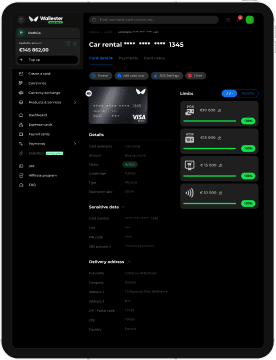
The Wallester dashboard gives you absolute financial control, allowing you to set strict daily spending limits and block non-fuel merchant codes instantly. When a driver pays at the petrol pump, the system automatically pushes the exact transaction details straight into your accounting software, fully supporting Xero, QuickBooks, and Sage. Your finance team never has to chase paper receipts again, and the software blocks unauthorised purchases before the bank clears the transaction. You get total financial control over every single road trip.