


When generative AI first landed on agency corporate cards, it was almost exclusively a copywriter’s tool: a single chat window for brainstorming headlines, refining strategy, or drafting social copy. Transaction data from the first half of 2026 suggests that era is over. In short, AI has grown from a text box into a multi-format production stack.
In our previous analysis of agency creative-technology spend, we found that generative AI captured 94.2% of creative-tech budgets, leaving just 5.8% for traditional design software. By creative-tech spend, we mean everything an agency pays for to make the work itself. The next question is where all that AI money is really going.
While most people outside the industry may still picture a chat window and a writer when they think of AI, recent expenditure data shows the money moving elsewhere: into images, code, video, and voice.
Across Wallester Business advertising and marketing accounts, LLMs like ChatGPT and Claude still account for most AI spend, at 62.2% combined. But 37.8% now goes to video, voice, coding, and other specialised tools. What began as a handful of mostly text subscriptions is becoming a broader production stack and its fastest-growing part is visual.
More Than a Fifth of AI Spend Now Goes to Video
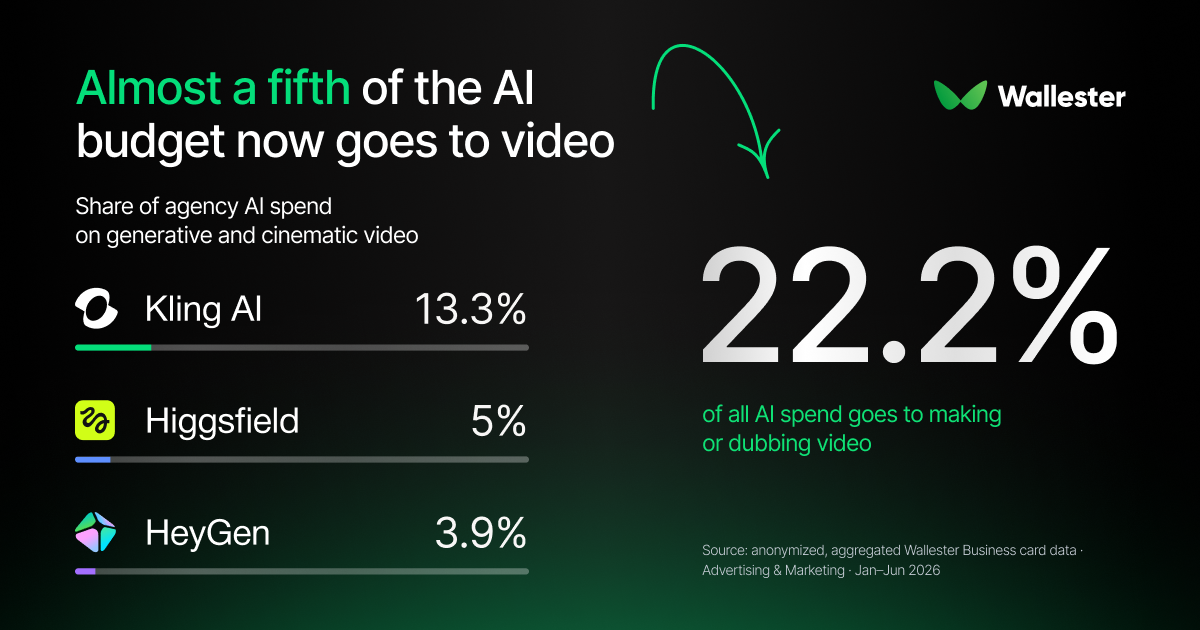
The clearest shift is toward generative video. Three tools tell the story: Kling at 13.3% of AI spend, Higgsfield at 5.0%, and HeyGen at 3.9%. Together, they take 22.2% of the AI budget. In other words, more than a fifth of AI spend now goes to generating or adapting video rather than writing text.
That tracks what clients are asking for. Short video is the format that fills social feeds, and agencies are paying for tools that produce it quickly. Voice is following the same path. ElevenLabs, which turns text into spoken audio, sits at 2.0% and is growing, often used to add voiceover to that same video.
LLMs Still Anchor the Budget
Behind the video story, two providers still anchor the spending. OpenAI holds 33.4% of AI spend and gets charged more often than any other tool, 42.7% of all AI card charges. It’s the one people open throughout the day. Claude follows close behind at 28.8% of spend. It grew quickly over the first six months of 2026, and while that growth comes off a smaller starting point, the result is what counts: on spend, the two are now almost level.
How the Money Is Charged: Individual Seats vs. Central Infrastructure
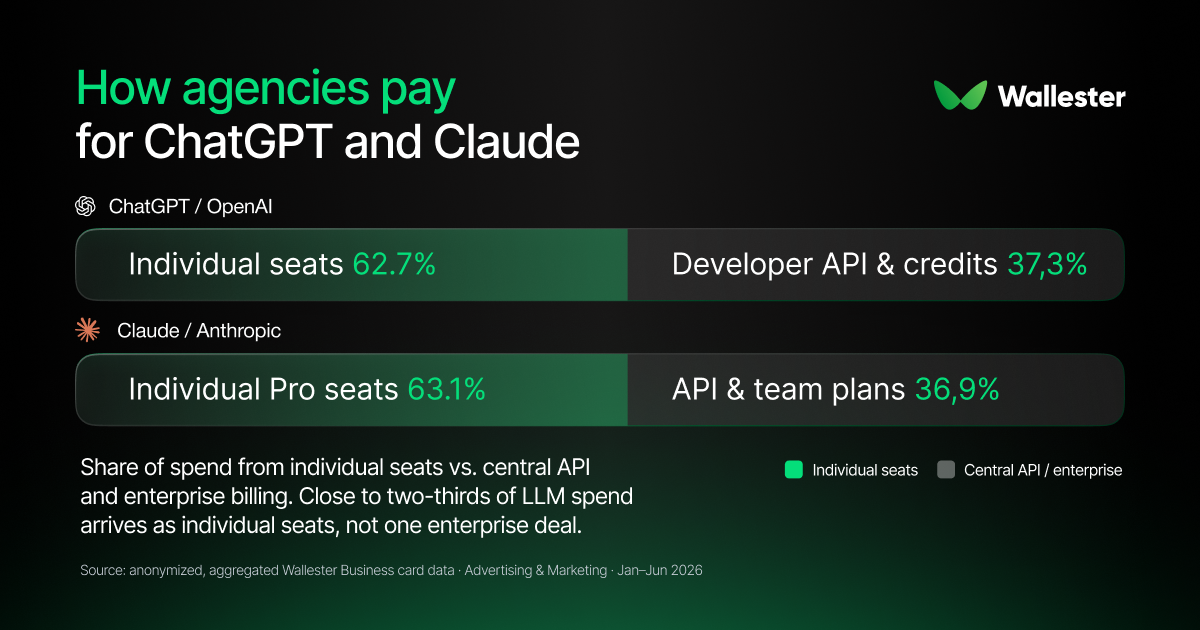
Examining payment descriptors reveals how agencies pay for these two LLM leaders. The spend splits almost identically between bottom-up seat purchases and top-down infrastructure:
- ChatGPT / OpenAI: 62.7% of spend goes to individual end-user seat subscriptions charged on team cards, while 37.3% flows into central corporate developer API usage and top-up credits.
- Claude / Anthropic: 63.1% of spend goes to individual Pro subscriptions, while 36.9% goes toward central Anthropic API billing and corporate team plans.
This indicates that nearly two-thirds of LLM spend isn’t approved as a single enterprise deal. Instead, it enters the business as dozens of individual seat subscriptions expensed across various virtual cards.
There’s one more clue in the data. Cursor, a coding tool, holds 10.1% of AI spend and grew fast. An agency paying that much for a coding tool is clearly building its own automations rather than buying everything ready-made.
Put it together and the AI budget has split apart. It used to be a single recognisable subscription. It’s now a dozen tools across text, video, voice, and code, most billed monthly in dollars, many added by whoever needed them that week. That is hard to keep track of without a system made for it.
How Wallester Business Helps You Manage an AI Budget That Keeps Splitting
An AI stack spread across a dozen providers is the kind of spend that slips out of view. Each tool is a small monthly charge. Together they add up to a real cost that nobody fully owns. Wallester Business gives that spend a shape.
With Wallester Business, an agency can:
- Open a business account with its own IBAN, no subscription required to get started
- Give each AI tool its own virtual card, so ChatGPT, Claude, a video tool, and a coding tool each show up as their own line
- Set a limit on each card, so usage-based charges can’t run past a ceiling you’ve set
- Hold and pay in 10 currencies, so dollar-billed AI subscriptions don’t add conversion fees
- Assign roles so the right people can add or approve a new tool, with the spend still visible to finance
- Track every AI charge live from one dashboard, on web or mobile
The account and cards are free to open, with premium plans for businesses that need more. The AI budget will keep breaking into smaller, more specialised pieces. The businesses that stay on top of it are the ones that give each piece its own card and its own limit before the charges start.
Methodology & Data Disclaimer:
This report is based on anonymised, aggregated card transaction data processed across active Wallester Business corporate accounts within the Advertising & Marketing industry between January 1, 2026, and June 30, 2026. All figures, growth metrics, and market shares are presented in relative percentages and indexed values to protect proprietary client financial data. Spendcategorisationsreflect verified merchant descriptors and standard Visa Merchant Category Codes (MCC) across active business accounts.

