In enterprise finance, the physical act of making a payment is now instantaneous. Capital moves across digital rails in milliseconds. However, for the majority of finance departments, the administrative process that follows remains a manual, multi-day ordeal. This gap between the moment a transaction occurs and the moment it becomes visible to the finance team is known as data lag.
For a company focused on scaling, data lag is a significant operational barrier. It creates a period where the organisation is effectively operating in a blind spot, unable to verify liquidity, enforce budgetary discipline, or make informed decisions based on current reality.
The Mechanics of Operational Latency
Data lag is rarely a single catastrophic event; rather, it is the accumulation of small delays that erode financial velocity. It exists in the “visibility gap”, meaning the time elapsed between an authorised spend and the finance lead receiving a verified, categorised record of that expenditure.
When a transaction occurs outside a unified payment infrastructure, it triggers a chain of reactive, manual tasks that consume high-value human capital:
- Receipt Retrieval: Finance teams spend hours chasing digital or physical receipts from employees across multiple departments.
- Manual Categorisation: Expenses are often categorised weeks after the fact, leading to inaccuracies in cost-centre reporting.
- Delayed Reconciliation: Matching bank statements to internal ledgers days or even weeks after a period closes ensures that the data is obsolete before it is even reviewed.
This process is inherently retrospective. If a finance leader cannot provide an accurate liquidity profile upon request because they are waiting on the “month-end close,” the business is operating on an information deficit. In high-growth environments, relying on yesterday’s data to solve today’s problems is a strategic liability.
The Scalability Breakpoint: Why Manual Tracking Fails
In a small team, data lag is often dismissed as a minor administrative chore. A founder can manually track a few dozen transactions in a spreadsheet without losing total control. However, as an organisation moves toward mid-market maturity, this manual model hits a structural breakpoint.
As you multiply departments, increase supplier complexity, and expand cross-border subscriptions, the administrative friction compounds. Internal data shows that finance teams in mid-sized companies can lose two to three full working days per month to manual reconciliation alone.
This represents a critical misallocation of resources. Those hours are spent reconstructing past events rather than analysing the future. When a finance team is buried in the “aftermath” of payments, they cannot effectively analyse spending trends, optimise capital allocation, or build the high-fidelity forecasts required for the next phase of expansion. The system fails to scale because the underlying infrastructure was designed for a company operating at half the speed.
The Deficit of Legacy Banking Tools
Traditional corporate banking tools often exacerbate the problem of data lag. Shared physical cards and delayed bank statements are artefacts of an era where real-time visibility was not a technical possibility. Today, they create specific risks:
- Accountability Gaps: Shared cards make it difficult to assign responsibility for specific transactions, leading to internal friction and audit complexities.
- Information Latency: Bank statements that arrive after a period closes guarantee that financial oversight is always a post-mortem exercise.
- Integrity Risks: Manual data entry into spreadsheets remains a leading cause of fiscal inaccuracy, which can lead to compliance issues during audits.
To solve these issues, businesses must transition to a proactive governance framework where the data is captured at the moment of the transaction.
Building a Real-Time Finance Function
Eliminating data lag requires a shift in infrastructure. When you integrate card issuance directly into your accounting workflow, you fundamentally change how the finance department operates.
By utilising an infrastructure where every transaction generates high-fidelity, categorised data at the point of purchase, the “month-end close” is reduced from a major project to a simple verification. This transformation allows the finance function to become a strategic asset. Budgetary oversight becomes proactive; governance is enforced at the point of sale via dynamic spending limits and 3D Secure (3DS) configurations, ensuring that spending stays within policy before the money ever leaves the account.
Wallester Business: Eliminating the Reconciliation Gap
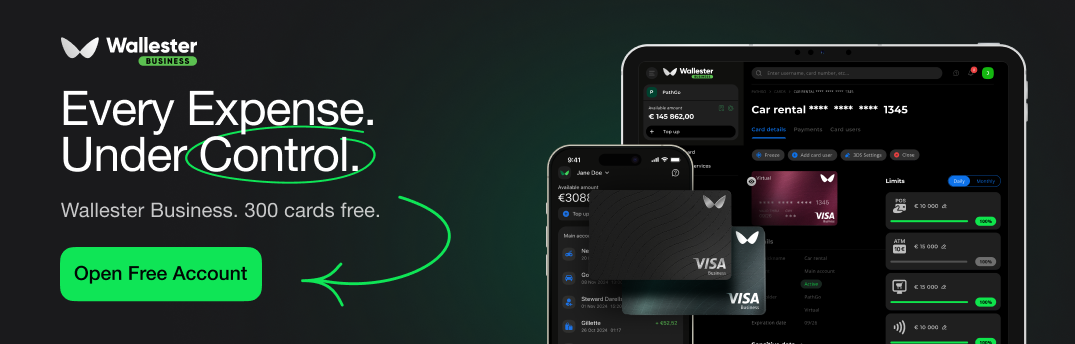
Wallester Business provides the unified platform required to merge Visa-grade card issuance with real-time expense management. We focus on removing the administrative drag so your team can focus on growth.
Our Strategic Infrastructure Includes:
- High-Velocity Issuance: Deploy up to 300 free virtual Visa cards instantly. This allows every project, department, or recurring subscription to have a dedicated “spend rail,” ensuring total clarity from the start.
- Instant Governance: Monitor every transaction as it happens via our platform or mobile app. You can set granular limits, merchant restrictions, and daily caps per user.
- Automated Source Capture: Our mobile app enables employees to digitise receipts at the point of purchase. The system automatically matches the image to the transaction, removing the need for retroactive “receipt chasing.”
- Native Accounting Integration: We offer native, real-time sync with Xero and QuickBooks, as well as a robust REST API for custom ERP environments. Your ledger becomes a live reflection of your capital.
- Optimised Security: Utilise disposable cards for one-off vendor payments to mitigate the risk of fraud, while maintaining a fully transparent, digital audit trail.
Moving Beyond Record-Keeping
The payment is simply the final step of a business decision. The data that follows should be an automatic extension of that decision. By eliminating data lag, you empower your finance team to stop acting as forensic investigators and start acting as strategic partners.
Wallester Business provides the framework for this change. It is time to stop managing the past and start focusing on the next phase of your company’s expansion.