


This guide covers how corporate cards support accounts payable automation. Readers will learn how these cards fit into accounts payable processes, comparing card programmes to traditional methods, evaluating software features, managing reconciliation, and establishing strong financial oversight.
Modern finance teams face rising pressure to execute business payments with speed and accuracy. Manual invoice processing and slow approval loops lead to disputes and high transaction costs. To address this, digitalising corporate finance prompts organisations to adopt corporate card programmes. These networks provide a modern alternative to traditional payment methods.
What is accounts payable automation and how do corporate cards fit into the process?
Accounts payable automation uses software to digitise and accelerate the accounts payable process. When businesses integrate corporate cards into this workflow, they convert manual payments into automatic card transactions, which improves spend control, speeds up settlement times, and gathers richer data.
Traditional AP workflows rely on manual entry, paper invoices, and slow approvals. Card-based payment models connect networks directly to approval systems, and automatically complete transactions using corporate cards. This setup yields instant payment execution and updates accounting ledgers immediately.
Q&A: Are corporate cards suitable for every supplier payment?
Corporate cards suit routine business transactions, but supplier acceptance and internal payment policies dictate where they work best. High-value acquisitions often require traditional bank transfers due to strict transaction limits. Finance teams must check supplier acceptance and transaction caps before setting up card-based rules across their supplier database.
Further Reading: Spend Limits and Controls: How Businesses Set Smarter Rules for Corporate Spending
What benefits and challenges come with corporate card-based AP automation?
Implementing card-based AP automation improves payment visibility and finance efficiency. It gives controllers strong payment controls through preset spend limits. However, organisations must manage supplier adoption challenges, establish governance, and address potential transaction fees during card programme rollout.
| Area | Traditional AP process | Corporate card programme |
| Payment | Bank transfer | Card payment |
| Approval | Manual loops | Automated rules |
| Visibility | Delayed | Real-time |
| Speed | Slow | Immediate |
| Reconciliation | Manual | Automated |
| Reporting | Monthly | Live |
The advantages of card-based payment automation include faster processing. In the UK, payment delays threaten business health. An ACCA report indicates 35.6% of UK SMEsstruggle with securing prompt payments. While card programmes speed up payments, organisations must define payment controls to prevent unauthorised spend.
Q&A: Can corporate cards improve working capital management?
Corporate cards offer a valuable interest-free period between the purchase date and the card statement payment deadline. This window allows businesses to hold onto cash longer, which improves short-term liquidity. Finance teams can plan cash outlays with greater accuracy, preserving capital for other operational needs while verifying that supplier payments still occur on time.
Which software features matter most for AP automation?
Successful AP automation depends on finding accounts payable software with deep accounting integration. Choosing a platform that offers virtual cards, spend controls, and ERP connectivity lets companies manage transactions smoothly and maintains financial data accuracy.
- Virtual cards: Secure single-use credentials.
- Approval workflows: Automated digital routes.
- Accounting integration: Direct ledger syncing.
- ERP connectivity: Unified system records.
- Reconciliation tools: Automatic matching software.
- Audit logs: Records of payment approvals.
- Spend controls: Strict custom limits.
- Transaction reporting: Real-time data dashboards.
These features upgrade operations. Virtual cards provide secure ways to settle invoices, which prevents details theft. Automated approval workflows route invoices without manual intervention, and direct ERP connectivity keeps ledger integration accurate.
| Feature | Business value |
| Virtual cards | Prevents card fraud |
| Approval workflows | Cuts processing delays |
| Accounting integration | Eliminates manual entries |
| ERP connectivity | Syncs spend data |
| Audit logs | Permanent approval records |
| Reconciliation tools | Automatic statement matching |
Further Reading: Using Virtual Cards to Track and Control SaaS Spend
How do corporate cards affect reconciliation, audit readiness, and working capital?
A card-based accounts payable process provides clean transaction data that speeds up reconciliation. Digital card systems create a permanent audit trail and let finance managers manage working capital, supporting cash flow forecasting and simplified compliance audits.
Payment timelines are a major focus for UK business groups. The UK Small Business Protections Bill introduces a 60-day payment cap for large firms paying smaller suppliers, alongside mandatory late-payment interest of 8% above the Bank of England base rate. Automated card payments help businesses meet these strict compliance standards to prevent late-payment penalties and maintain clean records.
Five practices for successful AP automation
- Define supplier payment rules.Set explicit guidelines for card purchases to prevent fee disputes and confirm supplier alignment.
- Establish approval thresholds.Set clear limits for management authorisation to keep high-value transactions under close review.
- Maintain accurate transaction records.Upload invoice receipts immediately to prevent missing documentation during audits.
- Review reconciliation reports regularly.Inspect transaction match logs weekly to locate and correct ledger discrepancies early.
- Align card controls with company policy.Link card spending caps directly to active budgets to block unauthorised department overruns.
Q&A: What creates reconciliation issues in corporate card programmes?
Reconciliation issues usually stem from missing invoice documentation and late transaction approvals. When staff members delay uploading payment receipts, the finance department cannot match card transactions to accounting entries. In addition, incorrect general ledger coding by cardholders creates data discrepancies, which forces AP teams to spend extra hours performing manual corrections during the monthly close.
How Wallester supports accounts payable automation
To improve an accounts payable process, companies require a payment infrastructure that connects directly with established ledger systems. The Wallester Business platform offers a dedicated corporate spend management solution that consolidates card issuance, expense monitoring, and transaction governance into a single dashboard. This system issues both physical and virtual corporate cards to help finance departments replace slow invoice workflows with automated, card-led settlements.
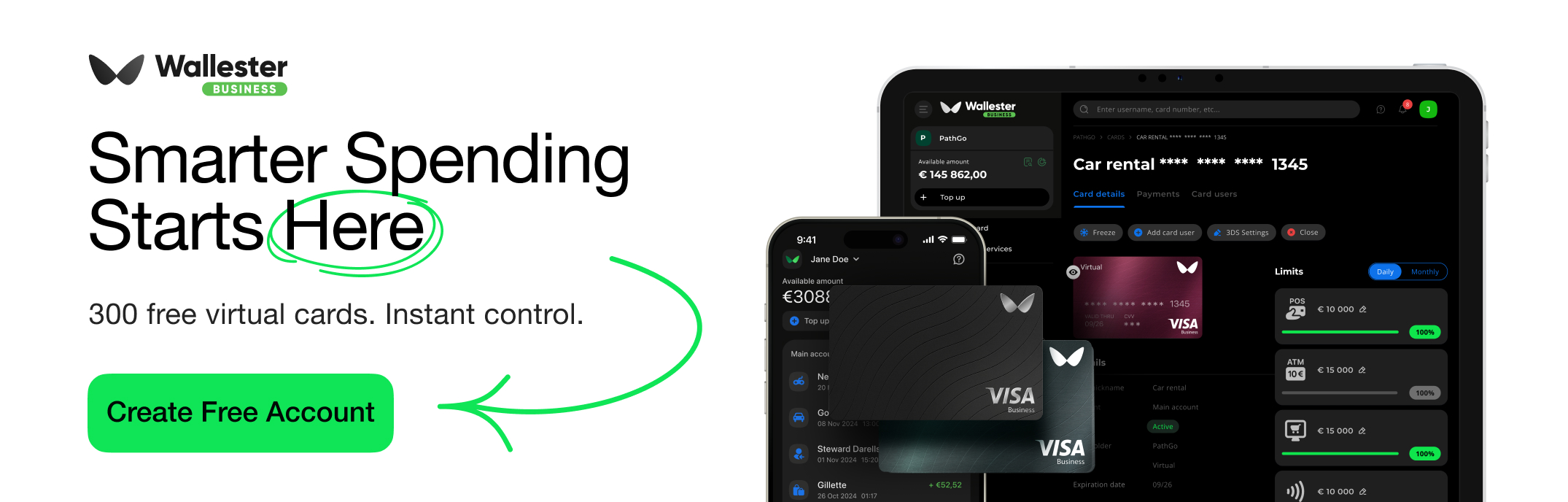
Through the platform, finance managers set precise spend controls and pre-approved limits for every physical or virtual card. When employees or procurement teams make supplier payments, the platform logs transaction data in real time and provides controllers with immediate payment visibility. The system routes every purchase through digital approval workflows to verify compliance with internal budgets before the transaction completes.
For reconciliation readiness, Wallester Business automates data transfers through direct accounting integration with major ERP platforms. When cardholders upload invoice receipts via the mobile application, the system matches the image data with the corresponding card transaction. This instant verification updates general ledgers directly, speeds up the month-end close, and maintains an unalterable audit trail. This end-to-end oversight gives group controllers total control over cash flows without tedious manual balance entries. Discover how the Wallester Business platform can fit into your accounts payable process and modernise your payment workflows today.

